City Guide
Wiesbaden
Allemagne · Best time to visit: Apr-Oct.
Day-by-day plan
Choose your pace
Durée du voyage
09:00
Landmark
From Wiesbaden Hbf, take bus 1 to Nerotal (12 minutes) and ride the 1888 Nerobergbahn — a water-ballast funicular that climbs without a motor, counterbalancing itself by filling the upper car with spring water before each descent. At the top stands the golden-domed Russian Orthodox Church of St. Elizabeth, built in 1855 by Duke Adolf of Nassau as a mausoleum for his nineteen-year-old wife who died in childbirth. From the lookout beside the church the Rhine plain rolls south toward Mainz, and the morning light hits the gold cupolas before any tour bus arrives.
Tip: Buy a return ticket at the lower station before queues form — it is cheaper than two singles, and the funicular only runs Apr-Oct (closed in winter). Skip the snack kiosk at the top; coffees are €5 with a captive-audience view, and you have a real lunch coming.
Open in Google Maps →11:15
Landmark
Take the funicular back down and walk south on Taunusstraße for fifteen minutes through quiet streets of 19th-century spa villas — the descent is part of the experience, you are walking through what Bismarck called 'the Nice of the North.' At Kranzplatz, the Kochbrunnen fountain still pumps salt-rich water at 66°C straight from the earth, and locals fill plastic bottles to drink it. A block south, the Kaiser-Friedrich-Therme (1913) shows its ochre Art Nouveau façade and curving entrance arches — the exterior alone tells you what Wiesbaden was at its turn-of-the-century peak.
Tip: Cup your hands at the Kochbrunnen and taste — it is free, mineral-heavy, faintly metallic and surprisingly salty (Germans once prescribed glasses of it for digestion). Bring an empty bottle if you want to take some with you; the hot water keeps for hours.
Open in Google Maps →12:30
Food
Walk south on Langgasse for seven minutes — the red brick spires of the Marktkirche rise in the gap at the end of the street. Lumen sits directly on Marktplatz in the church's shadow, with terrace tables and a local crowd at midday. The Flammkuchen (Alsatian thin tart with crème fraîche and bacon, €11) and the Hessischer Handkäs mit Musik (regional sour-milk cheese marinated in onion and vinegar, €8) are both proper Hessen plates; budget €15-20.
Tip: Take a terrace seat facing the church — at 12:30 the sun lights the Marktkirche's brickwork like fire and the photo is unmissable. The Handkäs comes with dark rye and is meant to be eaten slowly; it is an acquired taste and a flavor most travelers never try.
Open in Google Maps →13:45
Religious
Cross Marktplatz — the church is thirty seconds from your lunch table. The Marktkirche (1862) is Germany's tallest brick church and the symbol of Wiesbaden, its five spires visible from every old-town corner; the cool nave is free to enter. Next door, circle the Stadtschloss — the former ducal palace, now the seat of Hesse's state parliament — and the Neues Rathaus, both ringing the square in restrained late-classical stone.
Tip: Stand on the southwest corner of Schlossplatz facing the Marktkirche to fit all five spires into one frame — there is no cleaner angle in the city. If your day matches the Tuesday or Friday open-air market on this square, grab a Brezel from the bread stall (€1.50) and eat it walking; it is the most Hessen souvenir you can pocket.
Open in Google Maps →15:30
Landmark
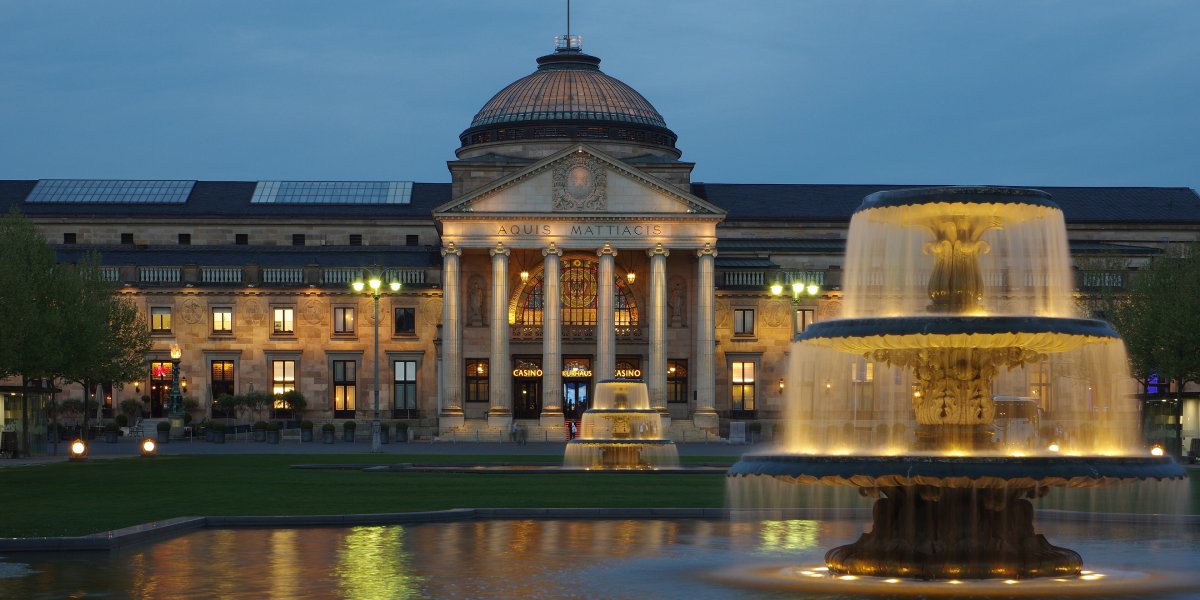
Leave Schlossplatz east on Friedrichstraße, then turn right onto Wilhelmstraße — Wiesbaden's grand boulevard, lined with chestnut trees, Belle Époque facades and the city's most exclusive shops — and walk eight minutes until the Corinthian columns of the Kurhaus rise ahead. The Kurhaus (1907) is one of Europe's most opulent spa palaces, and inside the Spielbank casino has been running since 1771 — Dostoevsky lost his shirt at these very tables in 1865 and wrote The Gambler in a frenzy of debt to pay it off. Behind the building, the Bowling Green — a perfect lawn flanked by twin colonnades, with the Hessisches Staatstheater (1894) just to the north — is the city's quiet stage for late-afternoon light.
Tip: Walk to the far end of the Bowling Green and turn back to face the Kurhaus around 17:30 in summer (16:30 in spring/autumn) — the western sun lights the entire colonnade in gold and this single frame is the photo of the day. You can step into the casino lobby for free without ID; the gaming rooms need a passport and smart-casual dress, but the exterior is the real icon. Avoid the seasonal pop-up cafés along the Bowling Green colonnades — they charge €8 for a coffee and €15 for a small beer; the temple-front backdrop costs the same to look at from anywhere on the lawn, and Wiesbaden's classic tourist trap is paying inflated prices for ordinary drinks because the view is included.
Open in Google Maps →19:00
Food
Käfer's is inside the Kurhaus — re-enter through the columned portico and turn right into the bistro wing. High ceilings, velvet banquettes, the same room where Belle Époque guests took supper after the gaming tables; you finish your day in the building you photographed an hour ago. The Wiener Schnitzel vom Kalb (€34) is the textbook order; for something local, the Tafelspitz with Frankfurter Grüne Soße (boiled beef in a cold sauce of seven herbs, €28) is the proper Hessen dish — budget €40-65.
Tip: Reserve a window table facing the Bowling Green at least 48 hours ahead — the view at dusk through the colonnade is the entire reason for the room, and walk-ins get pushed to the back. Order a glass of Rheingau Riesling from a vineyard twenty kilometers west of where you are sitting; the wine list is heavy on local growers and a Schloss Vollrads or Robert Weil is the right closing note to the day.
Open in Google Maps →
Trip builder
Plan this trip around Wiesbaden
Turn this guide into a bookable rail itinerary with FlipEarth.
Keep exploring
Related cities
More in the same country
FAQ
Frequently asked questions
How many days do you need in Wiesbaden?
Most travelers enjoy Wiesbaden in 1 days, with enough time for headline sights and a slower meal or museum stop.
What's the best time to visit Wiesbaden?
The easiest season for most travelers is Apr-Oct, especially if you want good weather and manageable crowds.
What's the daily budget for Wiesbaden?
A practical starting point is about €95 per person per day before hotels, then adjust based on museums, dining, and transport.
What are the must-see attractions in Wiesbaden?
A good first shortlist for Wiesbaden includes Nerobergbahn Funicular & Russian Orthodox Church of St. Elizabeth, Kochbrunnen & Kaiser-Friedrich-Therme, Wilhelmstraße, Kurhaus, Spielbank & Bowling Green.