City Guide
Augsburg
Allemagne · Best time to visit: May-Sep.
Day-by-day plan
Choose your pace
Durée du voyage
09:00
Religious
From Hauptbahnhof, walk east on Bahnhofstrasse and Karolinenstrasse for about 15 minutes — the boulevard ends at the cathedral's twin Romanesque towers rising over Frauentorplatz. Inside hang the five Prophet Windows (c. 1100), the oldest figurative stained glass still in situ anywhere in the world, and bronze doors cast in the 11th century. Arrive at opening to have the nave to yourself; morning sun lights the prophets like backlit jewels.
Tip: Enter through the south portal — most visitors miss the 11th-century bronze doors there (Last Judgment scenes, originally on the main entrance, moved here in the 1930s). Stand in the south transept and look up at the clerestory: the five small standing figures are Daniel, Jonah, Hosea, Moses and David — older than Notre-Dame's rose windows by a full century.
Open in Google Maps →10:15
Landmark
Exit the cathedral south, cross Frauentorstrasse and walk down Hoher Weg into the old town, then east via Barfüsserstrasse and Jakoberstrasse — 12 minutes through the medieval quarter. Founded by Jakob Fugger in 1521 for impoverished Catholic Augsburgers, the Fuggerei is the world's oldest still-functioning social housing — 67 ochre-yellow houses on eight cobbled alleys behind their own walled gates, where 150 residents still pay one Rhenish guilder (€0.88) in annual rent plus three daily prayers for the Fugger family. Walking these silent lanes feels like stepping into a parallel 16th-century city.
Tip: The €8 ticket buys the entire walled village — walk every alley, not just the museum apartment. Find house Mittlere Gasse 14 (Franz Mozart, Wolfgang's great-grandfather, lived here in 1681) and the WWII bomb shelter beneath the courtyard. The gates still close at 10pm and residents pay a €1 'late fee' to the Schließer — a 500-year-old curfew rule still enforced today.
Open in Google Maps →12:15
Food
Leave the Fuggerei through the main gate and walk west on Jakoberstrasse, then duck south through Schmiedberg — 10 minutes back toward the centre. Augsburg's covered market hall since 1958 is where locals actually eat lunch: a Fleischhalle, a Viktualienhalle, fish stalls, and a ring of warm-food kiosks under one glass roof. Order from a counter, eat at the long communal tables inside or the outdoor benches on Fuggerstrasse.
Tip: Order Schwäbische Käsespätzle (€8.50) from the warm-food row, a Currywurst Semmel (€5.50) from Reichenecker's butcher counter, and an Apfelkücherl (€3) from the fruit hall. Closed Sundays. Skip every café on Maximilianstrasse with a chalkboard menu in four languages — they charge 40% more for the same Schnitzel locals eat here for €11.
Open in Google Maps →14:00
Landmark
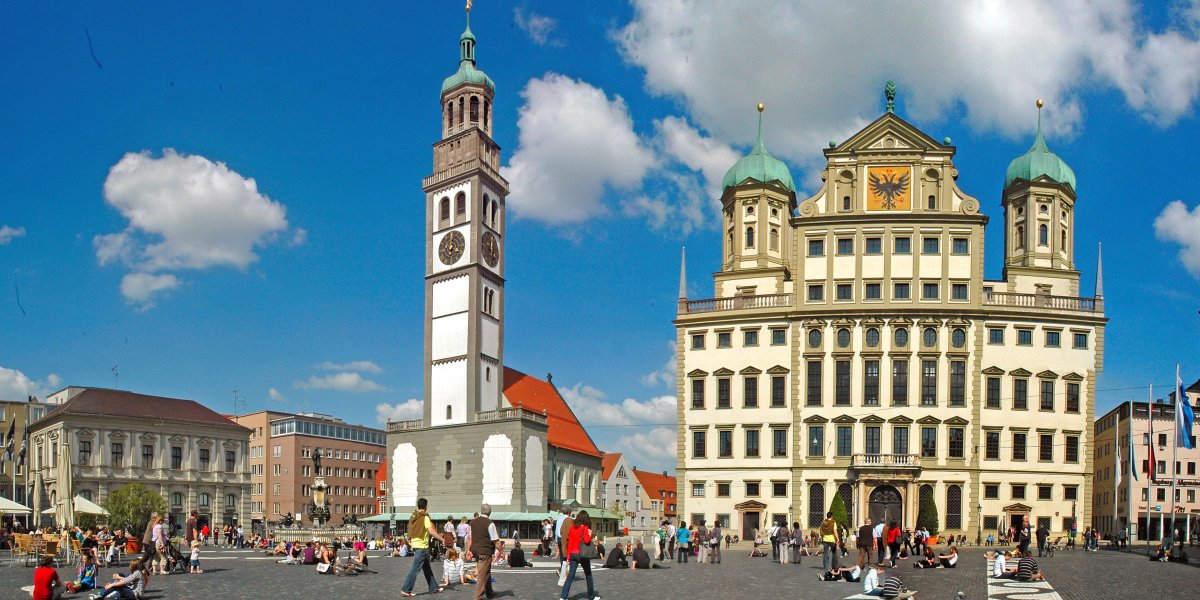
From the market, walk two minutes south down Annastrasse onto Rathausplatz — Augsburg's grand civic square opens beneath you. Elias Holl's 1620 Town Hall is the finest secular Renaissance building north of the Alps; beside it rises the 70-metre Perlachturm, a former watchtower with 258 steps to a wraparound viewing gallery. From the top, the only true 360° view of the city — onion domes below, the Lech valley east, and on a clear afternoon the snow line of the Alps to the south.
Tip: Climb the Perlachturm at 14:30 — southern light hits the Rathaus's twin domes head-on and the view straight down Maximilianstrasse to the towers of St. Ulrich is the postcard shot of Augsburg. Skip the Goldener Saal interior (you said no museums, and the climb gives you the better photograph anyway). Tower closes 18:00 sharp; last entry 17:30.
Open in Google Maps →16:00
Religious
Walk south down Maximilianstrasse for 700 metres — Augsburg's grandest avenue, lined with patrician townhouses and punctuated by three Renaissance bronze fountains: Augustusbrunnen (1594, the city's symbol), Merkurbrunnen, and Herkulesbrunnen, all by Hubert Gerhard and Adriaen de Vries. The boulevard ends at the late-Gothic basilica that holds Augsburg's two patron saints — and uniquely shares one wall with a Lutheran church, a 1555 architectural compromise after the Peace of Augsburg ended the religious wars.
Tip: Step inside both halves: enter the small Protestant St. Ulrich's first (the antechurch, west facade), then walk twenty paces east into the soaring Catholic Basilica — the contrast of Lutheran whitewashed restraint and Catholic gilded baroque under one roof, twenty paces apart, is the visual summary of the Reformation. Late-afternoon western light pours through the Catholic nave's south rose window around 16:30.
Open in Google Maps →19:00
Food
Walk back north up Maximilianstrasse for 8 minutes — the Augustus, Mercury and Hercules fountains are lit gold at dusk and the boulevard empties of day-trippers. Tucked behind the Rathaus on Elias-Holl-Platz, Die Ecke has been Augsburg's serious Swabian Wirtshaus since 1948 — dark-wood booths, white tablecloths, the wine list Bertolt Brecht and Bertolt Brecht's drinking circle once worked through.
Tip: Reserve a day ahead (+49 821 510600) or walk in by 18:45 — by 19:30 there's no table. Order the Augsburger Maultaschen in Brühe (€14) — broth version is the Swabian original, never 'geröstet' which is the tourist variant — followed by the Tafelspitz with horseradish (€26) and a Riegele Augustus dark beer (€4.80/0.5L). Pitfall warning: every restaurant on Rathausplatz with an outdoor terrace and a four-language menu marks up 30-40% for the square view — the 'Augsburger Spezialitätenmenü' for €32 on those boards is the same Schnitzel-and-Spätzle locals pay €19 for one street over.
Open in Google Maps →Aller au jour
09:00
Religious
Begin at the north end of the old town where the twin Romanesque towers of the Dom rise above Frauentorstraße — the cathedral opens at 7:00 but stays nearly empty until coach groups arrive around 10:00, so 9:00 is your window. Inside, walk to the south clerestory of the nave: the five Prophets Windows there (around 1100) are the oldest figural stained glass on earth still set in their original frames, and the morning sun fires them from behind. Hans Holbein the Elder painted four of the side altars in 1493, and the 11th-century bronze doors in the south portal are among the oldest cast bronzes in Germany.
Tip: Walk a full clockwise loop and look up at the Prophets Windows from directly beneath the south nave (not from a side angle) — that's the only spot they fully glow. Don't skip the crypt: take the unmarked stone stairs to the right of the high altar; the original Romanesque foundation hall down there is missed by almost every visitor.
Open in Google Maps →10:30
Landmark
Leave the Dom and walk south down Hoher Weg for 7 minutes — past the quiet inner courtyard of the Maximilianmuseum — and Rathausplatz suddenly opens with the bronze Augustusbrunnen (1594) at its center. Climb the 261 steps of the 70-metre Perlachturm first while your legs are fresh; from the top the entire Romantic Road horizon unrolls northward toward Donauwörth. Then cross to Elias Holl's 1620 Renaissance Rathaus and the Goldener Saal upstairs — a 14-metre gold-coffered ceiling that was bombed to ashes in 1944 and painstakingly reborn for the city's 2000-year anniversary in 1985.
Tip: Buy the combined ticket (€4.50, tower + Goldener Saal) at the Rathaus ground-floor counter — bought separately it's a euro more. Inside the Goldener Saal, stand on the small dark marble disc set into the floor at the room's centre and look straight up: the trompe-l'œil ceiling depths were calibrated for that exact spot.
Open in Google Maps →12:45
Food
Slip behind the Rathaus down Bäckergasse — 90 seconds from the Goldener Saal door — and you arrive at Bauerntanz, a wood-beamed Bavarian tavern where lawyers and museum staff actually take their lunch break. Order the Schweinshaxe (crackling pork knuckle with potato dumpling and red cabbage, €19.90) or the Augsburg-style Käsespätzle (egg noodles with three mountain cheeses and crispy onions, €13.50), washed down with a freshly tapped Riegele Helles from Augsburg's 1386 brewery. Average budget €18–28 per person.
Tip: Skip the bright front room — the rear chestnut-shaded courtyard is where the regulars sit and the staff serve twice as fast there. No reservation needed before 13:00 on weekdays; after that there's usually a 20-minute wait. Cash is faster than card.
Open in Google Maps →14:30
Museum
From Bauerntanz, head south down Maximilianstraße for 6 minutes — you'll pass the Hercules Fountain (1602) midway, one of the three monumental fountains that helped earn Augsburg its 2019 UNESCO water-management listing. Behind a modest pink facade at no. 46, the Schaezlerpalais opens into the most exquisite Rococo festsaal in southern Germany: gold stucco putti, mirrored panels, and an inlaid parquet floor on which the 14-year-old Marie Antoinette danced in April 1770 on her way north to marry the future Louis XVI. Beyond the ballroom, the German Baroque Gallery holds Dürer, Cranach and Holbein in unhurried rooms.
Tip: The festsaal is the headliner — ask the guard to point out the small inlaid plaque at one end commemorating Marie Antoinette's ball. Closed Mondays; Wednesday afternoons are quietest. Free admission on the first Sunday of every month, but it gets packed by 11:00 — afternoon is calmer.
Open in Google Maps →16:30
Religious
Continue four minutes south on Maximilianstraße — the Mercury Fountain (1599) frames the basilica's silhouette dead ahead, exactly as the Renaissance city planners intended. What looks like one church is actually two side by side: the Catholic basilica of St. Ulrich and Afra and, attached to its west front, the smaller Lutheran Ulrichskirche — a literal architectural handshake born from the 1555 Peace of Augsburg, the first European treaty to recognize two faiths under one roof. The basilica's onion dome (1594) became the prototype for every Bavarian church dome you'll see for the rest of your trip.
Tip: Enter the smaller Lutheran church first through the front door, then cross the narrow vestibule into the soaring Catholic basilica — that contrast is the whole point of coming. The crypt below the high altar holds the bones of St. Ulrich, who repelled the Magyars at the Battle of Lechfeld in 955; take the unmarked stairs to the right of the choir to reach it.
Open in Google Maps →19:30
Food
Walk back up Maximilianstraße for 12 minutes — at dusk the three fountains light up gold — and turn left behind the Rathaus into Elias-Holl-Platz. Die Ecke has been feeding Augsburgers since 1504; Bertolt Brecht ate here with his father, Hans Holbein the Younger drank here, and the cross-vaulted Stube room still feels like 1620. Order the Allgäu venison loin glazed with Augsburger Zwetschgendatschi plums (€38) in autumn, or the classic Tafelspitz with horseradish and apple in spring (€27). The wine list leans deep into Franconian Silvaner. Average budget €45–65 per person.
Tip: Reserve at least 48 hours ahead (+49 821 510600) and specifically request the Stube, the vaulted back room — walk-ins almost always get seated in the bistro front. **Watch out:** the broad-terrace restaurants directly on Rathausplatz with multi-language chalkboard menus and waiters chasing you down the street are tourist traps charging double for thawed Schnitzel; the local rule is, the more locals at the bar inside, the better the kitchen behind.
Open in Google Maps →09:00
Landmark
Be at the Herrengasse gate at 8:55 — the Fuggerei opens at 9:00 sharp and for the first hour you have the world's oldest functioning social housing estate (founded 1521 by Jakob Fugger 'the Rich') almost entirely to yourself. Sixty-seven mustard-yellow houses on eight cobbled lanes still shelter 150 needy Catholic Augsburgers, who pay an annual rent of 0.88 euros — the equivalent of one Rhenish guilder — plus three daily prayers for the Fugger family soul. Walk down Mittlere Gasse to House 14, the apartment where Mozart's great-grandfather Franz Mozart lived as a mason in the 1680s, then visit the show flat and the WWII Bunker-Museum included in the ticket.
Tip: Walk the alleys in the first 45 minutes — after 10:00, the photographable empty cobblestones disappear under tour groups until early evening. Most visitors miss the underground WWII bunker (entrance left of the Fuggerei chapel) which has the original 1944 emergency furnishings intact. Pay the ticket in cash if you can — a portion goes directly to the foundation's residents.
Open in Google Maps →11:15
Museum
Exit the Fuggerei via Jakoberstraße and cross the little bridge over the Lech canal onto Auf dem Rain — six minutes through the Lechviertel canal district, whose 22 km of waterways (now UNESCO-listed) once turned wheels for every silversmith, printer and tannery in old Augsburg. Bertolt Brecht was born in the lemon-yellow corner house at no. 7 on 10 February 1898; the modest two-floor museum traces his arc from rebellious Augsburg gymnasium student to the author of 'Mother Courage' and 'The Threepenny Opera' through original manuscripts, his father's drawing room, and the small upstairs bedroom where he wrote his first poems. Closed Mondays.
Tip: Skip the audio guide — it's German-only and the wall texts are bilingual and faster. The west-facing window in his childhood bedroom on the upper floor still looks out exactly as it did in 1898 onto the canal and the elm tree — sit on the bench beneath it for a minute; that view is the museum's quiet, unposted highlight.
Open in Google Maps →12:45
Food
Walk west along Auf dem Rain and Spenglergässchen for 8 minutes, the canal still beside you, until you reach the Annastraße entrance of the Stadtmarkt — Augsburg's covered market hall and the place real Augsburgers do their Friday shopping. For lunch, head to the Fischhalle in the southeast corner for a fresh-smoked trout sandwich from Reichart's counter (€7.50), or to the Viktualienhalle for a pair of Augsburger Würste (the city's coarse-cut pork sausage, €5 with sweet mustard and a warm Brezn). Eat standing at the high zinc tables under the glass roof. Average budget €10–18 per person.
Tip: Avoid the Italian delis along the central aisle — they're priced for tourists. The real value is the small Bavarian Metzger counters at the back of the Viktualienhalle: ask for 'eine Augsburger Wurst und ein Brezn' and you'll be served the proper local lunch for under €8. The market closes at 18:00 and is closed all day Sunday — plan around that if you adjust the schedule.
Open in Google Maps →14:30
Museum
Walk 10 minutes south through the old town along Heilig-Kreuz-Straße and Spitalgasse — the medieval city wall and the Rotes Tor (Red Gate) appear ahead. The Wasserwerk am Roten Tor is the centrepiece of the Augsburg Water Management UNESCO listing inscribed in 2019: three 16th-century water towers and an Archimedes-screw pumping station designed by Caspar Walter that delivered drinking water across the city through wooden pipes for 460 continuous years until 1879. The interior — the vast oak screw-pumps, the original 1416 gears, the lead-lined cisterns above — is only opened to the public on guided tours.
Tip: Tours run weekends April–November, on the hour from 14:00; buy tickets at the small Schwedenstiege entrance kiosk on the day, not online (online slots are pre-blocked for school groups). The tour is in German — pick up the free English handout when you enter. If the tour is sold out, the Lechpromenade between the towers is free and unforgettable at golden hour.
Open in Google Maps →16:30
Museum
Three minutes' walk north along Spitalgasse and you're at Die Kiste, the museum of the Augsburger Puppenkiste — the marionette theatre that has been Germany's national childhood for three generations. Jim Knopf, Urmel aus dem Eis, the Sandmännchen, Kater Mikesch — every figure that defined post-war German television puppetry was carved, painted and strung in this building. The strings are made of fishing line, the puppets are smaller than you imagine (most under 40 cm), and the second-floor display case holding the original 1976 Jim Knopf is the surprise highlight.
Tip: Closed Mondays; 45 minutes is plenty for the museum itself. If you want to actually see a Puppenkiste show that night, the adjacent theatre starts performances at 20:00 — book online a month ahead, they sell out. **Watch out:** the small souvenir cart outside on Spitalgasse sells unlicensed Jim Knopf knock-offs at triple the price; the official figures are inside the museum shop and clearly marked with the Puppenkiste seal.
Open in Google Maps →19:30
Food
Walk five minutes north up Maximilianstraße — the Hercules Fountain lit gold ahead — and Maximilians sits at no. 32, behind a tall vaulted doorway. The kitchen is unapologetically Bavarian and unapologetically large-portioned, but the sourcing is serious: Allgäu rinderbraten with dark beer gravy and bread dumpling (€26), grilled Augsburger Zander pikeperch from the Lech with parsley-butter potatoes (€28), and the house Wiener Schnitzel pounded to plate-size and fried in clarified butter (€24). The dark-wood cross-vaulted main hall is among the most atmospheric dining rooms in Bavaria. Average budget €35–55 per person.
Tip: Reserve via maximilians-augsburg.de — ask for a table in the vaulted Gewölbe hall, not the brighter front bistro. Arriving before 19:30 on a Saturday usually means a 30-minute wait without a booking. **Watch out:** the long covered terrace on Maximilianstraße looks tempting but is loud and gets passing tour groups; the real Maximilians experience is inside under the vaults — explicitly request that when booking.
Open in Google Maps →
Trip builder
Plan this trip around Augsburg
Turn this guide into a bookable rail itinerary with FlipEarth.
Keep exploring
Related cities
More in the same country
FAQ
Frequently asked questions
How many days do you need in Augsburg?
Most travelers enjoy Augsburg in 1 days, with enough time for headline sights and a slower meal or museum stop.
What's the best time to visit Augsburg?
The easiest season for most travelers is May-Sep, especially if you want good weather and manageable crowds.
What's the daily budget for Augsburg?
A practical starting point is about €85 per person per day before hotels, then adjust based on museums, dining, and transport.
What are the must-see attractions in Augsburg?
A good first shortlist for Augsburg includes Fuggerei, Augsburg Town Hall & Perlachturm.