City Guide
Melk
Autriche · Best time to visit: Apr-Oct.
Day-by-day plan
Choose your pace
Durée du voyage
08:30
Landmark
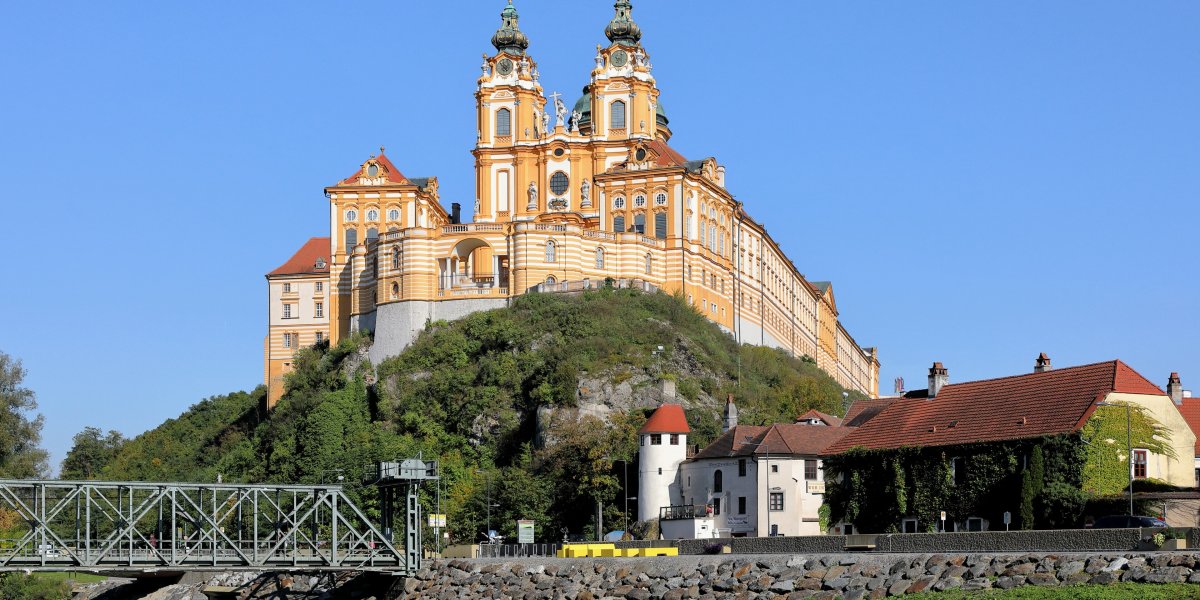
From Melk Bahnhof, walk 10 minutes north up Abt-Karl-Strasse — within three blocks the abbey's ochre walls rear up like an ocean liner moored above the rooftops. Skip the ticketed interior (you can't do the Marble Hall and library justice on a power-walk day anyway) and instead trace the free perimeter: through the Stiftspark gardens with their Baroque garden pavilion, up to the North Bastion terrace where the Danube curves out below, then around the east courtyard to study the full 362-meter facade. The abbey is the entire reason you came — give it real time, not a selfie-and-go.
Tip: 08:30 is the magic window: the outer terraces and gardens open free at 08:00, but the first coach tours don't roll in until 10:00. Shoot from the North Bastion toward the southwest — the morning sun hits the ochre walls dead-on and the Danube serves as a silver backdrop. The interior tickets (€13) require 90 minutes you don't have today; come back for an overnight in Wachau to do them justice.
Open in Google Maps →10:45
Neighborhood
Exit the abbey through the Wiener Tor and descend the Klosterhang steps directly into the medieval old town — a 4-minute walk drops you 60 meters and 600 years. Loop Rathausplatz with its Baroque town hall, the 1581 Renaissance Haus am Stein at Linzer Strasse 3, then walk the full length of Hauptstrasse past the Pfarrkirche St. Stephan (Melk's parish church, often mistaken for the abbey from the river but a separate Baroque gem), turning down narrow Sterngasse for a low-angle frame of the abbey rising over the tiled rooftops.
Tip: Sterngasse — the alley between Hauptstrasse 8 and 10 — is the only spot in town where you can frame the abbey through a foreground stone arch. Almost no tourist finds it because it reads as a residential dead-end on Google Maps. Step five paces in and shoot upward; the alley is narrow enough that a 24mm lens is barely wide enough.
Open in Google Maps →12:30
Food
Walk 2 minutes east along Hauptstrasse — Konditorei Madar has been rolling Wachauer Marillenknödel for over half a century, and they are the dish of this region: a whole Wachau apricot wrapped in potato-curd dough, boiled, rolled in butter-fried breadcrumbs, dusted with powdered sugar. Order a Doppelportion (two dumplings, €7.50) and an Einspänner coffee (€4.20). Stand at the counter if the queue is long — locals eat them standing all the time. You'll be done in 30 minutes and back on the road.
Tip: Marillenknödel only taste right with real Wachau apricots — Madar uses them fresh in season (Jul-Aug) and high-quality frozen Wachau apricots the rest of the year. Ask 'sind die Marillen aus der Wachau?' before ordering anywhere else; tourist cafés on Rathausplatz often substitute Turkish apricots and still call them Wachauer.
Open in Google Maps →13:30
Landmark
Cross the Melk river footbridge behind Hauptstrasse and pick up the red-white-red Welterbesteig waymarks — within 15 minutes you're climbing through apricot orchards onto the Hochrücken ridge above the Danube. The official Wachau World Heritage Trail rises to roughly 280m, runs east through vineyards with hawk's-eye views of the abbey shrinking behind you and the river silvering ahead, then descends after 7km to Schönbühel: a single white castle clinging to a rock straight out of the Danube, called the 'Watchman of the Wachau' for good reason. Loop back along the flat Donauradweg riverside path for a different perspective and half the climb. Total ~14 km of the most beautiful walking you will do in Austria.
Tip: Around trail kilometer 4 there is an unsigned clearing with a single weathered bench facing south — this is the angle the official Wachau tourism photos are shot from, with the abbey sitting on its bluff and the Danube curving in below. Most hikers blow past it chasing distance; sit down for ten minutes. Carry one full liter of water — there is no refill point between Melk and Schönbühel.
Open in Google Maps →17:45
Landmark
Back across the Pielach footbridge from the Donauradweg, instead of returning straight to the abbey turn east up Wiener Strasse — within 5 minutes you're at the foot of Kalvarienberg, a small hill east of the abbey crowned by a 17th-century Calvary chapel. Climb the 14 Stations of the Cross (10 minutes uphill through cypress and acacia) for the finest westward view in Melk: the entire abbey complex backlit gold-against-violet, the Danube valley fading behind, the yellow walls darkening to bronze as the sun drops behind them. This is the photograph the postcards copy, not the river-level shot.
Tip: The bench at the third Station of the Cross — not the summit chapel — is the photographer's spot: the cypress and the stone cross frame the abbey on a diagonal the top viewpoint can't match. Arrive 30 minutes before sunset for the gold-to-pink window; check the day's exact sunset time on a weather app, it shifts from ~19:30 in April to ~21:00 in June and back to ~18:30 in October.
Open in Google Maps →19:30
Food
Down off the hill and a 12-minute walk west along Wiener Strasse brings you back to Stiftsrestaurant Melk, tucked into the abbey's outer courtyard — this is dinner with the same yellow walls you photographed at dawn now floodlit golden overhead. Order the Tafelspitz (€22, the Austrian boiled-beef classic with apple-horseradish and chive sauce) or the Wachauer Fischteller of zander and trout (€26). Pair with a Smaragd-class Grüner Veltliner from a Wachau heuriger producer — €5.50 a glass here against €12 in any Vienna wine bar. Budget €35-45 with one glass of wine.
Tip: Book the south terrace 48 hours ahead via stiftsrestaurant.at for the floodlit abbey-wall view; it's open Apr-Oct and fills up on summer weekends. Tourist-trap warning: cafés on Rathausplatz advertise 'Wiener Schnitzel' at €24 made with pork (legally must be called Schnitzel Wiener Art) — a real Wiener Schnitzel is always veal and never under €19. If it's cheaper, it isn't the real dish; also ignore the 'tip jar' street musicians who follow day-trippers across the square after dark, a known low-grade scam aimed at the last evening train crowd.
Open in Google Maps →
Trip builder
Plan this trip around Melk
Turn this guide into a bookable rail itinerary with FlipEarth.
Keep exploring
Related cities
More in the same country
FAQ
Frequently asked questions
How many days do you need in Melk?
Most travelers enjoy Melk in 1 days, with enough time for headline sights and a slower meal or museum stop.
What's the best time to visit Melk?
The easiest season for most travelers is Apr-Oct, especially if you want good weather and manageable crowds.
What's the daily budget for Melk?
A practical starting point is about €90 per person per day before hotels, then adjust based on museums, dining, and transport.
What are the must-see attractions in Melk?
A good first shortlist for Melk includes Melk Abbey North Bastion & Stiftspark, Wachau Welterbesteig to Schönbühel Castle, Kalvarienberg Golden-Hour Viewpoint.