City Guide
Bad Ischl
Autriche · Best time to visit: May-Sep.
Day-by-day plan
Choose your pace
Durée du voyage
09:00
Landmark
From Bad Ischl Bahnhof, walk 15 minutes north along the Traun's east bank — the imperial yellow walls appear through the linden trees just as the road bends west. This is where Franz Joseph signed the 1914 declaration that began WWI, and where he and Sisi spent every summer of their marriage; the villa is still privately owned by Habsburg descendants today. Arrive at 09:30 opening for the cleanest morning light hitting the Kaisergelb facade head-on, and walk the empty back gardens to the Marmorschlössl, the small marble pavilion Franz Joseph built for Sisi, before the 10:30 bus tours converge on the front courtyard.
Tip: The postcard shot is from the gravel path 40m southeast of the villa's main entrance, where Mount Katrin rises directly behind the yellow walls — shoot between 09:30 and 10:00 before tour groups block the foreground. Skip the interior tour on a layover day; the gardens and Marmorschlössl exterior carry the imperial story in 90 minutes, while the interior tour would cost you nearly three hours of your day.
Open in Google Maps →11:45
Landmark
Leave the Kaiserpark through the south gate and follow the Traun's east bank for 10 minutes back toward town — the cream-and-green Neoclassical pavilion that appears on Auböckplatz is the Trinkhalle, the 1831 pump house where Habsburg royalty came to drink the salt-brine cure that turned a salt-mining village into the Empire's favourite summer Kurort. Late-morning sun lights the cream columns front-on, which is the cleanest photo window before afternoon shadows from the linden trees cut across the colonnade. Walk slowly through the arcade and around to the rear garden — the building now hosts rotating art shows but the architecture is the point.
Tip: The architectural shot is from across Auböckplatz facing the full colonnade — at 12:00 the light is at its flattest and shows all six columns evenly without shadow stripes. Ignore the bottled 'Kaiser-Brunnen' spa water for sale at souvenir shops nearby; it's a €4 marketing prop, and the public drinking fountain on Kreuzplatz 50m south flows the same Salzkammergut spring water for free.
Open in Google Maps →12:45
Religious
Walk 4 minutes south down Kreuzplatz and turn onto Pfarrgasse — the spire of St. Nikolaus rises straight ahead at the square's end. This is where Franz Joseph attended Sunday mass every summer for sixty years; after Sisi's 1898 assassination he commissioned a small gold-ground mosaic of her installed in the side aisle as a private memorial — most visitors photograph the facade and never see it. The square outside is loveliest just before lunch, when the chestnut trees throw soft shadows on the white facade and the streets empty — most travellers are already inside Zauner across the way.
Tip: Step inside for five minutes specifically to find the gold-ground Sisi mosaic in the side aisle — it's the most personal piece of Habsburg memory in town, and 90% of visitors miss it. Photography without flash is permitted; the gold tesserae read best in soft window light around midday.
Open in Google Maps →13:30
Food
Three doors south of the church on Pfarrgasse — you'll catch the butter-pastry smell before you see the green awning. This is Konditorei Zauner, founded 1832, the imperial-warrant pastry shop whose cakes were carried daily by liveried footmen to Franz Joseph at the Kaiservilla. Skip the tourist-heavy seated salon upstairs and head straight to the standing counter in the original front room, where locals still grab quick lunches between errands. Order a Frankfurter mit Semmel — a pair of warm Frankfurter sausages with a kaiser roll, €6.50 — and a slice of Zaunerstollen, the house chocolate-nut-marzipan log invented here in 1905, €5.20, with a kleiner Brauner espresso (€3.20). Under €15, eaten standing among regulars in 35 minutes.
Tip: Order at the standing counter, not the seated salon — same cakes, same prices, zero wait, and you'll be among locals rather than coach-tour groups paying a 20% terrace surcharge. The Zaunerstollen is the only must-try; the Sachertorten and Linzer slices are merely fine, and you're saving calorie budget for dinner.
Open in Google Maps →14:45
Landmark
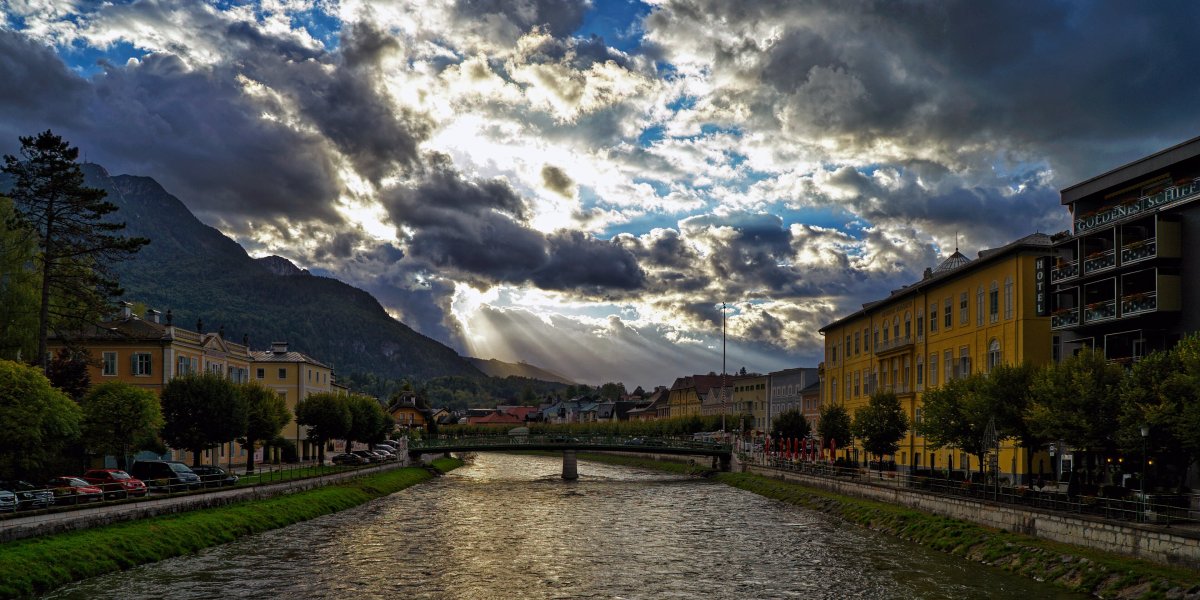
Leave Zauner south down Pfarrgasse to the Esplanade and follow the Traun downstream for 12 minutes — the cast-iron lampposts and pastel hotel facades along this stretch haven't changed since the 1880s. The river curves left and a yellow villa with a green steep-pitched roof appears on the right bank: this is the Lehár Villa, where Franz Lehár, composer of 'The Merry Widow,' spent his summers and final years until his death here in 1948 — the upper balcony where he composed is unmistakable from the wrought-iron gate. After exterior photos, cross the Lehár Bridge to the south bank and climb Kalvarienberg, 25 minutes up through fourteen Stations of the Cross to a small wooden platform. From there the whole town opens out in a single frame: Kaiservilla yellow in the north, Lehár Villa directly below you, church spire dead-centre — the only viewpoint in Bad Ischl that makes geographic sense of your entire day.
Tip: Climb Kalvarienberg between 16:30 and 17:30 for warm late-afternoon light hitting the Kaisergelb walls in the distance — earlier and the light is flat, later than 18:30 in summer and the valley shadow swallows the villa entirely. Skip the Katrin Almbahn cable car (€30 round-trip, two hours minimum); the Kalvarienberg view costs nothing, takes 50 minutes of walking you wanted anyway, and frames the town better than the summit can.
Open in Google Maps →19:00
Food
Descend Kalvarienberg via the eastern path back to the Lehár Bridge, then walk 5 minutes upstream along Leharkai — a low ochre building with green shutters at number 12 is Weinhaus Attwenger, Bad Ischl's oldest wine tavern (operating since the 17th century), where Lehár himself was a regular and where on a weeknight you'll still see more locals than tourists on the riverside terrace. Order the Salzkammergut Reinanke (lake whitefish from nearby Hallstättersee, pan-fried in brown butter and parsley, €24) with a glass of Grüner Veltliner from Wachau (€5.50); on a cool evening the venison ragout with bread dumplings (€22) is the local move. Reserve 24 hours ahead for a riverside terrace table in summer; if you didn't, arrive at 19:00 sharp when the kitchen opens — the inner wooden-bench tables fill within 30 minutes.
Tip: Tourist trap warning for Bad Ischl: avoid restaurants on central Pfarrgasse and the main Esplanade with multi-language menus posted outside — they're 30-50% pricier and serve reheated frozen Wiener Schnitzel. Skip anywhere advertising 'Sisi's Original Sachertorte' — Sachertorte is a Vienna invention, never local to Bad Ischl; the only authentic local pastry is Zaunerstollen and only Konditorei Zauner makes the real one. Locals eat at Attwenger, Goldenes Schiff, or the Bräugasthof — all tucked on side streets, none with English menus on the door.
Open in Google Maps →
Trip builder
Plan this trip around Bad Ischl
Turn this guide into a bookable rail itinerary with FlipEarth.
Keep exploring
Related cities
More in the same country
FAQ
Frequently asked questions
How many days do you need in Bad Ischl?
Most travelers enjoy Bad Ischl in 1 days, with enough time for headline sights and a slower meal or museum stop.
What's the best time to visit Bad Ischl?
The easiest season for most travelers is May-Sep, especially if you want good weather and manageable crowds.
What's the daily budget for Bad Ischl?
A practical starting point is about €80 per person per day before hotels, then adjust based on museums, dining, and transport.
What are the must-see attractions in Bad Ischl?
A good first shortlist for Bad Ischl includes Kaiservilla, Marmorschlössl & Kaiserpark, Trinkhalle, Esplanade Promenade, Lehár Villa & Kalvarienberg Viewpoint.