City Guide
Mainz
Allemagne · Best time to visit: May-Sep.
Day-by-day plan
Choose your pace
Durée du voyage
09:00
Religious
From Mainz Hauptbahnhof, walk south and uphill along Gartenfeldstraße for 15 minutes — a quiet climb past late-19th-century townhouses that locals actually live in, with the hilltop church bell tower pulling you forward. Inside this Gothic church hang the nine stained-glass windows Marc Chagall designed between 1978 and 1985 — the only Chagall windows in Germany, created by the Jewish master as a postwar act of reconciliation with the city that once burned its synagogue. The choir floods with a deep cobalt blue that no photograph has ever captured properly.
Tip: Arrive at 09:00 sharp when the doors open — you will have the choir to yourself for twenty minutes before the first tour groups arrive at 09:30. Stand on the central aisle facing the altar; the morning sun strikes the east windows between 09:30 and 11:00 and ignites the blue glass into something otherworldly. Photos without flash are permitted. A €2 donation in the wooden box by the door is the local courtesy.
Open in Google Maps →10:45
Landmark
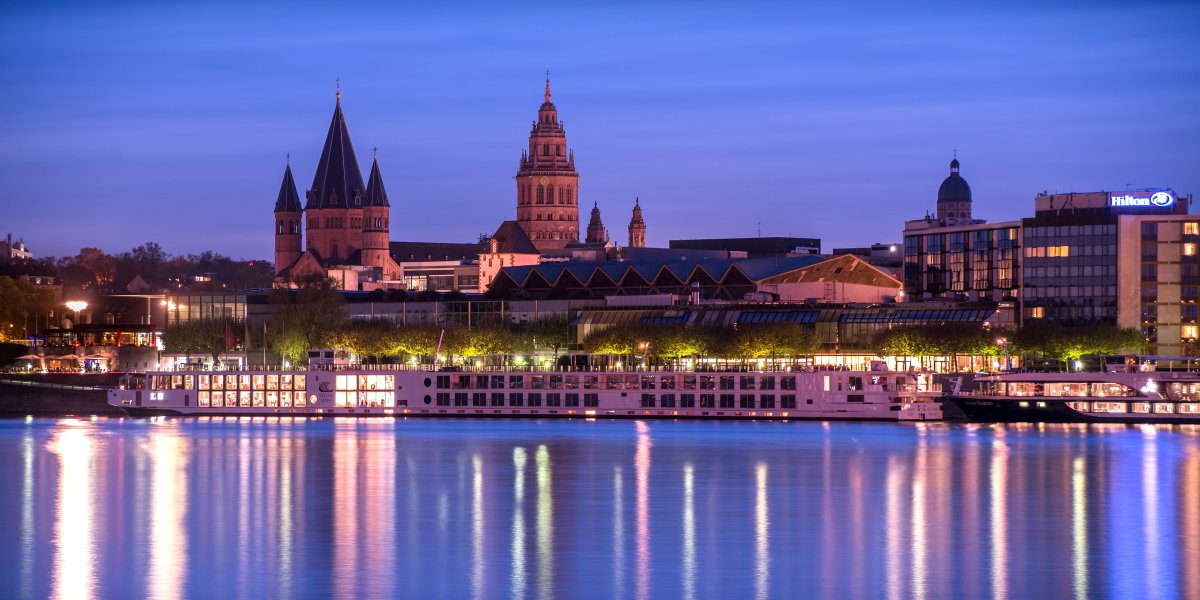
Exit St. Stephan, walk east downhill along Weißliliengasse for 10 minutes — you will cross Schillerplatz, where the Fastnachtsbrunnen carnival fountain bristles with over 200 satirical bronze figures (count the mocking faces, every one points at a different Mainz politician). The thousand-year-old red-sandstone Mainz Cathedral is one of the three Imperial Romanesque cathedrals of the Rhine, alongside Worms and Speyer. Walk a slow circle around the exterior — the original 975 AD core, the 11th-century rebuild after fire, and the six towers in their unrepeatable arrangement.
Tip: Enter through the Marktportal on the east (market square) side and do one slow lap of the interior — free, no ticket, fifteen minutes, and the towering Romanesque nave under a single shaft of light from the clerestory is the photograph everyone misses. If today is Tuesday, Friday, or Saturday, the wine market wraps the cathedral in white tents from 10:00 — pause for a small glass of Rheinhessen Riesling at any stand for €2.50 before continuing.
Open in Google Maps →12:30
Food
From the cathedral's north side, slip into Grebenstraße and follow the narrowing cobblestones for 3 minutes — you will smell the wine cellars before you see the hand-painted sign. This 18th-century wine tavern has been run by the same family for generations and is where cathedral clergy and old-town wine merchants eat lunch. Order the Mainz trinity 'Weck, Worscht un Woi' — a hard roll, two local sausages, and a glass of dry Riesling (€12) — and add the Spundekäs (€6), the whipped cream-cheese spread with paprika and onions that Mainzers will defend with their lives, served with a soft pretzel.
Tip: Order at the bar (no table service for quick lunches), point at what the locals are eating, and grab a wooden bench in the back room. The Spundekäs is the must-order — refuse the version with Brötchen and insist on the pretzel. Skip the touristy Eisgrub-Bräu two streets away; it serves the same beer for €3 more and none of the soul. Budget €15-20 with one glass of wine.
Open in Google Maps →13:45
Neighborhood
Walk one block east from Hottum to Liebfrauenplatz — the Gutenberg Museum's twin-gabled Renaissance facade sits directly opposite the cathedral's north flank, and the cobblestone outline in the square still traces where the medieval Liebfrauenkirche stood before Napoleon's troops tore it down in 1793. Photograph the museum exterior (the 1962 reconstruction of the 'Zum Römischen Kaiser' merchant house), then thread south down Augustinerstraße — the most photographed street in Mainz — and detour west into Kirschgarten, a fairytale triangular square of half-timbered houses around a Madonna fountain that 90% of day-trippers never find.
Tip: At the junction of Augustinerstraße and Kapuzinerstraße, look up — the cantilevered upper floors of the timbered houses almost kiss above the lane and this is the iconic Mainz alley shot. In Kirschgarten, stand at the southwest corner and frame the 1932 Madonna fountain with the 'Zum Aschaffenberg' half-timbered house behind it; the afternoon light from 14:30 onward warms the ochre plaster to gold. Free public toilets are inside the Karstadt department store on Schusterstraße — the only clean ones in the Altstadt.
Open in Google Maps →16:15
Park
From Kirschgarten, walk back through the Altstadt to Fischtorstraße and emerge onto the Rhine — 8 minutes, with the first glimpse of the river deliberately staged at the end of a narrow cobbled lane. Walk north along the Adenauer-Ufer promenade with the Rhine on your right and the cathedral towers receding behind you, then climb the steps onto the Theodor-Heuss-Brücke for the city's signature view: the six cathedral towers above the red-roofed Altstadt, framed by the working river. Continue 1.5 km north along the Mainz bank to the Zollhafen marina — the modern glass-and-steel counterpoint to the medieval skyline.
Tip: Cross all the way to the Kastel (Wiesbaden) side of the bridge and look back at sunset — around 17:30 in winter, 21:00 in summer — when the cathedral's red sandstone glows copper in the last light. The wooden benches on the Kastel embankment are the locals' secret and always less crowded than the Mainz side. Skip the river cruise touts at the dock; the 50-minute loop costs €15 and shows you nothing the bridge does not.
Open in Google Maps →19:30
Food
Return across the Theodor-Heuss-Brücke and walk south along Rheinstraße to Mailandsgasse — 12 minutes, with the cathedral towers lighting up amber as the streetlamps come on. Dinner is inside the soaring 13th-century vaulted nave of a former hospital chapel, where candles flicker against the Gothic stonework and the acoustics swallow conversation just enough. Order the Riesling-glazed pork knuckle (€24), the slow-braised regional specialty that locals come here for, or the full Spundekäs platter (€15) with a bottle of dry Rheinhessen Riesling from the deep wine list.
Tip: Reserve before 18:00 on Friday or Saturday — Mainzers book Heiliggeist for anniversaries and the place fills by 19:45. Ask for a table along the south wall away from the front-door draft. Dinner with wine runs €40-55. Pitfall warning: avoid the restaurants directly on the Rhine promenade — they trade on the river view at double the price with reheated kitchens, and the touts handing out menus at the Fischtor are the giveaway. Mainz's real dining gravity is in the dark cobbled alleys behind the cathedral, not on the waterfront.
Open in Google Maps →
Trip builder
Plan this trip around Mainz
Turn this guide into a bookable rail itinerary with FlipEarth.
Keep exploring
Related cities
More in the same country




FAQ
Frequently asked questions
How many days do you need in Mainz?
Most travelers enjoy Mainz in 1 days, with enough time for headline sights and a slower meal or museum stop.
What's the best time to visit Mainz?
The easiest season for most travelers is May-Sep, especially if you want good weather and manageable crowds.
What's the daily budget for Mainz?
A practical starting point is about €90 per person per day before hotels, then adjust based on museums, dining, and transport.
What are the must-see attractions in Mainz?
A good first shortlist for Mainz includes Mainzer Dom St. Martin & Markt.