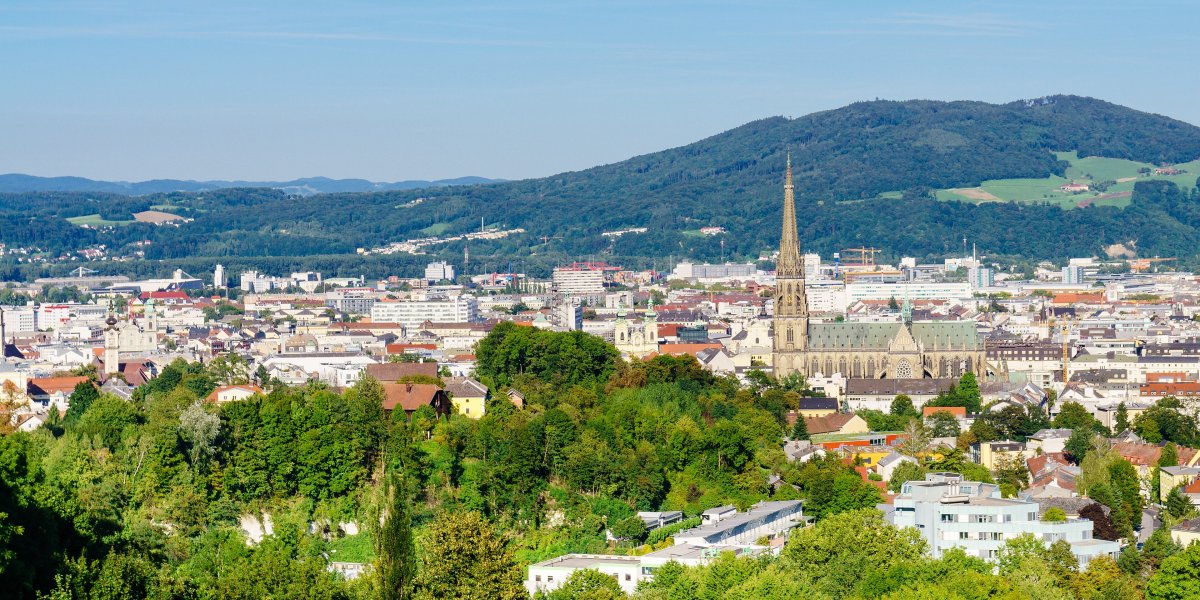
City Guide
Linz
Autriche · Best time to visit: May-Sep.
Day-by-day plan
Choose your pace
Durée du voyage
09:00
Landmark
Begin at Hauptplatz and cross the Nibelungenbrücke north to Bergbahnhof Urfahr — a 12-minute warm-up walk with the old town's spires reflecting in the Danube to your right. Board one of the world's steepest adhesion railways for a 20-minute climb through vineyards and forest to the twin-towered Baroque basilica perched 539 m above the city. The morning sun lights the old town from the east, and on a clear day the Alps draw a clean horizon line to the south.
Tip: Buy a one-way ticket up and walk down via the Kalvarienberg trail (3 km, 45 min, all downhill through forest past the Stations of the Cross chapels). You'll save the return fare, halve the morning crowd, and hit the city's best panorama bench halfway down — empty before 11:00.
Open in Google Maps →11:45
Landmark
The Kalvarienberg trail spills you into Urfahr; walk five minutes east along the Donaulände to reach the AEC's mirrored glass cube on the river's north bank. Even without going inside, the facade is the point — 38,500 programmable LEDs that turn the entire building into Europe's largest media-art canvas. Walk the riverside terrace for the textbook postcard of Linz: the cube in the foreground, the old town's spires lined up across the water.
Tip: The frontal shot everyone wants is taken from the middle of the Nibelungenbrücke pedestrian deck — the cube fills the frame with the Pöstlingberg basilica floating behind it. Skip the AEC's ground-floor cafe; it's a museum kiosk, not a local spot, and you've got real food two bridges away.
Open in Google Maps →13:00
Food
Cross the Nibelungenbrücke south into the old town and turn right at Hauptplatz onto Rathausgasse — a six-minute walk that drops you at Linz's most beloved counter. This is a stand-up Leberkäse joint that has been feeding office workers and tram drivers since the 1970s: no tables, no menu beyond a chalkboard, just locals on lunch break standing shoulder-to-shoulder at the bar.
Tip: Order the Käseleberkäs-Semmel (cheese-stuffed Leberkäse in a fresh Kaisersemmel roll, €4.80) with a small Almdudler — the only correct pairing. Eat it standing on the street; the moment you sit down anywhere in Linz, the same food costs three times more.
Open in Google Maps →14:00
Landmark
Walk three minutes northwest from Leberkas-Pepi back to the riverbank — the Lentos's translucent glass facade rises straight ahead, glowing pale blue in daylight and famously color-shifting through pink and violet at dusk. Stroll the Donaupark promenade west along the water past the Brucknerhaus concert hall: you're walking through Linz's open-air sculpture park, with the Pöstlingberg you climbed this morning hovering on one bank and the AEC cube glinting on the other.
Tip: The south facade facing the river is the photogenic one — most visitors only see the bland north entrance from Ernst-Koref-Promenade and leave underwhelmed. Walk down to water level via the stone steps just east of the building for the exact angle every Linz postcard uses.
Open in Google Maps →15:45
Landmark
Cut south from the river through Hofgasse into Hauptplatz, one of Central Europe's largest medieval squares, anchored by the 20-m white-marble Trinity Column. Loop east down Bischofstraße to circle the Mariendom — Austria's largest church by capacity, its 135-m spire kept exactly 2 m shorter than St. Stephen's in Vienna by imperial decree. Wander back through Domgasse past the Old Cathedral where Anton Bruckner was organist for twelve years, then climb the cobbled Schlossberg ramp up to Linzer Schloss. The castle terrace lays the whole city out below — the Danube curling north, the basilica towers across the river, the AEC cube glowing as the sun drops behind you.
Tip: Time the castle terrace for 17:30-18:30 in summer — golden hour lights the Pöstlingberg towers across the river and softens the AEC into a glowing block. The terrace is free and almost always empty after the museum closes at 17:00; locals know the view is the real attraction, not the exhibits inside.
Open in Google Maps →19:00
Food
Walk back down from the castle through the Altstadt to Landstraße — a six-minute descent that lands you at this 17th-century former monastery refectory with the largest beer garden in town: 1,500 seats under chestnut trees in summer, vaulted brick cellars in winter. This is where Linzers actually eat after work, not where tour buses stop. Hearty Austrian classics done by people who've cooked them their whole lives, paired with Stiegl on tap straight from the brewery in Salzburg.
Tip: Order the Tafelspitz mit Apfelkren (boiled beef with apple-horseradish and rösti, €19) and finish with a slice of Linzer Torte (€5.50) — you cannot leave this city without tasting the world's oldest documented cake recipe. Avoid the photo-menu places lining the south side of Hauptplatz: they charge €25 for microwaved schnitzel to people who don't know any better, and the Klosterhof is one block further for a tenth of the regret.
Open in Google Maps →Aller au jour
09:00
Museum
From Hauptplatz, cross the Nibelungenbrücke northbound — a 4-minute walk with the Danube opening to your left and the museum's pixel-grid façade lighting up the far bank. Step inside the moment doors open: Europe's most future-forward media museum runs AI labs, deep-space simulations and the Deep Space 8K immersive theatre on a single floor. This is why Linz holds the UNESCO City of Media Arts title — and why you start here, before any tour group arrives.
Tip: Book the first Deep Space 8K session of the day (usually 9:30 or 10:00) at the front desk the moment you arrive — it sells out by midday and there is no second chance to see floor-and-ceiling projections of Klimt, the Milky Way or the human cell at this scale.
Open in Google Maps →11:30
Museum
Exit AEC south, recross the Nibelungenbrücke and Lentos appears immediately on your right — 6 minutes total along the river path. The 130-metre glass-skinned box, designed by Weber+Hofer, holds one of Austria's strongest 20th-century collections — Kokoschka, Klimt, Schiele — across a single luminous floor you can clear in 90 focused minutes.
Tip: Skip the basement temporary shows on a tight schedule — the permanent floor has the Klimt and Kokoschka. Walk straight to the river-side café terrace afterwards and order an espresso (€3.20); the panoramic windows frame the AEC across the water and frame your morning in one shot.
Open in Google Maps →13:30
Food
From Lentos walk south through the Volksgarten and onto Landstraße — 8 minutes through the city's pedestrian artery — until the Klosterhof's old monastery archway appears on your left. The vaulted cellar dates to the 1600s; the inner courtyard, when sunny, is one of central Linz's most beloved lunch tables. Order the Wiener Schnitzel (€18.50) — fork-tender veal, lemon, the proper cranberry — or the Tafelspitz (€19.50) with apple horseradish.
Tip: Walk straight past the front street tables into the inner courtyard — locals always sit there. Reserve weekends online; on weekdays just arrive before 12:45 to claim a corner spot. Closed Sundays — if your Day 1 falls on a Sunday, switch with Promenadenhof for lunch.
Open in Google Maps →15:30
Religious
From Klosterhof continue south on Landstraße, then turn right into Herrenstraße — 6 minutes. The Mariendom's 134-metre neo-Gothic spire (Austria's largest cathedral by capacity) appears suddenly above the rooftops. Inside, the Linz Window's Marian and Habsburg motifs flood the south aisle with red and gold light around mid-afternoon — this is precisely why you come at this hour, not at noon.
Tip: The southwest tower platform is open Wed-Sun for €5 — 200 steps up to the only honest panoramic view of the central old town, with the Pöstlingberg's twin-towered basilica visible directly opposite (a preview of Day 2). Skip the gift shop crypt — it is overpriced and the same postcards are €1 cheaper on Landstraße.
Open in Google Maps →17:00
Neighborhood
From the Mariendom walk back north on Herrenstraße to Pfarrplatz, then drift west into the Altstadt's narrow lanes — 7 minutes — emerging onto the wide pastel Hauptplatz with its 1723 Trinity Column rising from the cobbles. This is the largest enclosed square in Austria; at this hour the cafés put chairs out, students sit on the stones, and the red Pöstlingbergbahn rattles across the western corner. Wander west into Altstadt via Schmidtorstraße to Mozarthaus and back along Klammstraße.
Tip: Stand at the square's southeast corner around 17:30 — late sun lights the pink Old Town Hall façade and the Trinity Column casts its longest shadow due north, framing the perfect Linz postcard. Walk one block west into Altstadt for evening light on the Hofgasse, far quieter than the square itself.
Open in Google Maps →19:30
Food
From Hauptplatz head south along Promenade — 4 minutes under the linden trees that line the city's prettiest avenue — to the Promenadenhof's chestnut-shaded terrace. This century-old institution is where Linz comes for properly executed Austrian classics: the Linzer Bauerngröstl (potato-and-beef pan, €17) and the Linzer Brettljause cured-meat board (€19) are the order. Finish with a Marillenknödel (apricot dumpling, €9).
Tip: Book the inner courtyard table 24 hours ahead — that is where locals eat; the street terrace is louder. Pitfall: ignore every 'traditional Austrian' restaurant fronting Hauptplatz itself — they charge €28 for the same schnitzel that costs €18.50 four minutes away, and the standard is visibly worse. Promenadenhof is the locals' answer to that trap.
Open in Google Maps →09:00
Landmark
From Hauptplatz, the bright red Pöstlingbergbahn waits on its own platform at the square's western corner — a 3-minute walk from any old-town hotel. Climb aboard at 9:00 sharp: the carriage clatters uphill on a 11.6% gradient, the world's steepest adhesion railway, with the Danube and the snow-streaked Alps unfolding behind you. Twenty minutes later you arrive at the twin-towered Pilgrimage Basilica (1748), walk the panorama terrace, then duck into the Grottenbahn — a hand-painted dragon train through fairy-tale grottoes that has thrilled Linz children since 1906.
Tip: Sit on the right-hand side going up — the unobstructed Danube view is on that side; everyone fights for the left. Buy the combined Bergbahn + Grottenbahn ticket at the Hauptplatz station (€13.90); it saves €4 versus buying separately. The best photograph of the basilica is from the southwest meadow loop, not the entrance courtyard the bus tours queue at.
Open in Google Maps →12:00
Food
Take the same Pöstlingbergbahn back down (20 minutes) to Hauptplatz, then walk 4 minutes east into Graben — the parallel street to Landstraße that locals use to escape the shopping crowds. Wirt am Graben is a small honest Stube serving Upper Austrian classics: the boiled-beef Tafelspitz (€18) with chive sauce and the Linzer Backhendl (free-range fried chicken, €16) are the orders. Half the room speaks Mühlviertler dialect at lunchtime.
Tip: Order the Tagesteller (daily menu) board chalked above the bar — it is €4-5 cheaper than the printed menu for the exact same plate, and rotates with whatever the market had that morning. Arrive before 12:30 to skip the office crowd.
Open in Google Maps →14:00
Museum
From Graben walk west via Altstadt and Hofgasse — 8 minutes climbing the gentle ramp the Habsburgs once rode up to their riverside fortress. The 15th-century Linzer Schloss now houses Upper Austria's state museum: the medieval armoury, baroque interiors and the spectacular modern glass-and-steel south wing (added in 2009 after the fire that destroyed it) under one roof, plus a panorama terrace looking straight down onto the Danube.
Tip: Go straight to the third-floor 'View of the Old Town' room before anything else — the floor-to-ceiling window is the best panoramic interior shot of central Linz, and after 15:00 the western sun reflects off the river and washes the whole room in gold. Closed Mondays.
Open in Google Maps →16:00
Food
Descend from the castle back to Altstadt via Tummelplatz, then cross to the Promenade — 6 minutes downhill through the prettiest corner of the old town. Café Traxlmayr (1847) is THE Linz coffeehouse: red velvet banquettes, brass chandeliers, newspapers on wooden poles, and the city's most authoritative Linzer Torte (€5.20) — the lattice-crusted hazelnut tart filled with redcurrant jam whose recipe was written down in 1653, making it the world's oldest known cake recipe. Pair it with a Verlängerter (€4.20).
Tip: Sit in the back room (Herrenzimmer) not the front salon — that is where the regulars settle in with newspapers and the waiters move at coffeehouse pace. Buy a vacuum-packed whole Linzer Torte from the front counter (€18) — it keeps two weeks unopened and travels home in any suitcase, infinitely better than the airport tins.
Open in Google Maps →17:30
Neighborhood
From Traxlmayr step out onto the Promenade and walk one block south to Landstraße — Linz's 1-kilometre pedestrian boulevard, the spine of city life. By this hour the Friday market stalls are packing up, cast-iron lamps flicker on, and the Ursulinenkirche's twin baroque towers glow apricot in the falling light. Drift south past Mozartkreuzung, peek into the Carmelite convent garden, and loop back via the Promenade for an aperitif terrace.
Tip: Skip the chain stores at Landstraße's north end — the genuinely interesting independent shops (Wollzeug for Mühlviertler linen, Brückl for jams and oils) sit between Mozartkreuzung and the Ursulinenkirche. The Carmelite garden gate at Landstraße 35 is open until 19:00 and almost nobody knows it is public.
Open in Google Maps →19:30
Food
Five minutes further south on Landstraße at number 49 — Josef Stadtbräu's brass-and-brick brewery hall is unmissable. Linz's loudest, friendliest in-town brewery serves its house Märzen and Pils straight from copper tanks behind the bar, plus the heavyweight classics: the Linzer Brettljause platter for two (€22) and the slow-roasted pork knuckle with bread dumplings (Schweinsstelze, €24). Most of the room is locals winding down the workweek over the brewmaster's Pils.
Tip: Sit in the back hall under the copper kettles, not the front bar — that is where the bigger pours and the brewmaster's tastings happen. Reserve weekend evenings online; weekdays you can walk in after 19:30. Pitfall: skip any Pöstlingberg-top restaurant claiming a 'panorama menu' — the food up there is industrial and three times the price; the view is the experience, the food is not.
Open in Google Maps →
Trip builder
Plan this trip around Linz
Turn this guide into a bookable rail itinerary with FlipEarth.
Keep exploring
Related cities
More in the same country
FAQ
Frequently asked questions
How many days do you need in Linz?
Most travelers enjoy Linz in 1 days, with enough time for headline sights and a slower meal or museum stop.
What's the best time to visit Linz?
The easiest season for most travelers is May-Sep, especially if you want good weather and manageable crowds.
What's the daily budget for Linz?
A practical starting point is about €95 per person per day before hotels, then adjust based on museums, dining, and transport.
What are the must-see attractions in Linz?
A good first shortlist for Linz includes Pöstlingbergbahn & Pilgrimage Basilica of Pöstlingberg, Ars Electronica Center, Lentos Art Museum & Donaupark Riverwalk.