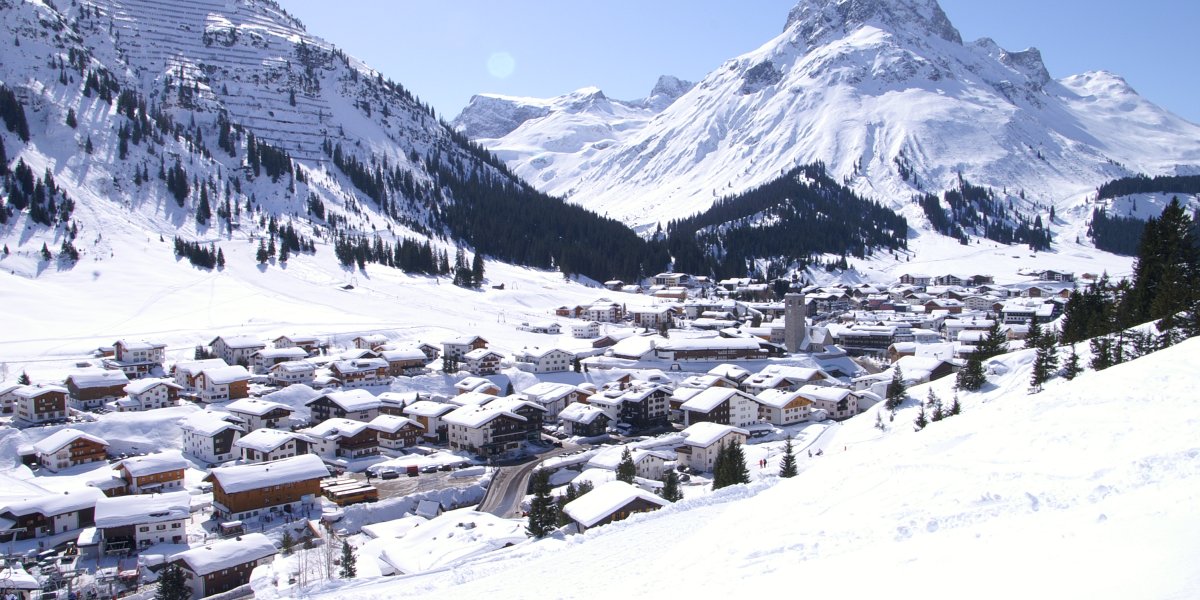
City Guide
Lech am Arlberg
Autriche · Best time to visit: Dec-Apr, Jun-Sep.
Day-by-day plan
Choose your pace
Durée du voyage
08:00
Religious
Start where Lech has gathered for 700 years: the onion-domed parish church whose white tower rises above the Lech River like the village's signature. The 8 a.m. light hits the facade head-on and the square is yours — skiers and hikers haven't left their hotels yet, and the snow on the cemetery wall is still untouched by footprints.
Tip: Stand on the wooden footbridge 30 m east of the church — the postcard angle is the onion dome framed against the Karhorn pyramid. At 8:00 the sun is still low and behind you; by 10:00 it crosses the steeple and you're shooting into glare. The medieval frescoes in the cemetery chapel around the back are visible through the open arcade — you don't need to go in.
Open in Google Maps →09:00
Landmark
Cross the bridge in front of the church and walk 4 minutes south along the river to the Rüfikopfbahn base station — the cable car ride alone is worth coming to Lech for. In eight minutes you climb 1,300 vertical meters to a wind-scoured ridge at 2,362 m where the entire Lechtal opens at your feet: Omeshorn, Karhorn, and on a clear day all the way to the Silvretta glaciers. Walk the 20-minute panoramic loop along the summit ridge — this is the Alpine 'I was here' photo.
Tip: Take the first cabin at 09:00 sharp — by 11:00 the summer hikers and winter ski school groups jam the platform and afternoon haze rolls into the valley. Walk past the summit cross to the small wooden bench on the west side: it's the only Karhorn shot without cable wires in the frame. Skip the Rüfikopf Panoramarestaurant — overpriced and you'll regret filling up before the afternoon climb.
Open in Google Maps →12:30
Food
Ride the cable car back down (15 min) and walk 5 minutes north into the village center to Hagen's — the village butcher every Lech local visits weekly between ski runs. Order the Käsekrainer (cheese-stuffed sausage, €6) with a fresh Brezel (€2.50) and eat standing at the wooden counter outside; €10 buys you the same lunch a Range Rover guest is eating two meters away. Don't sit down for a long meal — you'll lose the afternoon.
Tip: Order at the back grill counter, not the front bakery — the back is where the hot Wurst comes off in under 90 seconds. Ask for süßer Senf (sweet mustard), never ketchup; the locals will judge you. Add a small bottle of Mohrenbräu beer (€3.50) — it's the Vorarlberg brew, only available west of the Arlberg pass.
Open in Google Maps →14:00
Landmark
Walk south from Hagen's across the river bridge and up the Petersboden meadow trail — 35 minutes of steady climbing through wildflower (or snow-covered) Alpine pasture brings you to Rud-Alpe at 1,560 m, the most photographed wooden hut in the Arlberg. The 400-year-old larch-shingle building houses the Hannes Schneider Ski Museum honoring the Lecher who invented the modern Arlberg downhill technique — we're staying outside, where the south terrace frames the hut perfectly against the Wösterspitze peak.
Tip: Do not take the Schlegelkopf chairlift up — the 35-minute walk through the meadow is the experience, and you'll see marmots in summer or arrive with rosy cheeks in winter. The terrace is free to walk on without ordering, but the apple strudel at the outdoor counter (€7) is the one exception worth breaking the 'no long lunches' rule for. The best photo angle is the southeast corner with the hut's larch shingles in the foreground and Wösterspitze framed above the roofline.
Open in Google Maps →16:30
Landmark
Continue contouring east along the high pasture trail for 25 minutes — you'll spot the half-buried concrete dome on the Tannegg ridge long before you reach it. Skyspace Lech is American light-artist James Turrell's gift to the village: a circular underground chamber with a round oculus open to the sky, where the changing afternoon light makes the seamless painted walls shift through colors that have no name. It's the most surprising thing in the Alps and almost nobody on your flight will have heard of it.
Tip: Reservations are mandatory and must be booked in advance via skyspace-lech.com — pick the 17:00 afternoon slot, not the sunset slot (it ends after dinner). Bring a fleece: the chamber stays at 12°C year-round even when it's 28°C in the meadow outside. Lie down on the stone bench rim and look straight up at the oculus — sitting upright is the tourist mistake.
Open in Google Maps →19:30
Food
Walk back down the pasture trail to Lech village — 30 minutes mostly downhill through larch forest with the church bells echoing up the valley as the light fails. s'Pfefferkörndl inside Hotel Pfefferkorn on the main street is where actual Lech locals eat, not the showy hotel restaurants up the hill: a wood-paneled Stube with 14 tables, where the Rehragout (venison goulash, €32) is the dish and the homemade Kasspatzln (alpine cheese spätzle with crispy onions, €24) is what you order if one of you doesn't do game.
Tip: Reserve before you fly into Austria — they take maybe four walk-ins per evening and turn dozens away. Ask for the corner table by the window facing the church. Pair the venison with a glass of Zweigelt from Burgenland (€9) rather than red Tyrolean — the sommelier will respect you. PITFALL WARNING: ignore the signs along the main road advertising 'Tiroler Spezialitäten' with English menus and photographs of every dish — they exist to capture day-trippers, prices run 30–40% above the locals' spots, the meat is rarely from the Vorarlberg side of the pass, and the 'home-made' sticker on the strudel is always a lie.
Open in Google Maps →Aller au jour
09:00
Religious
From the Lech river bridge, walk 3 minutes east along Dorfstraße to the church plaza. This 14th-century Gothic parish church carries the resort's signature silhouette — onion-domed tower framed against the Omeshorn peak — and at 9 a.m. the eastern sun lights the facade just before the bells ring on the hour. Step into the small graveyard behind: the wooden Walser grave markers tell the story of the shepherds who founded Lech 700 years ago.
Tip: Enter through the side door on the north wall, not the main portal — the stone holy-water basin dates to 1390 and most visitors walk past it. Photography is allowed but flash is not, and the wooden choir loft above the entrance is the best angle for the painted ceiling.
Open in Google Maps →10:30
Landmark
Exit the church and walk 8 minutes south across the wooden bridge to the Bergbahn Oberlech base. The glass gondola lifts you 250 m in 8 minutes to Oberlech at 1700 m — the famous car-free hamlet where every hotel is connected by an underground luggage tunnel and only horse sleds and skiers move on the surface. Walk the south-facing promenade between Hotel Goldener Berg and Hotel Sonnenburg for the postcard view back down into Lech valley.
Tip: Buy a single-ride uphill ticket only (€16), not the round-trip — you will descend on foot via Burgwald later. The cabin window facing north (right-hand side going up) gives the unobstructed view of the Omeshorn cliffs.
Open in Google Maps →12:30
Food
From Oberlech follow the wide gravel track signposted 'Rud-Alpe / Schlegelkopf' for 15 minutes downhill through alpine meadows with the Mohnenfluh peak directly ahead. Rud-Alpe is a 400-year-old larch-log alm dismantled in the valley and rebuilt at 1560 m, dark beams polished by generations of shepherds. Order Käsknöpfle, the Vorarlberg cheese spaetzle (€21), and the Kaiserschmarrn caramelized pancake (€16) on the south-facing terrace facing the Wösterspitze.
Tip: Arrive before 12:30 to claim a terrace corner table — no reservations are taken for lunch and the place fills by 13:00. Pair the Käsknöpfle with the house elderberry schorle (€5), not beer; the acidity cuts the cheese fat.
Open in Google Maps →14:30
Museum
Step out of the Rud-Alpe dining room and into the adjoining stone wing — the museum is upstairs, 30 seconds from your lunch table. Hannes Schneider invented the Arlberg ski technique in 1907 right above this valley, making him the father of modern downhill skiing. Original hickory skis from 1900, the U.S. passport he received after fleeing the Nazis to New Hampshire in 1939, and the photo wall of Princess Diana, the Dutch royals and Jordan's King Hussein on the runs outside — all in a single quiet room with no lines.
Tip: Free entry but easy to miss — there is no ground-level sign, just ask Rud-Alpe staff for 'Skimuseum.' The 1907 Schneider technique film loop in the back corner runs only four times daily; ask when the next showing starts so you don't walk past the room's centerpiece.
Open in Google Maps →16:00
Park
Leave the museum the way you came in and pick up the trail marked 'Lech – Burgwald 1h30' opposite Rud-Alpe's wood-stack. The path drops 200 m through high pasture then enters the Burgwald, a larch-and-spruce forest along the Lech river — late afternoon is when the western light hits the Omeshorn cliff face dead-on, turning the limestone amber. The final 20 minutes follow the river back into Lech village, ending exactly at your morning bridge.
Tip: Wear real shoes — the upper section is steep and stays muddy even in summer after morning dew. The single best photo stop is the wooden bench at the 'Burgwald 30 min' sign, where the trail bends and the Omeshorn frames perfectly between two larch trunks.
Open in Google Maps →19:30
Food
From the bridge, walk 4 minutes south along Dorfstraße — Hus Nr. 8 is the cream-colored Walser farmhouse with green shutters on the right. Built in 1590 as the village schoolmaster's home, the dining room keeps the original low ceiling beams and a working cheese cave in the basement that you can visit between courses. Order the Hauseigene Käseplatte, seven local mountain cheeses aged in that cellar (€26), and the Tafelspitz boiled beef with apple-horseradish (€36) — the signature dish of the Arlberg.
Tip: Reserve at least 7 days ahead in season (Dec–Mar, Jul–Aug) — there are only 9 tables. Pitfall warning: avoid the chalet-front restaurants between the bridge and Hotel Post — they charge €38 for a Wiener Schnitzel that locals eat for €22 at Crêperie Schüna two doors down.
Open in Google Maps →09:00
Landmark
Catch the free Lech–Zürs Skybus from the Postamt stop at 08:40 (every 15 min) for the 6-minute ride south to Zürs, then walk 4 minutes from the Zürs stop to the Trittkopfbahn base. The two-stage cable car climbs 1000 m in 7 minutes to the 2423 m Trittkopf summit, where the panorama platform opens onto the Patteriol, Valluga and Hoher Riffler peaks of the Verwall and Lechquellen ranges. Morning is the only time the south face of the Patteriol is in shadow-free light — by noon it backlights.
Tip: Buy a one-way uphill ticket (€18) at the kiosk, not the round-trip — you hike down. The Trittkopf summit cross is 80 m past the cable car exit on the right; almost no one walks out that far, so you get the panorama alone.
Open in Google Maps →11:00
Park
From the Trittkopf cross, follow the broad ridge trail marked 'Trittalpe – Zürsersee' for a gentle 600 m descent over 90 minutes. The path opens onto Zürsersee, a turquoise glacial tarn cradled between the Trittwangkopf and the Madlochjoch — the first of the three lakes that give the Green Ring its name. Wind off the lake drops to nothing between 12:00 and 13:00, when the surface mirrors the Madlochjoch ridge perfectly.
Tip: Take the narrower foot trail along the lake's eastern shore, not the wider one above — the eastern bank has a flat boulder at the south end locals call 'der Spiegel' (the mirror) for its reflection angle. Avoid the lake 14:00–16:00 in summer: thermals kick up white-caps and the reflection is gone.
Open in Google Maps →13:30
Food
Descend from Zürsersee on the marked 'Zürs – Ortskern' path, 25 minutes through alpine pasture into the village; the Walserstube is on the ground floor of the white-and-red Hotel Edelweiss on Zürserstraße. The dining room is a 200-year-old larch-paneled parlor with a green tile stove, and the kitchen runs the most disciplined traditional Walser cooking in the valley. Order the Riebel, buckwheat-cornmeal porridge fried with butter and topped with stewed plum (€18), and the Käsknöpfle Trio of three regional spaetzle styles (€24).
Tip: Request the corner table at the back-right window — it faces the Trittkopf you just descended. The Walserstube serves lunch only until 14:30 sharp; arrive by 13:30 so you have time for the apricot strudel that locals stop in just to eat.
Open in Google Maps →15:00
Park
From the Walserstube door, walk 200 m north on Zürserstraße to the green-and-white 'Grüner Ring – Lech' trailhead opposite the chapel. The 7-km path traces the Zürsbach stream down the valley, passes the Stierlochbach waterfall plunging 40 m through a limestone slot (the trail's emotional centerpiece), then follows the old shepherd's road through larch woods into Lech. The descent is gentle — 350 m down across 2 hours — and the late-afternoon light catches the waterfall spray as rainbow from the wooden viewing platform.
Tip: Cross the wooden footbridge above the Stierlochbach falls, not below — the upper angle frames the waterfall with the Omeshorn peak behind, the iconic Green Ring shot. The trail ends at the Lech tennis courts; turn left along the river to reach the village center in 8 minutes.
Open in Google Maps →18:00
Park
Pick up the Lechweg path at the eastern end of Dorfstraße and follow the river upstream for 1 km past 14 contemporary sculptures commissioned from Vorarlberg artists — granite, larch and steel pieces sited so the mountains compose the background. The trail ends at the 1738 Allerheiligen wooden footbridge, the oldest surviving structure in the valley, where the locals come for sunset photos with the church tower beyond. Alpenglow on the Omeshorn typically peaks 45 minutes before sunset, around 19:00 in summer and 16:30 in winter.
Tip: The third sculpture, 'Steinwand' by Marbod Fritsch, reveals its shadow text only in the last 20 minutes before sunset — most visitors walk past it as a plain block. Stand 4 m east of it to read 'Hier oben' carved by the light.
Open in Google Maps →19:30
Food
From the Allerheiligen bridge, walk 4 minutes north on Tannberg toward the village center — Achtele is the green-shuttered townhouse on the left, just past Hotel Tannbergerhof. The 18-seat wine-restaurant is run by sommelier Albert Walch from a 100-year-old Walser building, and the handwritten menu changes weekly around Vorarlberg producers. Order the Bergkäse Tasting flight, five mountain cheeses with house chutney (€32), and the Lammrücken aus dem Großen Walsertal, lamb saddle from the next valley with thyme jus (€48).
Tip: Achtele opens at 18:30 but only seats from 19:00; arrive 19:00 sharp for the corner banquette under the wine wall and ask Albert to pair from open bottles — the by-the-glass list of 30 Austrian whites changes daily. Pitfall warning: skip the late-night après-ski clubs around Hotel Krone — covers run €35 just to enter, music ends at 02:00 with no last bus, and a night taxi back to most hotels is €40.
Open in Google Maps →
Trip builder
Plan this trip around Lech am Arlberg
Turn this guide into a bookable rail itinerary with FlipEarth.
Keep exploring
Related cities
More in the same country
FAQ
Frequently asked questions
How many days do you need in Lech am Arlberg?
Most travelers enjoy Lech am Arlberg in 1 days, with enough time for headline sights and a slower meal or museum stop.
What's the best time to visit Lech am Arlberg?
The easiest season for most travelers is Dec-Apr, Jun-Sep, especially if you want good weather and manageable crowds.
What's the daily budget for Lech am Arlberg?
A practical starting point is about €160 per person per day before hotels, then adjust based on museums, dining, and transport.
What are the must-see attractions in Lech am Arlberg?
A good first shortlist for Lech am Arlberg includes Rüfikopf Cable Car & Summit Ridge, Rud-Alpe Hut (Hannes Schneider Ski Museum Exterior), Skyspace Lech by James Turrell.