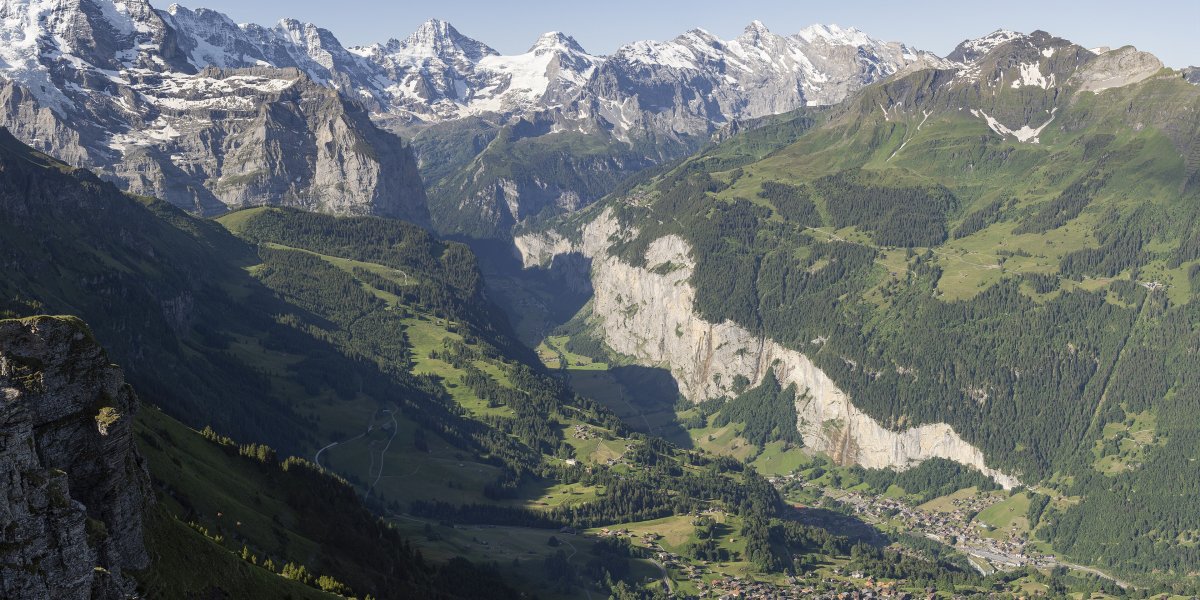
City Guide
Lauterbrunnen
Suisse · Best time to visit: Jun-Sep.
Day-by-day plan
Choose your pace
Durée du voyage
08:00
Neighborhood
From Lauterbrunnen station, take the BLM funicular up to Grütschalp (a 4-minute lift through forest), then the panoramic mountain train 14 minutes along the cliff edge into Mürren — drop your luggage in a locker at the station first if you have any. The first 200 m past Mürren station give you the canonical Bernese Oberland postcard: the Eiger–Mönch–Jungfrau wall directly across the valley at eye level, the cliff falling 800 m at your feet, and almost no one around at this hour. Walk south down Allmendstrasse past the old wooden chalets to the open meadow at Stäger — that's the unobstructed shot.
Tip: Buy a one-way ticket to Mürren only (CHF 12.40) — you are walking down, not returning this way. Sit on the LEFT side of the train from Grütschalp into Mürren; the entire Jungfrau wall opens on that side and 90 percent of travelers sit right by mistake. Avoid the 09:30 train up — that's when the Interlaken day-tour buses arrive.
Open in Google Maps →10:30
Park
From the south end of Mürren follow the signed path 'Gimmelwald 30 min' — a paved cliff-edge route with the Eiger, Mönch, and Jungfrau staring at you the entire way and almost no tourists, because everyone else takes the cable car. Thirty wooden farmhouses, 130 residents, no cars: Gimmelwald is the most authentically alpine village you will ever set foot in, and the cowbells are louder than the human voices. From Gimmelwald the trail turns into the steep Sefinental switchbacks and drops 600 m through pine forest to the valley floor at Stechelberg in 90 minutes.
Tip: Going down on foot is non-negotiable here — every Instagrammer takes the Schilthornbahn cable car and you'll have the cliff trail almost to yourself. In Gimmelwald look for the unattended honesty fridges outside the farmhouses: locals leave fresh alpine cheese for CHF 5 a slice, leave correct coins in the wooden box. Wear shoes with grip; the last kilometer below Gimmelwald is loose rock and slippery after rain.
Open in Google Maps →12:30
Food
At the trail's end where the asphalt restarts, Hotel Stechelberg sits 100 m to your left next to the Schilthornbahn valley station — wooden balcony, geraniums, the giant chestnut tree out front. This is mountain comfort food the way farmers eat it: Berner Rösti with two fried eggs and bacon (CHF 24), Älplermagronen pasta with caramelized onion and apple sauce (CHF 22), Rugenbräu lager from Interlaken on tap. Eat on the terrace facing the Jungfrau, not inside.
Tip: Skip the menu and order the Älplermagronen (CHF 22) — pasta + cream + alpine cheese + crispy bacon + caramelized onion, with the applesauce on the side that you actually mix in. Arrive by 12:15 — the Schilthorn day-tour buses flood the terrace at 12:45 and after that you wait 40 minutes for a rösti. Pay cash; the card machine here has been 'broken' for three years.
Open in Google Maps →14:00
Landmark
From the hotel terrace walk back to the valley road and head north toward Lauterbrunnen — 2.5 km along the Weisse Lütschine river, flat the whole way, about 35 minutes. The Trümmelbachfälle entrance is on your right behind a small parking lot; a tunnel elevator carved inside the mountain lifts you to the top of ten glacier-fed waterfalls thundering through caves in the rock — 20,000 liters per second of meltwater from the Eiger, Mönch and Jungfrau, the only subterranean waterfalls in Europe open to the public.
Tip: Ride the elevator straight to the top (Galerie 10) first, then walk back down through all ten levels — going up against the flow of the tour groups means you stand alone at the most violent upper falls. The temperature inside drops to 8°C even in August so bring a layer; the spray will soak your camera lens in seconds, so phones in a ziplock and shoot through the plastic. Closed mid-November to early April — the meltwater stops in winter.
Open in Google Maps →16:30
Landmark
Back out to the valley road, walk north 3 km on the riverside path — the Weisse Lütschine on your right, 800 m vertical cliffs left and right, and after 35 minutes the village rolls into view with Staubbach plunging 297 m off the cliff straight behind the church spire. Late-afternoon western sun lights the falls head-on and on clear days a rainbow holds in the spray from about 16:30 to 18:00. Take the 15-minute switchback stairs behind the church to walk into the rock gallery directly behind the falling water.
Tip: The real postcard angle — Staubbach framed above the church spire — is from the small bridge on Stutzligasse 100 m north of the church, not from the village center where 90 percent of travelers shoot a worse version. The walk-behind gallery closes after the first snowfall (usually mid-October) and reopens late May, and it's slippery wet rock all summer — grippy soles, no flip-flops. Skip the gondola-shaped souvenir shops on Hauptstrasse charging CHF 6 for a magnet; the Coop on the main road sells the identical one for CHF 2.50.
Open in Google Maps →19:30
Food
From the Staubbach footbridge walk 5 minutes south back along Hauptstrasse — Hotel Oberland is the broad wooden chalet on your left just past the church, the one with the red shutters and the carved balcony. This is where Lauterbrunnen locals actually eat: three-cheese fondue moitié-moitié (CHF 32 per person, Gruyère + Vacherin, the correct Fribourg ratio), Berner Platte sausage and sauerkraut (CHF 28), Eringer beef tartare from the black combat cows of Valais. Slow service, wood-panelled stube, the way it should be.
Tip: Reserve by phone the night before (+41 33 855 12 41) — the wooden stube has 12 tables and walk-ins are refused after 19:30 from June to September. Order the fondue moitié-moitié (CHF 32 per person, two-person minimum) — it's the regional ratio of Gruyère to soft Vacherin, not the touristy all-Gruyère blend you'll get elsewhere. Pitfall warning for the village: any restaurant on Hauptstrasse with a sandwich-board menu translated into six languages with food photos is a day-tripper trap charging CHF 35 for frozen industrial rösti — the local rule is if the menu has pictures, walk past it.
Open in Google Maps →
Trip builder
Plan this trip around Lauterbrunnen
Turn this guide into a bookable rail itinerary with FlipEarth.
Keep exploring
Related cities
More in the same country

FAQ
Frequently asked questions
How many days do you need in Lauterbrunnen?
Most travelers enjoy Lauterbrunnen in 1 days, with enough time for headline sights and a slower meal or museum stop.
What's the best time to visit Lauterbrunnen?
The easiest season for most travelers is Jun-Sep, especially if you want good weather and manageable crowds.
What's the daily budget for Lauterbrunnen?
A practical starting point is about €120 per person per day before hotels, then adjust based on museums, dining, and transport.
What are the must-see attractions in Lauterbrunnen?
A good first shortlist for Lauterbrunnen includes Trümmelbach Falls, Staubbach Falls.