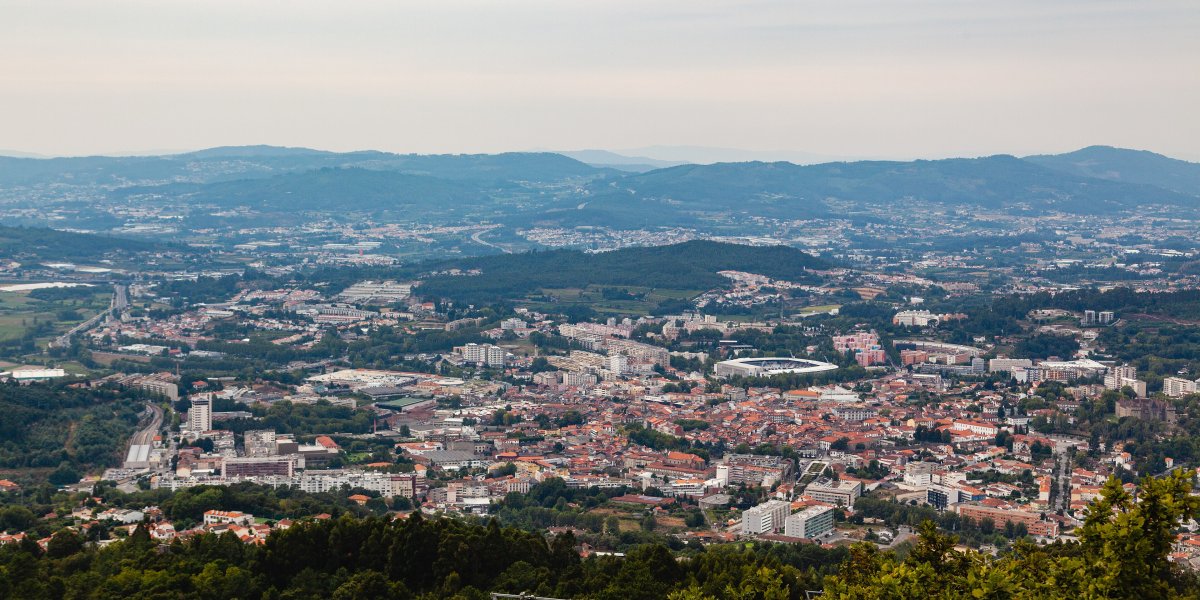
City Guide
Guimaraes
Portugal · Best time to visit: May-Sep.
Day-by-day plan
Choose your pace
Durée du voyage
09:30
Landmark
From the train station, walk 15 minutes northeast through the old town along Rua de Santa Maria — the cobblestones steepen at the end as the medieval keep rises into view. Arrive right at opening to beat the Porto tour buses that fill the courtyard by 10:30. The blunt granite keep silhouetted against the green hillside is the image you came for — circle the exterior walls for the classic shot, no entry needed.
Tip: Skip the paid keep climb — the interior is a one-room display not worth losing 30 minutes over on a tight day. The best photo angle is the north slope looking back at the keep with the bronze equestrian Afonso Henriques in the foreground; morning sun lights the south face of the tower directly.
Open in Google Maps →10:45
Landmark
Walk south 2 minutes through the pine grove between the castle and the palace — the tiny Romanesque chapel on your path is Igreja de Sao Miguel do Castelo, where Afonso Henriques was baptized in 1106 (door is open, free, two minutes inside is plenty). The 15th-century ducal palace beyond it is one of Portugal's most photographed buildings, with its forest of brick chimneys above grey stone. Walk the full perimeter to the southern garden where the iconic frame opens up.
Tip: The chimneys-and-statue composition works best around 11:30, when the sun is east of the building and lights the south facade head-on. From the garden's southeast corner, line up the chimneys behind the equestrian statue — it compresses 900 years of Portuguese history into one frame.
Open in Google Maps →12:15
Landmark
Walk downhill 5 minutes via Avenida Alberto Sampaio — the surviving section of medieval city wall runs along your right side as you descend. Halfway down, the inscription 'AQUI NASCEU PORTUGAL' (Portugal Was Born Here) is carved deep into the stone: the most patriotic photo in the country, the line every Portuguese child memorizes. The whole stop takes 10 minutes plus photos.
Tip: Cross to the opposite sidewalk to fit the full inscription in frame — standing directly underneath crops the words. Morning light from the east hits the carving square-on; after 13:00 the wall falls into shadow and the letters lose depth. Shoot vertically with the wall filling the right two-thirds of frame for the best result.
Open in Google Maps →13:00
Food
Continue south 5 minutes to Largo do Toural — the broad arcaded square at the foot of the old town. Cervejaria Martins, open since 1930, sits on the southwest corner; locals stand at the marble counter for cold imperial beers and Portuguese petiscos with no ceremony. This is fast, honest, unpretentious — the opposite of the tourist menus laminated in the next street.
Tip: Order a bifana (pork-in-a-roll, 3.50€) and a rissol de camarao (shrimp turnover, 1.80€), paired with an imperial beer (1.50€). Stand at the counter — table service costs extra and the counter is where regulars eat. You'll be out in 40 minutes for under 15€.
Open in Google Maps →14:30
Neighborhood
Walk north 3 minutes through the medieval gate into Largo da Oliveira — the UNESCO heart of the old city. The Gothic stone shrine at the centre is Padrao do Salado, a 14th-century battle memorial; behind it stands the Igreja Nossa Senhora da Oliveira. Step through the arch into adjoining Praca de Santiago, ringed by 15th-century houses with overhanging wooden balconies — the most photographed street view in northern Portugal. Take afternoon coffee here while the slanted light warms the granite facades.
Tip: Order coffee at one of the small cafes facing Praca de Santiago, not the large terraces on Largo da Oliveira — same coffee, half the price. A bica from a takeaway window is 0.80€; the identical espresso on the Largo terrace is 2.50€ plus a forced 'cover charge' for bread you didn't order.
Open in Google Maps →18:30
Food
Walk north 3 minutes onto Rua de Santa Maria, the medieval spine of the old town with its low arches and worn granite paving. Solar do Arco occupies a 17th-century mansion built straight into a stone archway over the street — eat under the arch in summer or in the wood-panelled dining room year-round. Traditional Minho cooking, properly executed, served by people who have done this for two generations.
Tip: Reserve in advance (fills with locals Friday-Saturday). Order Vitela a Moda de Guimaraes (veal in red wine reduction, 18€) and Bacalhau com Broa (cod under a corn-bread crust, 17€), paired with a Vinho Verde tinto. Pitfall warning: do NOT eat on Largo da Oliveira itself — the terrace restaurants there mark up standard menus 40% and reheat plates for the bus crowds. One street north on Rua de Santa Maria, prices drop and quality jumps.
Open in Google Maps →
Trip builder
Plan this trip around Guimaraes
Turn this guide into a bookable rail itinerary with FlipEarth.
Keep exploring
Related cities
More in the same country
FAQ
Frequently asked questions
How many days do you need in Guimaraes?
Most travelers enjoy Guimaraes in 1 days, with enough time for headline sights and a slower meal or museum stop.
What's the best time to visit Guimaraes?
The easiest season for most travelers is May-Sep, especially if you want good weather and manageable crowds.
What's the daily budget for Guimaraes?
A practical starting point is about €90 per person per day before hotels, then adjust based on museums, dining, and transport.
What are the must-see attractions in Guimaraes?
A good first shortlist for Guimaraes includes Castelo de Guimaraes, Paco dos Duques de Braganca, Aqui Nasceu Portugal Wall.