City Guide
Budva
Monténégro · Best time to visit: May or September.
Day-by-day plan
Choose your pace
Durée du voyage
09:00
Landmark
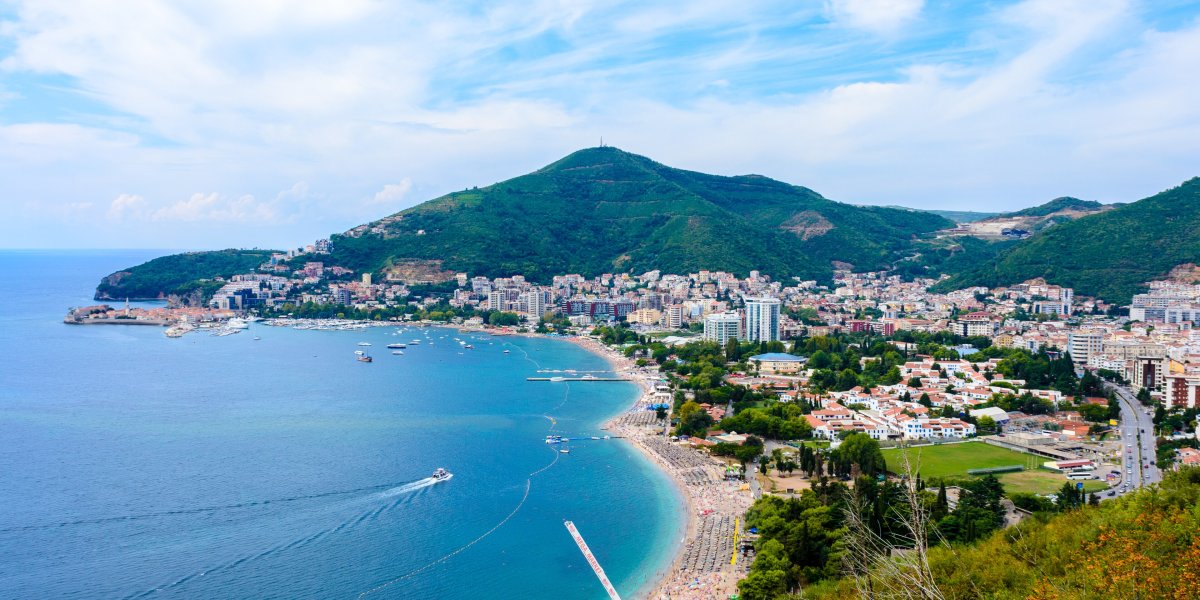
Begin at the western end of Slovenska Plaža promenade, where the paved path narrows and the Ballerina appears on her rock — Budva's bronze symbol, arms raised toward the Adriatic. Continue past her through the natural tunnel cut into the cliff to Mogren I, then over the wooden bridge to the smaller pebble cove of Mogren II, with the Stari Grad walls visible across the bay. At 9am the rocks are quiet and the morning sun hits the statue from behind — the only window for silhouette shots before the day-trippers arrive.
Tip: Arrive before 9:30 — by 10am cruise groups crowd the rock and the queue for the statue photo backs up. The textbook angle is from the path 15 meters east, framing the dancer against open sea (not back toward the hotels). Skip the algae-stained tunnel route if the sea is rough; the wooden bridge between Mogren I and II is the dry alternative.
Open in Google Maps →10:30
Neighborhood
Loop back along the same rocky coastal path, the old town walls now growing in front of you — 10 minutes along the seafront brings you to the Sea Gate. Inside, the polished marble alleys of the 2,500-year-old walled town are barely 200 meters across: pass Sveta Trojica Church with its pink-and-white banded stone, the small ruined Santa Maria in Punta on the seaward edge, and the worn medieval coat of arms above every doorway. Wander without a map — every lane leads back to the central square within four minutes.
Tip: Enter via the Sea Gate, not the inland Main Gate — the seaside arch frames the bell tower for the iconic first photo, and most tour groups arrive at the opposite gate. The free rampart section beside Sveti Ivan Church gives you a panorama of red roofs at no cost; save your ticket money for the Citadela cannons next, where the view is genuinely better.
Open in Google Maps →12:00
Landmark
From the central square, follow the alley south past Sveta Trojica — 3 minutes to the Citadela entrance at the southern tip of the walls. Skip the small interior library and open-air theatre; the only reason you're here is the upper cannon platform, where the ramparts drop straight into the sea and Sveti Nikola island floats offshore. From this corner you can see the entire 5 km coastal arc you'll walk this afternoon, all the way down toward Sveti Stefan.
Tip: €5 cash entry, opens 9:00 — climb straight up the stone stairs and head to the southwest cannon. That vantage, with Sveti Nikola behind and terracotta roofs in the foreground, is the single best photo of Budva. The interior library and stone theatre take 2 minutes combined; don't let them eat your time.
Open in Google Maps →13:00
Food
Step down from the ramparts, out the Main Gate and into the open square — the bakery is two minutes north toward the marina. This is where Budva actually eats lunch: a counter of fresh-baked burek in metal trays, sold by weight, with a few high tables outside on the pavement. Order a wedge of sirnica (cheese burek, around €3) and a slice of the meat pita (around €3), eat standing — total bill under €8 versus €25 for an identical-quality lunch inside the walls.
Tip: Order the cheese sirnica, not the meat — the cheese-to-pastry ratio is what locals queue for, and it's still hot from the morning bake. Pair with a half-liter bottle of kefir (salty yogurt drink, €1); sounds strange, perfect with warm pastry. The trays empty by 14:00 — go before 13:30 or you'll get the leftover meat pita nobody wanted.
Open in Google Maps →14:30
Landmark
Head south along the Slovenska Plaža promenade — the paved coastal walkway runs unbroken for 5 km through the hotel zone of Bečići, up over a low pine ridge to the turquoise pebble cove of Kamenovo, down to the fishing village of Pržno, and finally rounds the headland to the postcard viewpoint of Sveti Stefan. Take it slowly: stop for a free swim at Kamenovo (clear water, almost no crowds), grab a gelato in Pržno's tiny piazza, and arrive at the upper viewpoint by 17:30, when the western sun lights the terracotta roofs of the islet from behind and the causeway glows pink.
Tip: The real viewpoint is the unmarked widening on the main road above the islet — pass the first crowded balcony (always packed with tour buses) and walk 50 meters further south for an identical view with no heads in your frame. The islet itself is a private Aman hotel and closed to the public; don't waste 20 minutes walking down to the locked causeway gate. Wear sneakers — 5 km in sandals will end your day.
Open in Google Maps →19:00
Food
Descend from the viewpoint and follow the coast road around the bay — 5 minutes brings you to Adrović, a family-run terrace cut into the hillside directly opposite Sveti Stefan. Every table looks across the water at the floodlit islet, and the kitchen still serves Adriatic-caught fish at honest prices. Order the buzara mussels in white wine and garlic (€18) and a whole grilled sea bass priced by weight (around €22 for a 400g fish), with a half-liter of Vranac, the dark Montenegrin red.
Tip: Reserve a terrace table 24 hours ahead — without a booking after 19:30 you'll be seated indoors and miss the islet view that's the whole point. Ask the staff to fillet the fish at the table; they do it cleanly in 30 seconds. Pitfall warning: the row of nearly identical-looking restaurants at the main Sveti Stefan parking turnoff charge €40+ for the same sea bass and the fish is frozen — Adrović is worth the extra five-minute walk past them.
Open in Google Maps →Aller au jour
09:00
Landmark
Enter Stari Grad through the seaside main gate and head straight up to the Citadela — the medieval fortress crowning the old town's tip. At nine sharp you're climbing alone while morning sun rakes warm light across the honey-colored walls below; the cruise crowds won't push through until ten-thirty. From the seaward bastions the entire Adriatic curve opens in one frame — beach, mountains, terracotta rooftops, and the green Sveti Nikola islet floating offshore.
Tip: Skip the cramped maritime museum inside — three faded prints aren't worth your time. Walk straight to the cannons on the south rampart: old town below, Sveti Nikola dead-center, the postcard shot of the whole trip.
Open in Google Maps →10:45
Neighborhood
Descend from the Citadela into stone passages barely shoulder-wide — morning light slants down between the walls in clean golden shafts. You'll pass the 12th-century Church of St. John, find the hidden square Trg između crkava where three different bell towers face each other across thirty paces of cobble, and end on the seaward city-wall walk where the Adriatic crashes one storey below.
Tip: The single-best photo in Stari Grad is the alleyway behind the Church of St. Mary — stand inside the alley and frame the bell tower against a triangle of blue sea between two buildings. No guidebook lists this angle.
Open in Google Maps →12:30
Food
Step out of the seaward wall and you're at the door — Konoba Stari Grad has held this corner for decades, tables set against the medieval ramparts with the Adriatic licking the rocks below. Order crni rižoto (black squid-ink risotto, €14) and a half portion of buzara mussels (€12) — both Montenegrin staples done properly, with the local Vranac red by the carafe.
Tip: Arrive 12:25 sharp for the terrace tables on the rampart side — they hold three for walk-ins, and once gone you're stuck in the windowless interior. Decline the laminated 'tourist menu' and ask for the daily-chalkboard one — same kitchen, half the price.
Open in Google Maps →14:30
Museum
Walk five minutes back into the old town's quietest corner — the museum sits in a four-storey stone palace on Petra I Petrovića Street, easy to miss from the alley. Budva is 2,500 years old, and here is what's been pulled from under your feet: Greek pottery, Roman bronzes, an Illyrian helmet, a Hellenistic gold diadem. The cool stone interior is exactly what your legs need after the midday sun.
Tip: Skip floors one and two (minor modern paintings) and go straight to the basement — that's where the real treasure lives: the 5th-century BC Greek silver belt and the Hellenistic blown-glass perfume bottles. English captions are on the right of each case, not the front.
Open in Google Maps →16:30
Park
Exit the old town through the west gate and follow the cliff path — 600 meters along the rocks with the sea crashing one storey below, past the bronze 'Ballerina' statue and through a short rock tunnel that opens to Mogren I, then Mogren II. By four-thirty the sun has moved west, the water is its warmest of the day, and the south-facing sand is still in full light — locals call this the golden hour for swimming.
Tip: Walk past Mogren I (closer, packed with €15 sunbeds) and through the tiny rock tunnel to Mogren II — half the crowd, free spots on the right side against the cliff, exact same crystal water. The tunnel is unsigned; look for the painted blue arrow on the rock.
Open in Google Maps →19:30
Food
Walk back along the Slovenska Plaža promenade — 15 minutes east of old town, the seafront opens up and Jadran's white tablecloths appear from far off. This is where Montenegrins from Podgorica drive in to eat fish on Friday nights: the daily catch is laid out on ice, you point at your fish, they weigh it and grill it whole. Brancin (sea bass, €55/kg) with grilled blitva is the move — about €40 for a generous one-kilo fish shared between two.
Tip: Reserve after 16:00 — ask specifically for 'donja terasa' (lower terrace, closest to the water). The fish display is real, point at the one you want and watch them weigh it in front of you. PITFALL: avoid the cluster of restaurants on the central Slovenska promenade — menus in eight languages, waiters chasing pedestrians, prices doubled, quality halved. Any restaurant with food photos on its sign: walk past.
Open in Google Maps →09:00
Landmark
Take a 10-minute taxi from Budva (€8-10) south along the Adriatic Magistrale and ask the driver for 'vidikovac Sveti Stefan' — the official viewpoint just north of the islet. You're here at nine because the morning sun rises from the east-southeast, lighting up the rose-colored stones of the islet head-on; by noon the sun is overhead and the photos go flat. This is the most photographed view in all Montenegro — your first sight of it stops you mid-step.
Tip: The marked viewpoint with the parking lot is fine — but walk 80 meters further south until the road bends. There's a small clearing on the cliff edge with NO railing in the frame — that's where the calendar shot is made. Use 0.6x ultrawide on your phone to fit the whole sweep.
Open in Google Maps →10:15
Religious
From the viewpoint, take the small road inland — a 1.2-km climb up through olive groves and pines, about 25 minutes of switchbacks. You'll hear cicadas, smell wild fennel, watch the islet shrink below you with each turn. The 13th-century Praskvica Monastery sits hidden in a fold of the hill: two old stone churches, three monks' cells, a well, and almost always one Serbian Orthodox monk who speaks slow English.
Tip: Knock on the door of the smaller church (St. Nikola) — if locked, ask the monk in the cells for the key. Inside are 17th-century frescoes blackened by candle soot, never reproduced in any guidebook. Leave a €2 coin in the wooden box by the door on your way out — it's not a fee, it's good manners.
Open in Google Maps →12:30
Food
Walk back down the hill (20 minutes, knees-friendly direction) and continue south to the Hotel Adrović — its restaurant terrace is the only place in Sveti Stefan where you eat with the entire islet floating perfectly framed below. Order njeguški pršut (smoked Montenegrin ham from the mountain village of Njeguši, €14) with local kajmak cheese and grilled squid with chard (€20). The view alone is worth twice the bill.
Tip: Request 'stol na donjoj terasi' (table on the lower terrace) — three tables are positioned with the islet dead-center in the stone railing frame. Skip the bottled wine list and ask for the house Vranac by the carafe (€8/half-liter) — same grape, a third the price, served chilled.
Open in Google Maps →14:30
Park
Cross the road below the restaurant and enter Miločer Park through the wrought-iron gate — a 5-minute walk into the former Karađorđević royal summer residence's grounds. The park is 200-year-old Aleppo pines and 800-year-old olive trees; the gravel path opens onto King's Beach (Kraljevska Plaža), 130 meters of pink-tinged pebbles backed by the king's white villa. Afternoon shade falls across the sand and the sea breeze cools you after the climb to Praskvica.
Tip: Queen's Beach (Kraljičina Plaža) on the south side is reserved for Aman Sveti Stefan guests — security will turn you back at the gate. King's Beach is fully public and looks essentially identical, with the bonus that you can sit under the same 600-year-old olive trees the royal family planted in the 1930s.
Open in Google Maps →16:30
Neighborhood
Follow the coastal path north from Miločer — 15 minutes along the rocks, past two small coves, until it opens onto Pržno Bay. Pržno is the village Budva would be if it had stayed small: one cobbled street, twelve fishing boats, a 200-meter strip of sand-and-pebble beach. At five-thirty the sun sits low on the western horizon, and the light bouncing off the water turns the Sveti Stefan islet (visible to the south) a deep rose-gold.
Tip: Walk to the rocky outcrop at the southern end of Pržno Beach — the locals call it the sunset rock. From here you frame Sveti Stefan in the same shot as the setting sun, the only spot in Montenegro that gives you both compositions in one frame. Bring shoes, the rocks are sharp.
Open in Google Maps →19:30
Food
Walk ninety seconds from the sunset rock — Konoba Langust sits two doors from the water on the village's only street, blue shutters, sea-spray-aged stone walls. This is a working fisherman's restaurant: the catch is whatever came in that morning. Order the ribarska plata for two (fisherman's plate, €70) — five kinds of seafood grilled over olive wood, served with blitva (Swiss chard sautéed in garlic and olive oil) and homemade bread.
Tip: Reserve 48 hours ahead in summer — they have 14 tables and the front four go to regulars. Ask for the 'fjaka menu' (chef's choice) if you want to be properly fed without choosing. PITFALL: Sveti Stefan-side restaurants near the causeway charge a 30-40% 'view premium' for the same fish — Pržno gives you the same Adriatic, the same boats, and dinner for two-thirds the price. Last bus to Budva is 22:30; otherwise a taxi is €10 flat.
Open in Google Maps →
Trip builder
Plan this trip around Budva
Turn this guide into a bookable rail itinerary with FlipEarth.
Keep exploring
Related cities
More in the same country
FAQ
Frequently asked questions
How many days do you need in Budva?
Most travelers enjoy Budva in 1 days, with enough time for headline sights and a slower meal or museum stop.
What's the best time to visit Budva?
The easiest season for most travelers is May or September, especially if you want good weather and manageable crowds.
What's the daily budget for Budva?
A practical starting point is about €90 per person per day before hotels, then adjust based on museums, dining, and transport.
What are the must-see attractions in Budva?
A good first shortlist for Budva includes Ballerina of Budva Statue & Mogren Beach Path, Citadela Fortress, Coastal Walk to Sveti Stefan Viewpoint.