City Guide
Groningen
Netherlands · Best time to visit: May-Sep.
Day-by-day plan
Choose your pace
Trip length
09:00
Landmark
Exit Hoofdstation's south side and cross the Verbindingskanaal footbridge — the building hits you the moment you reach the other side: Mendini, Starck, Coop Himmelb(l)au and de Lucchi each got a piece, and the result is an unapologetic clash of yellow, red and gold rising straight out of the canal. The east face catches morning sun perfectly; circle the building clockwise on the surrounding footbridge to collect every angle in about forty minutes. You won't go inside — outside is the whole point.
Tip: Stand on the small island bridge at the building's southeast corner around 09:30 — the canal acts as a mirror and you get a perfectly symmetrical shot before the tour groups arrive at 10:00. Don't waste time looking for an angle without scaffolding on the yellow tower; the chaos is the photo.
Open in Google Maps →09:55
Neighborhood
Head north over the Folkingebrug and Folkingestraat begins the moment you step off the bridge — voted the most beautiful shopping street in the Netherlands, and it makes the case in thirty seconds: independent bookshops, antique dealers, leather workshops, and the marble facade of the old synagogue at no. 60 still marking the heart of Groningen's pre-war Jewish quarter. Walk slowly all 400m, then loop back along Brugstraat to the canal-side Hoge der A — the gabled warehouse fronts here are the postcard view of merchant-era Groningen.
Tip: Look down as you walk — bronze Stolpersteine cobblestones name deported Jewish residents in front of the houses where they lived. The bakery at Folkingestraat 47 sells warm stroopwafels straight off the press; sandwich one between your fingers and eat it walking. Most visitors miss the synagogue facade entirely because it's tucked between two shops — slow down at no. 60 and look up for the Star of David in the tile above the door.
Open in Google Maps →12:30
Food
From the canal, cross back east into the Vismarkt and Land van Kokanje sits a few doors south of the leaning A-Kerk tower — exposed brick, communal tables, chalkboard menu, the kind of place Groningen students bring visiting parents. Order the truffle-mayo croque madame (€12.50) or the slow-roasted pork sandwich with apple chutney (€11), and a Groningse koffie — strong filter with a small shot of jenever on the side, €6. Plates land in twelve minutes; you eat, you go.
Tip: Aim for the long window counter facing the A-Kerk — you eat lunch staring at a 750-year-old leaning church tower, and they don't need a reservation before 12:45 even on weekends. Skip the dessert menu; you'll want room for stroopwafel ice cream at the tower later. Cash isn't accepted anywhere in Groningen lunch spots — tap-to-pay or contactless card only.
Open in Google Maps →13:45
Landmark
Cross the Vismarkt diagonally and walk east on Akerkstraat — four minutes and you're at the foot of the tower on Grote Markt. The 97m brick spire has stood since 1482 and survived two collapses; the 260-step climb is steep, narrow, and absolutely worth it. From the top you see the entire flat green of Groningen province stretching to the horizon, the white sail-dots of the Wadden Sea on clear days, and directly below you the red-tile maze of the medieval centre you just walked.
Tip: Buy the ticket at the small shop at the tower's base, not online — same €6 price but no time slot, and the queue between 14:00 and 15:00 is the shortest window of the day (groups go up at 11:00 and 16:00). Climb empty-handed; the spiral is too tight for backpacks worn on the front. The carillon plays every 15 minutes — time your descent to be on the staircase, not the bell deck, when the hour strikes.
Open in Google Maps →15:30
Park
From the tower base, head north up Oude Ebbingestraat for 600m, then cut left through the iron gate into the Prinsentuin — a walled 17th-century renaissance herb garden that almost no day-tripper finds, free to enter through summer. Exit the north gate, cross Noorderbinnensingel, and the Noorderplantsoen opens up: 14 hectares of English landscape park draped over Groningen's old defensive earthworks, with curving paths past the bastion mounds, two duck ponds, and clear views back to the Martinitoren spire. Walk the full perimeter — this is where you put in the kilometres and feel the rhythm of a Dutch student city.
Tip: Walk the perimeter clockwise starting from the southeast corner — late-afternoon sun hits the white wooden footbridges at the north end around 17:00, which is the picture every Groningen postcard is trying to take. Café de Toeter inside the park serves the cheapest cold beer in the city centre (€3.50 for a half-litre of Hertog Jan); take it to the lawn between the two ponds and you've found the local hangout. Skip the rose garden in the southwest — overgrown most of the year and not worth the detour.
Open in Google Maps →19:30
Food
Retrace Oude Ebbingestraat south back to the tower and 't Feithhuis sits in the cobbled courtyard of the Martinikerkhof, in a 17th-century canon's house with a wisteria-covered terrace tucked directly behind the church you climbed that afternoon. This is where Groningers come for an unhurried evening — order the gestoofde rundvlees (slow-cooked beef in Groninger dark beer, €26) or the pan-seared zeebaars with samphire from the nearby Wadden (€29), and finish with a glass of local Hooghoudt jenever distilled three blocks away. Watch the floodlights flick on against the Martinikerk wall around 21:30 in summer; this is the moment the day earns its name.
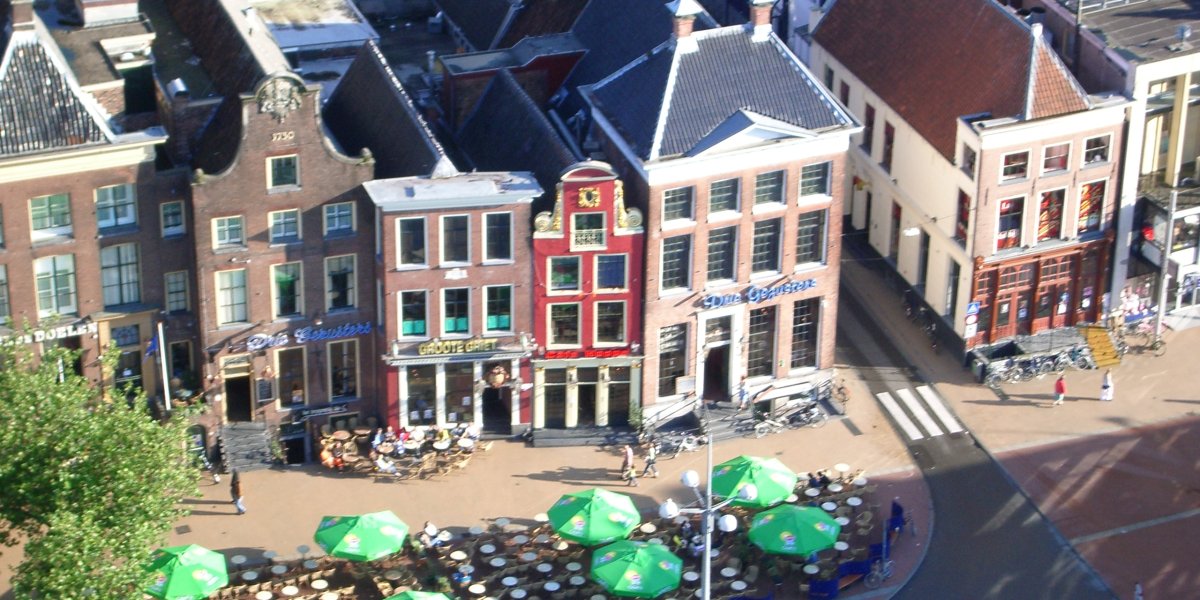
Tip: Phone ahead for a courtyard table after 19:30 — they rarely seat the terrace for walk-ins, and the indoor room is half the experience. Pitfall warning: skip the big terraces on Grote Markt's east side (De Drie Gezusters and its neighbours, plus the chain Italian on the corner) — central-looking, but coach-group prices, microwave kitchens, and house wine that arrives warm; 't Feithhuis is the same five-minute walk and a completely different planet. Avoid the bicycle-rickshaw drivers waiting at the church door on the way out — they quote €5 and charge €25, walk to the station instead.
Open in Google Maps →Jump to day
10:00
Park
Start at the iron gates on Martinikerkhof and slip into a 17th-century walled garden hidden behind the old Prinsenhof palace. The Renaissance parterres, herb beds, and a 1731 sundial inscribed 'Tempus praeterit more fluentis aquae' make for a quiet warm-up before the tourist day wakes up. Free entry, daily April-October.
Tip: Enter through the small side gate on Turfsingel — guidebooks send everyone to the main gate and the side entry draws zero crowds. The sundial sits in the northeast corner near the tea house; ask the gardener for the translation if they're around.
Open in Google Maps →11:00
Landmark
Exit the gardens south through the side gate — the spire is dead ahead, 2-minute walk down Martinikerkhof. At 97m, 'Old Martin' is the tallest medieval tower in northern Netherlands; 260 spiral steps climb past the carillon to a viewing deck where Forum's striped facade and the flat Wadden horizon both come into view. Climb now while your legs are fresh.
Tip: Book online via the VVV website — Saturday walk-up queues hit 40 minutes by noon. Time the climb to the half hour: the 62-bell carillon plays a full tune while you're inside the stone shaft, and the sound is otherworldly from within.
Open in Google Maps →12:30
Religious
Descend the tower and step through the small connecting door — 30 seconds into the church nave. The 1742 Schnitger organ still plays free Saturday recitals, and the 13th-century choir frescoes — whitewashed for 300 years, uncovered in the 1980s — are improbably expressive. Step out onto Grote Markt afterwards; the east side was bombed flat in 1945 and carefully rebuilt.
Tip: Midday south light hits the choir frescoes at exactly this hour — they look almost lit from within. Free 14:00 Saturday organ recitals (March-October) if you want a return visit; the keyboard is on the west balcony, sit in the central nave for the best stereo.
Open in Google Maps →13:30
Food
Cross Martinikerkhof back the way you came — 1 minute to a 16th-century canon's residence turned café-restaurant. The Groninger mosterdsoep (mustard soup, €8.50) is the city's calling card, thick and tangy with bacon and farmer's bread; pair it with a Hoogeveen abbey beer. The hidden 'buitentuin' terrace backs directly onto the Prinsenhof wall.
Tip: Ask for the terrace ('buitentuin') if weather holds — walk-ins get seated indoors by default. Order the €19 daily lunch plate over anything on the printed menu; it's the chef's actual cooking rather than the tourist favorites.
Open in Google Maps →15:30
Neighborhood
Head south down Sint Walburgstraat and cross Grote Markt's southwest corner — 7 minutes to the top of Folkingestraat. Twice voted Best Shopping Street in the Netherlands, this former Jewish quarter has independent bookstores, vintage shops, and an 1906 Moorish-interior synagogue. At its south end, the white-spired Der Aa-kerk rises over Vismarkt — once a beer warehouse, once Napoleon's stable, now restored to its 15th-century shell.
Tip: The Synagogue is closed Saturdays (Shabbat) but open Sundays — sequence your weekend trip accordingly. From the bridge over Hoge der A at Vismarkt, the late-afternoon sun behind Der Aa-kerk gives a clean white silhouette — the cleanest photo angle in the old town.
Open in Google Maps →19:30
Food
Two-minute walk east across Vismarkt to the gilded sandstone gable on the corner. Built 1635 as the city's tax office, the 'Gold Office' has a richly carved Renaissance facade and vaulted candlelit rooms inside. The North Sea cod with crab beurre blanc (€26) and Groninger blind veal sweetbread (€28) are the kitchen's signature plates.
Tip: Reserve at least 4 days ahead and ask specifically for the window table on the canal side — only two exist. Skip the rijsttafel houses along Grote Markt with photo menus on easels: they buy in frozen platters and charge €30 for what any brown café does better for half the price — Groningen locals never eat at the easel-menu places.
Open in Google Maps →10:00
Museum
From Groningen Hoofdstation cross the small bridge south — the museum sits on its own island in the canal, 3-minute walk. Designed in 1994 by Alessandro Mendini with Philippe Starck and Coop Himmelb(l)au, it's a cluster of clashing yellow, red, and stainless-steel pavilions — itself the most photographed building in the north. Rotating exhibitions cover the Geldermalsen wreck Chinese porcelain, Belle Époque silver, and contemporary art.
Tip: The iconic shot is from the curved pedestrian bridge on the museum's north side toward Stationstraat — not from the museum forecourt where most people stop. Arrive at 09:55 sharp; the first tour bus dumps 50 people at 10:30 and the yellow tower stairwell becomes single-file slow.
Open in Google Maps →12:30
Food
Walk back north across the canal, up Stationstraat, then through Folkingestraat to Grote Markt — about 10 minutes through the historic core. One of Europe's largest cafés sprawls across 21 rooms in three 17th-century townhouses. Order the Groninger eierbal (€4.50) — a deep-fried egg-in-ragout ball you'll only find north of the IJ — alongside the kapsalon (€11.50), the local student invention of fries, döner, and melted cheese.
Tip: Take the central staircase to the third-floor 'Salon' room — original 1670 exposed beams and zero tourists. Pay at the downstairs bar, not the table, to leave faster when service slows on a busy Sunday.
Open in Google Maps →14:00
Landmark
Exit east onto Grote Markt; Forum's dark angular mass looms directly opposite — 90 seconds. NL Architects' 2019 cultural center stacks a library, cinema, comic museum, and free 45m rooftop terrace around a cantilevered central void where the escalators ride the edge. The roof has 360° views: Martinitoren close enough to count its bells, Wadden Sea visible on clear days.
Tip: Free rooftop access via the dedicated elevator near the main entrance — you don't need a library ticket and most visitors don't know this. Skip the 11th-floor Kaap Hoorn café (€5 coffee with the same view); the open rooftop benches one level up are free, and mid-afternoon sun is behind you for the Martinitoren shot.
Open in Google Maps →16:00
Park
Exit Forum north on Oude Ebbingestraat, cross Diepenring canal, then northwest along Nieuwe Boteringestraat — 12 minutes to the park's south gate. A 19th-century English landscape park laid out along the line of the old city ramparts, with winding ponds, mature beeches, and a hidden Japanese-style footbridge near the south end. Easy 2-km loop takes 40 minutes at a wandering pace.
Tip: Hesselink kiosk at the south entrance does a €3 stroopwafel ice cream that beats anything in the center — buy one on the way in and eat it on the wooden footbridge at the northwest curve. The east-side path near the football pitch dead-ends; stay on the inner loop.
Open in Google Maps →17:30
Neighborhood
Exit the park's east gate and walk one block east to where the canal bends — 4-minute walk. A 17th-century merchants' harbor lined with stepped-gable houses, vintage houseboats, and ground-floor design ateliers; the date stones above each gable run 1638-1881 if you look up. Lage der A and Hoge der A continuing south form the most photographed canal stretch in the city.
Tip: Walk only the north (sun-side) bank this hour — the south quay is already in shadow. The bridge at Reitemakersrijge gives the postcard angle: stacked gables on the left, Der Aa-kerk steeple framed at the canal's far end. Tourist boats stop running by 17:00 so the water goes glassy still.
Open in Google Maps →19:30
Food
Continue south along Noorderhaven, then east onto Oude Boteringestraat past the Provincial House — 5 minutes to a 17th-century mansion turned theatrical bistro. Open kitchen, dry-aged Groninger blaarkop beef on a wood grill, and a working robotic wine-pouring arm at the bar (a functioning kinetic art piece, not a gimmick). The 4-course set menu (€44) is paced over two hours and is the way to order.
Tip: Request 'tafel 12' — the front bay window facing Boteringestraat, only one with street view. The wine robot performs at 19:30 and 21:00; time your meal around it. Avoid the gabled-facade restaurants along the eastern edge of Grote Markt with photo menus on easels — locals never eat there and you'll pay €30 for what brown cafés like De Pintelier serve for €15.
Open in Google Maps →
Trip builder
Plan this trip around Groningen
Turn this guide into a bookable rail itinerary with FlipEarth.
Keep exploring
Related cities
More in the same country
FAQ
Frequently asked questions
How many days do you need in Groningen?
Most travelers enjoy Groningen in 1 days, with enough time for headline sights and a slower meal or museum stop.
What's the best time to visit Groningen?
The easiest season for most travelers is May-Sep, especially if you want good weather and manageable crowds.
What's the daily budget for Groningen?
A practical starting point is about €80 per person per day before hotels, then adjust based on museums, dining, and transport.
What are the must-see attractions in Groningen?
A good first shortlist for Groningen includes Groninger Museum (Exterior), Martinitoren.