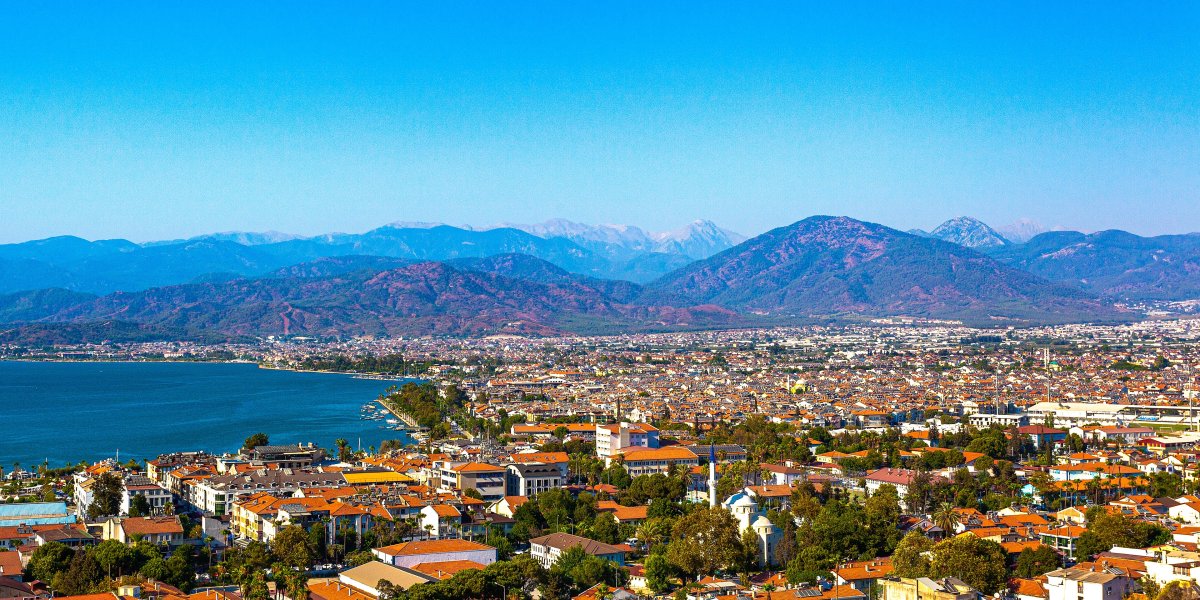
City Guide
Fethiye
Türkiye · Best time to visit: Apr-Oct.
Day-by-day plan
Choose your pace
Trip length
09:00
Landmark
Start at the foot of Kaya Caddesi — the 4th-century BC Lycian tombs are carved straight into the cliff above town, their columned temple facades appearing suddenly as you round the corner. Mornings are the only time to come: the sun rises in the east and lights the rock face in honey gold, while by afternoon the cliff falls into deep shadow and loses all definition. Climb the steel staircase up to Amyntas Tomb itself for Fethiye's signature shot, then look out across the bay you'll be ending the day on.
Tip: The ticket (75 TRY) only gets you onto the upper terrace — but the iconic postcard shot is actually from the road below looking up at the full cliff face. Go up first to step inside the tomb chamber, then take the wide shot on your way down before the light shifts.
Open in Google Maps →10:30
Landmark
Continue uphill from the tombs along Çaylı Sokak — a 15-minute steep climb through pine trees, past stray cats sunning on stone walls, brings you to the half-ruined castle on the acropolis. Built by the Knights of Rhodes on much older Lycian foundations, the walls are mostly gone but the view is the entire reason to come up: the marina, Şövalye Island, the entire arc of the bay, and the rock tombs you just left, all in one frame. Do the harder climbs now while the temperature is still mild and your legs are fresh — there is no shade and no cafe up here.
Tip: There's no gate, no ticket office, and no signage — just walk up and find a flat rock on the southern edge for the panoramic shot. Refill water at the small fountain by the last house before the dirt trail begins; the next reliable tap is back down in the bazaar.
Open in Google Maps →12:15
Food
Descend back into town along Kaya Caddesi — 12 minutes downhill on cobbles, the smell of charcoal pulling you straight to the circular open-air fish market in the center. The system is theatrical: pick your own fish at the central stalls (sea bass ~180 TRY/kg, calamari ~140 TRY/kg, prawns ~250 TRY/kg), then carry it to any of the ringside restaurants who'll grill or fry it for a fixed 200 TRY per person cover that includes unlimited meze, bread, and salad. Lunch happens to time perfectly with the post-noon dip in tourists.
Tip: Skip the front-row touts shouting in English at the entrance and walk past them to Mehmet & Ali Baba Kardeşler — the one with older Turkish men playing backgammon out front. Don't accept 'house wine' before asking the price (it's the classic markup trap); order rakı by the glass with ice and a small jug of water — that's how locals drink with fish.
Open in Google Maps →14:00
Neighborhood
Five steps out the fish market's side door, the labyrinth of Paspatur begins — narrow Ottoman lanes draped in bougainvillea, crammed with carpet shops, spice barrels, silver workshops, and 'evil-eye' nazar trees hung with hundreds of blue glass beads. This was the Greek quarter before the 1923 population exchange, and the stone houses are older than they look. Don't follow a map — turn wherever a passage looks interesting and you'll always loop back to Hamam Sokak.
Tip: The carpets in the main tourist lane carry roughly 3x markup; the fair-priced shop locals actually use is on Şehit Fethi Bey Caddesi behind the mosque. For real handmade evil-eye glass (not the imported Chinese stuff), find Pinar's tiny workshop two doors down from the big nazar tree in the central square — she blows them on-site and the small ones are 50 TRY.
Open in Google Maps →16:00
Park
Exit Paspatur on the marina side and turn right onto the seafront promenade — a flat 5 km along the bay, past fishing boats, palm-lined kordon, and the river bridge where the long sandy stretch finally opens up. The walk is half the activity: time it for late afternoon when the islands start to silhouette and the kitesurfers come in to shore. Find a spot on the sand at the southern end of the beach by 17:30, kick off your shoes, and wait — Çalış faces due west, so the sunset drops straight into the water behind Şövalye and the smaller islets.
Tip: Skip the loud beach bars halfway up the strip and walk to the quieter southern end near the river bridge — fewer kitesurfers in the frame, better sunset composition without parasol clutter. The boardwalk stand selling midye dolma (stuffed mussels, 8 TRY each, squeeze the lemon yourself) is the only acceptable beach snack; everything sold from the wheeled carts is 3x marked up.
Open in Google Maps →19:30
Food
From the beach, walk south for 5 minutes along the wooden boardwalk — Yengeç ('crab' in Turkish) sits directly over the water on a deck that's been family-run since the 1970s. Order the çupra tuzda (sea bream baked whole in a salt crust, cracked open tableside, 850 TRY for two) and start with the cold meze platter (220 TRY) of haydari, fava, samphire, and octopus salad. The last colors of sunset will still be on Şövalye Island when your first course arrives.
Tip: Reserve a deck table for 19:45 by calling ahead — walk-ins land at the back row away from the water and miss the whole point. PITFALL WARNING: avoid the picture-menu seafood places back on the Paspatur harbor side with waiters chasing you down the street — markups run 50%+ over Çalış, the 'today's catch' is usually yesterday's, and the unitemized 'service charge' often appears on the bill. Stay in Çalış for dinner, then taxi back (about 80 TRY, 10 minutes) — never walk the unlit promenade alone after dark.
Open in Google Maps →Jump to day
09:00
Landmark
From the harbor, head east on Kaya Caddesi then up the signed stone stairs — a 15-minute walk ending in a short, steep climb through fig trees. Carved straight into the cliff face above town in 350 BC, this Ionic-temple-fronted Lycian tomb looks back over the bay like a film set. Arrive now and you have it almost to yourself — tour vans roll in at 10:30, and by noon the facade falls into deep shadow.
Tip: Don't step inside the chamber — graffiti and bat smell ruin it. The best photo is from the wooden platform 20m below the facade: sit cross-legged, shoot upward to catch the full pediment with the two reclining figures, between 09:15 and 09:45 when raking light still defines the carved drapery.
Open in Google Maps →10:45
Museum
Walk back down the stairs and west along Okul Sokak — 10 minutes downhill past Ottoman-era houses with bougainvillea spilling over the walls. Small but mighty: Lycian sarcophagi, bronze figurines pulled from local shipwrecks, and the famous trilingual Letoon Decree — the stone that cracked the Lycian script in 1973. You can do a focused tour in under 90 minutes without skimming anything important.
Tip: Skip the audio guide — English labels are clear. Head straight to the ground-floor case holding the Letoon stele; the Greek text beside the Lycian is what gave linguists their Rosetta key. Most visitors miss the back room with the underwater-archaeology amphorae — it's where the staff hang out, and they'll happily talk through the finds in English.
Open in Google Maps →12:45
Food
Out of the museum, walk south through Paspatur's back alleys — 5 minutes through narrow lanes of carpet shops and brass kettles. This is steam-tray Turkish home cooking the way a grandmother makes it; bank clerks, fishermen, and old men in flat caps share the long communal tables. Order stuffed dolma (95 TL / €2.80), lamb şiş on a copper plate (250 TL / €7), and a cold glass of ayran.
Tip: Ignore the laminated English menu by the door. Walk straight to the steam trays at the back, point at three small dishes, and you'll eat for under €8. Ask for bread 'sıcak' (warm) — they refill the basket free. The stuffed peppers (biber dolması) sell out by 13:30; if you see them, take them.
Open in Google Maps →14:30
Neighborhood
Step out the restaurant door and you're already in it — wander north into Çarşı Caddesi. The original 17th-century Ottoman shopping quarter, rebuilt to the same street grid after the 1957 earthquake: spice stalls smelling of sumac and dried mint, antique brass coffee pots, working hammams, cats asleep on prayer rugs. The light filtering through the vine pergolas at this hour is what turns a market walk into a memory.
Tip: The evil-eye amulets piled at street stalls are 95% Chinese-made resin. For real hand-poured glass nazars, go to the small workshop on Çarşı Caddesi number 32 — they pour them in the back, deep cobalt with bubbles inside (€4 each vs. €1.20 fakes outside). Watch for 'tea house' touts who pull you in for 'free apple tea' — the rug pitch comes 10 minutes later.
Open in Google Maps →16:45
Landmark
Walk west out of the bazaar onto Atatürk Caddesi (8 minutes along the seafront), passing the 2nd-century Lycian sarcophagus marooned in the middle of the road — the city paved around it in the 1970s rather than move it. Continue along the marina promenade to the breakwater for sunset: gulets lined three deep, the mountains behind them, water turning copper around 18:30 in summer. End at the breakwater tip, where the light hits Şövalye Island and turns the whole harbor gold.
Tip: The best sunset frame is from the breakwater's outer edge (15 min walk from the sarcophagus) — Şövalye Island silhouettes against the sun, with masts in the foreground. Sit on the seawall, not the painted promenade tables: those €8 'sunset cocktails' are watered down. Buy a Bomonti beer at the harbor kiosk (€3) and walk.
Open in Google Maps →20:00
Food
A 5-minute walk back inland from the marina to the covered fish market on Hal ve Pazar Yeri. The ritual: buy fresh fish straight from the central stalls (sea bass ~€18/kg, prawns ~€22/kg, calamari ~€14/kg), then hand it to any surrounding restaurant — they grill or fry it for a flat 200 TL (€6) per person, including bread, salad, and a meze plate. With a half-bottle of rakı under string lights and the smell of charcoal everywhere, this is the meal you'll show photos of.
Tip: Pick a restaurant on the QUIET north row (Çarıklı Mehmet'in Yeri or Cem & Can) — same shared kitchen, no aggressive touts. Pitfall warning: refuse the 'free welcome rakı' offered the moment you sit — it appears on the bill at €4/shot. Order 600g sea bass for two; weigh it yourself at the fish stall before handing it over (touts sometimes swap to a smaller one).
Open in Google Maps →08:30
Entertainment
Hotel pickup by your pre-booked operator's van — 25 minutes south through pine forests to the Babadağ base station. The cable car climbs in three stages to the 1,700m takeoff platform; the view back over the Lycian peninsula stretches 60 km on a clear morning. Tandem flight is 25–35 minutes, spiraling down to land directly on Ölüdeniz beach — going at 09:00 means stable morning thermals and crystal visibility before the afternoon haze rolls in.
Tip: Eat only a banana for breakfast — the spiral descents make half of first-timers queasy. Pay the €15 GoPro upgrade; your phone is useless mid-flight. Ask specifically for a pilot launching from the 1,700m (not 1,200m) platform — only the higher takeoff gives the lagoon flyover. Wear closed shoes for the run-off; sandals get yanked off on takeoff.
Open in Google Maps →11:30
Park
You literally land here — once helmets are off, walk 200m north along the pebble shore to the central public beach. This is one of Turkey's most-photographed coastlines: the Taurus mountains rising vertically from turquoise water, paragliders descending like slow confetti every 90 seconds against a backdrop of pine cliffs. Belcekız is the free public stretch; the famous lagoon proper is a separate ticketed cove at the far southern end (the next stop).
Tip: Rent a sunbed (€8) on the southern third of Belcekız — fewer kids, and you watch paragliders touch down 50m from you. Do NOT swim past the orange buoys: that's the paraglider emergency-landing zone, and pilots will not abort a water landing for a swimmer. Showers behind sunbed row F are free; the ones behind the cafes charge €1.
Open in Google Maps →13:00
Food
A 4-minute walk back along the beach road, set behind a tamarisk garden. Locals come here when central Ölüdeniz fills with British package tourists — it's the kitchen the lifeguards and paragliding pilots actually eat at. Order Kayaköy pidesi (long Turkish flatbread with minced lamb and oregano, €7), kuzu tandır (slow-baked lamb shoulder falling off the bone, €14), and a freshly-squeezed lemonade.
Tip: Sit in the courtyard, not the street-front tables — cooler, and you can see the pide oven. The pide takes 15 minutes from order; start with the mixed mezze plate (€3.50). Ask 'taze mi?' (is it fresh?) about the lemonade — the answer separates the squeezed-this-morning version from the bottled one.
Open in Google Maps →14:30
Park
A 12-minute walk south from the restaurant along the lagoon access road, ending at the nature park gate (€3.50 entry). Inside, the famous postcard view appears 200m along the wooden walkway: the lagoon curves into a perfect crescent, a pale sandbar dividing two impossible shades of blue. Afternoon is when the color saturation peaks — the sun is overhead enough to read straight through the shallow water.
Tip: Walk 600m past the crowded main beach to the quieter pebble cove at the far western end — same water, 80% fewer people. The single best photo angle for the full crescent in one frame: climb the small pine-covered ridge on your right just past the cove (5-minute scramble, no path but locals know it). Bring water shoes — the pebbles get scorching after 15:00.
Open in Google Maps →17:30
Landmark
Pre-arranged taxi from the Blue Lagoon gate — €10, 12 minutes through pine switchbacks over the saddle. Five hundred roofless stone houses on a south-facing hillside, abandoned in the 1923 Greek-Turkish population exchange and never resettled; two churches still stand with fragments of saint frescos ghosting the plaster. Arriving now is deliberate: late-afternoon light turns the stones rose-gold, swifts circle the ruined belltowers, and the tour coaches have just left.
Tip: Enter through the lower ticket gate, not the upper one the coach tours use — same price, no queue, and you climb upward through the village instead of down (better light progression). Don't miss the lower church (Panagia Pyrgiotissa) — its apse still holds fragments of saint frescos behind a wooden barrier; the upper church (Taxiarchis) gives the wide hillside view at sunset.
Open in Google Maps →19:30
Food
A 6-minute downhill walk from the village exit into Kayaköy proper. A 50-year-old institution under grape-vine pergolas, with charcoal grills sunk into every table — the kind of place Fethiye locals drive 25 minutes to reach. The system: walk to the butcher counter at the entrance, point at the cuts you want (lamb chops €18/kg, kuzu külbastı €22/kg, sucuk sausage €10/kg), they bring it raw with a glowing charcoal pit set into your table, and you cook it yourself.
Tip: Order 250-300g of meat per person — the staff will steer you toward 500g; you don't need it. Don't skip the gözleme: the spinach-and-cheese version (€5) is hand-rolled at the open kitchen 3m from your table. Pitfall warning: ignore the half-dozen 'Kayaköy stone-house restaurants' uphill from the village — they charge double for frozen lamb thawed that morning. Cin Bal is the only one in the valley locals genuinely vouch for; book ahead in summer (+90 252 618 0066) or arrive by 19:15.
Open in Google Maps →
Trip builder
Plan this trip around Fethiye
Turn this guide into a bookable rail itinerary with FlipEarth.
Keep exploring
Related cities
More in the same country
FAQ
Frequently asked questions
How many days do you need in Fethiye?
Most travelers enjoy Fethiye in 1 days, with enough time for headline sights and a slower meal or museum stop.
What's the best time to visit Fethiye?
The easiest season for most travelers is Apr-Oct, especially if you want good weather and manageable crowds.
What's the daily budget for Fethiye?
A practical starting point is about €70 per person per day before hotels, then adjust based on museums, dining, and transport.
What are the must-see attractions in Fethiye?
A good first shortlist for Fethiye includes Amyntas Rock Tombs, Telmessos Castle (Fethiye Kalesi).