City Guide
Tartu
Estonie · Best time to visit: May-Sep.
Day-by-day plan
Choose your pace
Durée du voyage
09:00
Park
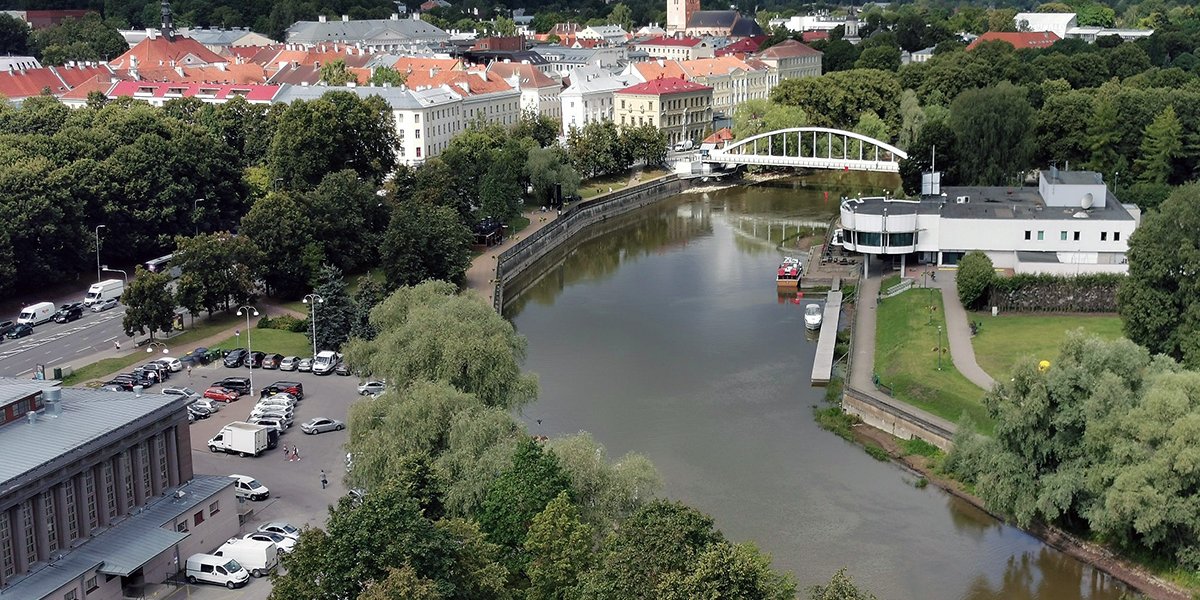
Begin the morning by climbing the path off Lossi street — six minutes through century-old lindens and you're standing inside the broken brick gables of a 13th-century cathedral, gothic windows now framing only sky. Loop south past the Old Anatomical Theatre and the 1816 Observatory where Friedrich Georg Wilhelm Struve first measured the Earth's curvature, then cross Angel's Bridge for the textbook view down onto the red roofs of old town. This hour belongs to you — by 11:00 the school groups arrive, and the silence between the ruins is the entire reason to be here early.
Tip: Cross Angel's Bridge first, then Devil's Bridge in the opposite direction without speaking — local tradition says the wish only counts in that order, in silence. Tourists never know this; if a passing student smiles at you, that's why.
Open in Google Maps →11:00
Landmark
Descend Toomemägi's south stairway and in four minutes you emerge on Ülikooli street, directly opposite the yellow neoclassical facade with its six Corinthian columns. Founded in 1632 by Swedish King Gustavus Adolphus, this is the second-oldest university in Northern Europe and the institution that made Tartu what Estonians call 'the city of good thoughts.' Step into the foyer (free, weekdays) to see the marble staircase, then walk one block south on Rüütli to glimpse the famously leaning Tartu Art Museum — the 'Pisa of Tartu,' tilting 5.8 degrees because it was built on rotting log foundations over the medieval moat.
Tip: Stand 15m back across Ülikooli street for the classic head-on shot — the columns only compose properly with distance. For the leaning Art Museum, shoot it from the south side of the street with a vertical reference (a lamppost) in frame so the tilt actually registers in the photo.
Open in Google Maps →12:00
Food
Werner sits 80m east on Ülikooli — ninety seconds from the university gates and you're inside Estonia's oldest café, opened 1895, where generations of students have argued philosophy over rhubarb cake. Order the seljanka (Estonian-style spicy meat soup, €8) and a slice of kohupiimakook (curd cheesecake, €4) — a full lunch under €15. Sit upstairs in the wood-paneled main room facing Ülikooli; the ground-floor deli is takeaway only and you'd miss the entire point.
Tip: Order at the upstairs counter first, then take your number to a table — there's no table service for the café menu, and confused tourists often sit waiting. Add one marzipan-cherry chocolate truffle (€2) at the till and eat it with your coffee; they're house-made and don't survive the journey home.
Open in Google Maps →13:00
Landmark
Continue east on Ülikooli — in three minutes the street widens into Raekoja plats, the pink-and-white Town Hall (1789) anchoring the head of the cobbled square that slopes gently down toward the Emajõgi river. The Kissing Students fountain in front, the city's official emblem since 1998, is where graduates throw caps and couples make pacts. Walk the full length of the square down to the riverbank, then back up the north side — the medieval merchant houses now hold cafés, but the geometry of the square itself, this gentle bowl tipped toward the water, is what makes Tartu feel like nowhere else in the Baltics.
Tip: Photograph the Kissing Students from the south-east corner of the fountain with the Town Hall directly behind — the bronze umbrella in the sculpture frames the pink facade like a deliberate composition. Early afternoon light hits the Town Hall straight on; by 16:00 it falls into shadow.
Open in Google Maps →14:00
Museum
Leave the square eastward via Vabaduse pst, then north onto Narva mnt — a 35-minute walk past the river, the Botanic Garden, and through the leafy Raadi neighbourhood ends at Estonia's most audacious modern building. The museum extends as a single 355-metre ribbon of concrete and glass running straight down a former Soviet bomber runway — an architectural reclaiming of occupied land, opened 2016. Walk the full length of the south face: it tapers toward the airfield horizon like a frozen aircraft mid-takeoff. The east end opens onto Raadi Manor lake, where locals fish on summer afternoons. You're not going inside; the gesture of the building, on its violent ground, is the entire experience.
Tip: Approach from the airfield side (the rear, not the visitor entrance) — late-afternoon sun strikes the long glass facade at a low angle and the whole wall mirrors the sky. Walk all 355m; halfway feels like a Land Art piece. To return, either retrace along Narva mnt for the 35-minute river walk back, or catch bus 27 from outside the museum to Raekoja plats (€2, 12 minutes).
Open in Google Maps →19:30
Food
From old town, walk three minutes up Lossi street to the foot of Toomemägi — Püssirohukelder occupies a 1768 gunpowder magazine carved into the hillside, with the world's tallest restaurant ceiling at 11 metres of bare brick vault. Order the slow-roasted pork knuckle with sauerkraut (€19) and a half-litre of the house-brewed Gunpowder Beer (€6) — dark, malty, brewed in the cellar itself. The room rumbles with conversation under the vault; come hungry, leave loud.
Tip: Reserve by 18:00 for a 19:30 table — weekends fill with Tallinn weekenders and walk-ins are turned away after 20:00. Ask for table in the smaller vaulted side-room (not the main hall) — the acoustics are warmer and you'll hear your companion. PITFALL: the cafés ringing Raekoja plats look picturesque but cater purely to tourists — laminated menus in eight languages, microwaved seljanka at triple the price. Anywhere on the square itself, walk on; Püssirohukelder is two minutes uphill for a reason.
Open in Google Maps →
Trip builder
Plan this trip around Tartu
Turn this guide into a bookable rail itinerary with FlipEarth.
Keep exploring
Related cities
More in the same country
FAQ
Frequently asked questions
How many days do you need in Tartu?
Most travelers enjoy Tartu in 1 days, with enough time for headline sights and a slower meal or museum stop.
What's the best time to visit Tartu?
The easiest season for most travelers is May-Sep, especially if you want good weather and manageable crowds.
What's the daily budget for Tartu?
A practical starting point is about €80 per person per day before hotels, then adjust based on museums, dining, and transport.
What are the must-see attractions in Tartu?
A good first shortlist for Tartu includes University of Tartu Main Building, Raekoja Plats & Kissing Students Fountain.