City Guide
Piran
Slovénie · Best time to visit: May-Sep.
Day-by-day plan
Choose your pace
Durée du voyage
09:00
Landmark
Step off the bus and into the oval marble heart of Piran before the cruise tenders dock. Named for the violinist Giuseppe Tartini, born in the pink palazzo at the square's edge in 1692, this elegant oval was an inner harbor until 1894 — picture mooring lines where café chairs now sit. The bronze Tartini stands mid-square with his cape catching the morning light against pastel Venetian facades, and the only sounds at this hour are pigeons and the espresso machines warming up.
Tip: Stand at the south end facing the Church of St. Peter for the postcard shot — Tartini's silhouette frames perfectly against the yellow-and-pink palazzos before 09:30. Caffè Teater on the square opens at 07:30 for a proper €1.80 espresso the locals drink, not the €4 cruise version served two doors down.
Open in Google Maps →10:00
Religious
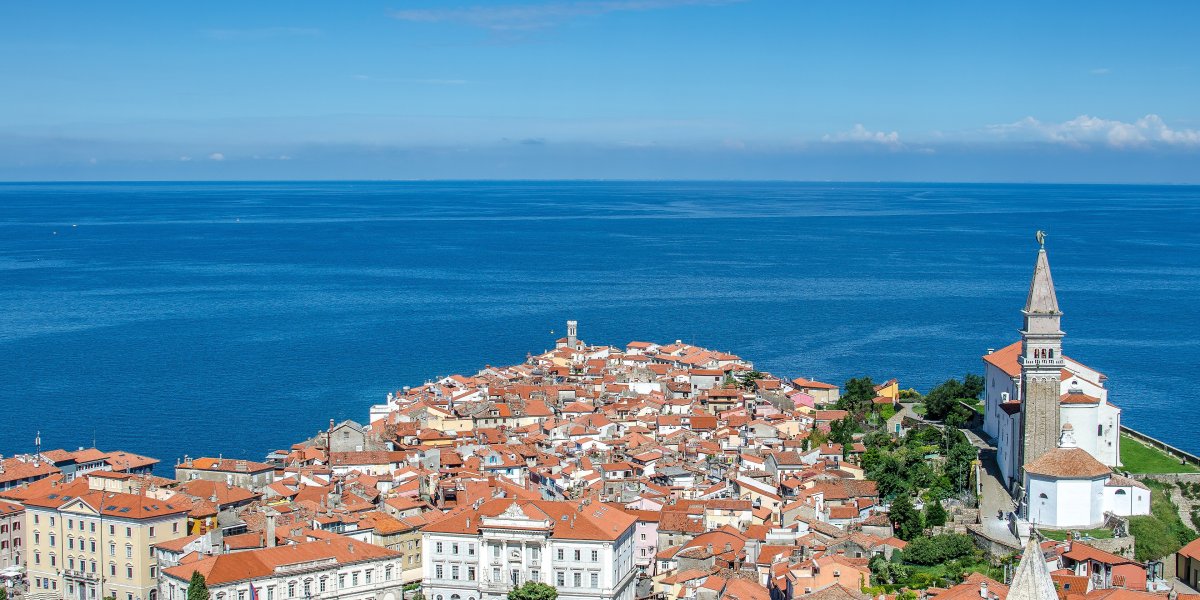
From Tartini Square, slip behind the Tartini statue into the stepped lane Ulica IX. korpusa — a 5-minute climb past stone houses with laundry strung between balconies. The 17th-century cathedral itself is humble, but the real prize is the freestanding 46-meter bell tower, modeled directly on Venice's San Marco campanile and finished in 1609. Two euros and a creaking wooden staircase deliver you to a 360-degree panorama: terracotta rooftops tumbling to the Adriatic on three sides, the Italian Julian Alps faintly visible northwest on clear mornings, and the salt pans glinting south where you'll walk later.
Tip: Climb at 10:00 sharp — by 11:30 the bell tower has a 25-minute queue on cruise days. The bay below is mirror-flat before the maestral wind picks up at noon, so this is your only window for the iconic flat-water shot of Piran's red-roofed peninsula.
Open in Google Maps →11:30
Landmark
Leave the cathedral via Cerkveni trg and follow the signposted path uphill for 8 minutes through quiet residential lanes — locals nod from doorways and cats sun themselves on warm stone. The 15th-century Venetian walls (€2) crown the peninsula's spine with seven surviving towers, and from the ramparts you finally see what every Piran postcard shows: the tongue of red rooftops jutting into a turquoise Adriatic, the bell tower piercing the skyline below you. Most day-trippers never make this climb — at midday you'll share the walls with maybe a dozen people.
Tip: Walk the walls east-to-west so the sun stays behind your camera. The third tower from the entrance has the cleanest unobstructed sightline — frame the cathedral's bell tower in the foreground with the open sea behind for the shot everyone tries and only this angle gets right.
Open in Google Maps →13:00
Food
Descend back through Rozmanova ulica — 10 minutes down to Prvomajski trg, a tiny inner square anchored by a 18th-century stone water cistern where children once filled jugs. The Fritolin is a 70-year family-run fried-fish counter with no tablecloths, no translated menus, and the best quick seafood between Trieste and Pula. Order at the window: paper cone of fresh-fried calamari (€10) and a plate of grilled mixed sardines (€8), eat at the communal wooden tables under canvas awnings while old men play chess at the next table.
Tip: Arrive by 12:45 — the 13:00 local lunch rush adds a 20-minute wait. Order one calamari cone plus one grilled fish plate (not the fried combo platter) so you taste both styles, and ask for 'domače belo vino' — €3 for a generous glass of the house Malvazija the tourist menus won't offer.
Open in Google Maps →14:30
Park
From Prvomajski trg, head south along the seafront past the Punta lighthouse and follow the coastal promenade 7 km through Portorož — the bay stays at your right shoulder for the entire sun-drenched walk, with bougainvillea spilling over villa walls and the salt-pan glitter growing on the horizon. Enter via the northern Lera gate (€7) where harvesters have raked salt by hand for 700 unbroken years using identical wooden tools each generation. Walk the wooden boardwalks through the white pans, spot egrets and pink-tinged flamingos working the brine, and visit the restored salt-makers' stone cottages.
Tip: Hit the boardwalks at 16:00 — the low afternoon light turns the still water into perfect mirrors and the salt pyramids blush pink. Use the Lera entrance (not Fontanigge, 4 km further south); the open-air Thalasso Lepa Vida foot pools by the gate are €5 and a lifesaver for tired feet. Catch bus 1 back from Lucija stop (every 30 min, €1.30) — do not walk back, you'll lose dinner.
Open in Google Maps →19:30
Food
Bus 1 returns you to Piran in 20 minutes; walk 3 minutes west from the station along Dantejeva ulica to an unassuming yellow facade one street back from the harbor — no signage shouting, no host with a menu. Owner Mara cooks while her husband Tomi serves, and the Istrian-Slovenian kitchen here is what every harbor-front tourist trap pretends to be. Order the gnocchi with black truffle and Adriatic prawns (€18) and the whole sea bream baked in salt crust (€26 for two), cracked tableside and dressed with olive oil from Mara's family grove in the Karst. Pair with a glass of Vipava Valley Malvazija (€5) and finish with the homemade rakija on the house.
Tip: Reserve by phone the day before (+386 5 673 4735) — only 8 outdoor tables and cruise concierges block-book them by 18:00. Avoid the harbor-front strip on Cankarjevo nabrežje entirely: picture menus, aggressive hosts in white shirts, 40% markup on frozen fish, and tales of €80 sea-bass scams that surface in TripAdvisor every season. After dinner, walk 100 m to Cantina Klet on the seafront for a final glass of Refošk at sunset — €3, no menu, just point at the wine the locals are drinking.
Open in Google Maps →Aller au jour
09:00
Landmark
Start at the perfect oval that defines Piran — once an inner harbor for Venetian galleys, paved over in 1894 and now framed by pastel facades and the white marble statue of Giuseppe Tartini, the violinist born here in 1692. Walk the full ellipse clockwise, pausing at the Venetian House across from Tartini with its inscription 'Lassa pur dir' — 'Let them talk,' a 15th-century merchant's reply to gossip about his Piranese lover. Morning belongs to the locals here: the café umbrellas haven't unfurled yet, and the soft light catches the pastel facades without harsh shadow.
Tip: The square reads best from the staircase in front of the Court House at its southwest corner — frame Tartini's statue with the red Venetian House behind. Before 10:00 the umbrellas are still folded and the square looks as it did 200 years ago. Avoid the obvious central vantage; everyone shoots from there and the angle flattens the buildings.
Open in Google Maps →10:30
Religious
From Tartini Square, exit the northeast corner past the Court House and climb the wide stone staircase — 5 minutes of switchbacks through narrow lanes, with glimpses of the sea opening between houses at every turn. The cathedral crowns the headland like a Venetian sentinel, its 17th-century campanile a deliberate miniature of San Marco's in Venice. Step inside for the baroque marble altar, then climb the bell tower's 146 wooden steps for terracotta roofs spilling toward three different stretches of sea.
Tip: Climb the campanile clockwise (the staircase spirals that way) and stop at the second wooden window — it frames Tartini Square below in a way no postcard captures. Time your climb so you're at the top at 11:00: the bells ring on the hour, and standing inches below them as they strike is something most visitors miss by minutes. Cathedral interior is free; only the tower charges.
Open in Google Maps →13:00
Food
Descend the cathedral steps and turn left into the maze of inner-town lanes — 3 minutes downhill on Cojzova ulica brings you out at tiny Prvomajski Square, where the smell of frying fish announces the spot. This is Piran's most beloved fritolin — a counter-service fish fryer with a takeaway window and a handful of outdoor wooden tables. The mixed fried calamari with sardines and anchovies (12€) is the order, served in a paper cone with lemon — the fish came in this morning from the bay you've been looking at all day.
Tip: Pay first at the inside counter, take your numbered slip, then claim an outside bench — locals never sit indoors. Order the 'mešano' (mixed plate, 12€) over single-fish portions for best value, and add a glass of Refošk (3€), the local Istrian red. Skip the chips; the polenta is the right pairing. Closed Tuesdays.
Open in Google Maps →15:00
Landmark
From Prvomajski Square, take Ulica IX. korpusa east — a 7-minute uphill walk through quieter neighborhoods where laundry hangs across the lanes. The 15th-century walls appear at the lane's end like a stone wedge dropping toward the sea, built when Piran feared Ottoman raids from across the Adriatic. Climb the parapet and walk to the westernmost turret for the view that defines Piran: the entire peninsula seen as a single shape, cathedral spire piercing terracotta roofs, the Gulf of Trieste curving toward Italy.
Tip: Enter via the upper gate (Gradnik Tower) rather than the lower entrance — most tourists take the lower and never make it to the better turrets. The far western turret is the photograph; afternoon light puts the sun behind you and the entire peninsula lights up in gold. Bring water — there's no fountain on the walls and the climb is fully exposed.
Open in Google Maps →17:30
Museum
Walk back down the same route to the harbor — 10 minutes downhill — and turn right along the waterfront promenade until you reach the salmon-pink Gabrielli Palace on Cankarjevo nabrežje. Inside, Piran's maritime heritage is laid out across two floors of a Venetian patrician's home: ship models, navigation instruments, and an entire room devoted to the salt-making tradition you'll meet tomorrow at Sečovlje. Late afternoon is the museum's quietest hour — most cruise daytrippers have already boarded their buses back.
Tip: Skip the ground-floor naval models and head straight upstairs to the salt-pans room — the 17th-century wooden tools displayed there are the same ones still in use today at Sečovlje, and seeing them now sets up tomorrow's visit perfectly. The painted ceilings of the palace itself are worth the entrance fee; look up at every doorway.
Open in Google Maps →19:30
Food
From the museum, walk south along the harbor for 4 minutes, then turn left into Dantejeva ulica — the small wooden sign is easy to miss. Pri Mari is the restaurant locals send their visiting relatives to: Croatian-Slovenian owners Mari and Tomi have run it for two decades, and the seafood here is the best in town. The sea bass baked in salt crust (32€, cracked tableside) is the signature; the homemade gnocchi with truffle (16€) is the surprise — let Mari choose the wine to pair.
Tip: Reserve at least 48 hours ahead by phone, not email — Mari doesn't check the inbox often. Closed Mondays year-round and Sundays out of season. Avoid the harbor-front 'tourist menu' restaurants on Cankarjevo nabrežje: the €15 fish boards posted outside hide €40 bills with cover charges, bread fees, and 'sea view' surcharges, and the fish is frozen. Pri Mari is 5 minutes inland and half the price for triple the quality.
Open in Google Maps →09:00
Park
Take the 8:55 bus from Piran's main terminal (line 1 to Sečovlje, 2.50€ each way); 20 minutes south through olive groves and seaside villages drops you at the Lera entrance. The salt pans have produced sea salt by the same method for 700 years — wooden rakes, shallow pools, and the microbial 'petola' mat that protects the crystals from contamination by the clay below. Walk the wooden boardwalks across the working pans, watch the salters at their morning rake, then cross to the Salt-Making Museum at Fontanigge where original 18th-century salter's houses preserve the trade.
Tip: Buy the combined Lera + Fontanigge ticket (7€) — most visitors only do Lera and miss the museum, which is the better half. Arrive at the Lera entrance by 9:15 to see the salters at their morning rake; by 11:00 they retreat from the heat and the pans go still. The on-site Lepa Vida spa is a tourist trap at 50€ for a mud bath — the experience is the walking, not the dipping.
Open in Google Maps →13:00
Food
Bus back from Sečovlje arrives at Piran terminal at 12:45; walk 5 minutes along the harbor and into Tartini Square. Caffè Teater occupies the ground floor of the neoclassical Tartini Theatre, with outdoor tables under the arcade facing the square's full ellipse. The Istrian prosciutto and Tolminc cheese board (12€) with a glass of crisp Malvazija (4€) is the right pace after a hot morning — local, light, and over in under an hour.
Tip: Sit outside under the theatre's arcade — shaded in early afternoon and the best people-watching seat on the square. Order 'malvazija ledena' (chilled, not on the standard menu but they'll pour it). Skip the pasta dishes — the cold plates are what locals actually eat at lunch here, and the kitchen rushes hot food.
Open in Google Maps →14:30
Religious
Exit Tartini Square at the east corner past the church entrance — 2 minutes brings you to the unassuming wooden gate on Bolniška ulica. Most visitors walk past without realizing what's inside: a 14th-century Franciscan cloister with frescoed walls, a central courtyard with a stone well, and the kind of silence only a working monastery still maintains. The adjoining Church of St. Francis holds an altarpiece by Vittore Carpaccio's school and a wooden ceiling painted with the lives of Franciscan saints.
Tip: Push through the church entrance to the gate on the right — that's the cloister, free to enter but almost no one does. The 1301 frescoes on the western wall are the oldest in Piran. Drop a coin in the wooden donation box; the monks restore the cloister themselves with these. Check the noticeboard for the summer early-music concert schedule — tickets are 10€ and the acoustics under the stone arcades are extraordinary.
Open in Google Maps →16:00
Neighborhood
Slip out of the cloister gate northbound and follow Cojzova ulica uphill — 4 minutes through some of the old town's oldest unrenovated lanes, where bare Istrian stone shows behind crumbling stucco. First of May Square (Prvomajski trg) was Piran's center before Tartini Square existed — smaller, quieter, framed by two baroque rain cisterns and a single stone wellhead from 1775. This is what Piran looked like before tourism: laundry strung across the square, kids on bicycles, a single café with three chairs.
Tip: Look down before looking around: the wellhead in the square's center is hollow and 9 meters deep — the iron grate cover lifts (it's not locked). The unrenovated houses around show what the rest of Piran looked like before pastel paint arrived in the 2000s. Walk one block north up Ulica IX. korpusa to see the only completely uncovered Istrian stone facade left in town.
Open in Google Maps →17:00
Landmark
From the square, follow IX. korpusa west toward the sea — 8 minutes through descending lanes ends at the open promenade hugging the rocky tip of the peninsula. Punta is where the Gulf of Trieste meets the open Adriatic, and the small white lighthouse beside the 13th-century Church of St. Clement marks Piran's outermost point. Sit on the warm limestone slabs the locals use as evening lounges and watch the sun drop behind Trieste — on clear evenings the Dolomites' snow line catches the last light on the horizon.
Tip: Arrive 45 minutes before sunset and walk to the rocks 30 meters north of the Church of St. Clement — not the lighthouse itself, which everyone crowds around. From there the lighthouse silhouette against the orange sky is the shot. On clear tramontana-wind evenings (usually after rain) the Dolomites are visible; ask a local 'le Alpi oggi?' — they'll tell you if it's a Dolomite-visible night.
Open in Google Maps →20:30
Food
Walk back from Punta along the eastern seawall — 10 minutes along the pedestrian quay with the marina lights coming on as you go — then turn inland onto Židovska ulica. Pirat is the harbor's quiet favorite: family-run since 1992, with a small terrace facing the boats and a kitchen that does Adriatic seafood without the harbor-front markup. The fish soup with toasted bread (8€) and the grilled Adriatic squid stuffed with prosciutto and cheese (22€) are the right ending — the wine list is short, all Slovenian, all good.
Tip: Order the fish soup and the stuffed squid — skip the pasta dishes, which are weaker. Cash payment gets you a discreet 5% discount; ask. Be wary of street touts in the marina area pushing 'fresh fish, special price' at €25/kg — they're sourced frozen from supermarkets and add 'preparation' fees that double the bill. A real Piran fish dinner is always priced per portion on the printed menu, never per kilo on a chalkboard outside, and never sold by someone calling to you from the street.
Open in Google Maps →
Trip builder
Plan this trip around Piran
Turn this guide into a bookable rail itinerary with FlipEarth.
Keep exploring
Related cities
More in the same country
FAQ
Frequently asked questions
How many days do you need in Piran?
Most travelers enjoy Piran in 1 days, with enough time for headline sights and a slower meal or museum stop.
What's the best time to visit Piran?
The easiest season for most travelers is May-Sep, especially if you want good weather and manageable crowds.
What's the daily budget for Piran?
A practical starting point is about €90 per person per day before hotels, then adjust based on museums, dining, and transport.
What are the must-see attractions in Piran?
A good first shortlist for Piran includes Tartini Square, Piran Town Walls.