City Guide
Kiruna
Suède · Best time to visit: Dec-Mar, Jun-Aug.
Day-by-day plan
Choose your pace
Durée du voyage
09:00
Landmark
Begin north of town at the foot of Luossavaara, the conical iron-ore mountain twin to Kiirunavaara — a forty-minute climb on the south-face access road (or a chairlift ride in winter) lifts you 720 m above the Arctic tundra. From the summit, the entire story of Kiruna lays itself out at your feet: the gaping wound of the LKAB mine to the south, the patchwork of the old town being dismantled in the middle distance, and the angular new center rising 3 km east. The morning sun strikes the mine head from a low angle, throwing the industrial geometry into sharp relief — this is the single best photograph you will take in Kiruna, and it has to be in the morning before the light flattens at noon.
Tip: In winter the chairlift opens at 10:00, but the south-facing ridge gets sun by 09:30 — walk up the access road on the east side for that half hour and you get the panoramic shot with no one in it. Bring traction spikes Dec-Apr; the upper switchbacks ice over and trail runners are useless on them.
Open in Google Maps →11:30
Landmark
Descend the south face of Luossavaara and follow Gruvvägen along the rim of the world's largest underground iron-ore mine — a thirty-minute walk that drops you at the public viewing platform above the Kiirunavaara open-cut section. From here you see exactly why the entire city is being moved: the orebody runs at a 60° angle directly under what used to be downtown Kiruna, and as LKAB digs deeper, the ground above fractures and sinks. The processing towers, the conveyor belts, the iron-red dust coating every surface — this is what a billion-euro municipal relocation looks like from above.
Tip: Skip the paid InfoMine underground tour unless you have three hours to spare — the exterior viewpoint tells the more dramatic story for free. The wind here is constant and brutal; the platform has no shelter, so take your photos in the first ten minutes before your fingers stop working.
Open in Google Maps →13:00
Food
Walk northeast along Hjalmar Lundbohmsvägen for about twenty-five minutes — you pass directly through the deformation zone where houses are being either dismantled or jacked up onto transporters and rolled east — into the still-functioning central blocks. Café Safari has fed Kiruna since the 1980s and is the closest thing the town has to a living room: open-face shrimp sandwiches, hearty reindeer soup, and cinnamon buns the size of your palm. Order the räksmörgås (~165 SEK / €15) with a coffee, sit at the window, and listen to the locals argue in Swedish-Sami shorthand about which block of flats moves next.
Tip: Budget €18-25 for a sandwich and coffee. The LKAB shift change hits at 12:00 sharp and the queue triples; arrive at 13:00 on the dot and you walk straight to a table. Pay by card — almost no business in Kiruna takes cash anymore.
Open in Google Maps →14:30
Religious
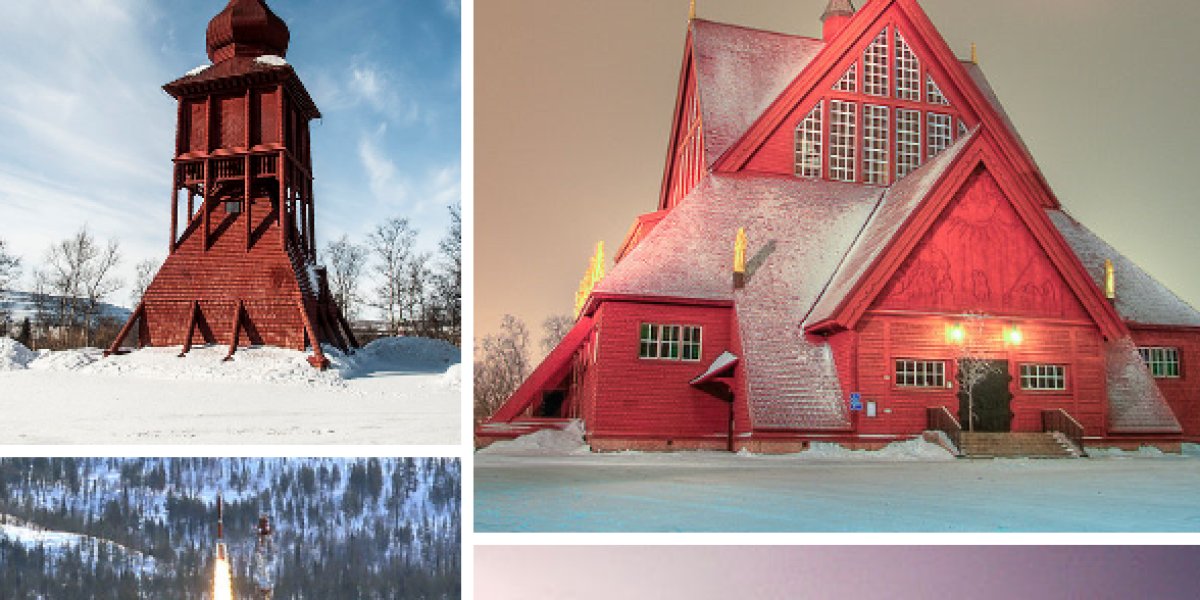
From Café Safari, head due east along the temporary haul road that the church itself was rolled along in August 2025 — a 3 km walk along the literal path the city is taking. Kiruna Kyrka, voted Sweden's most beautiful building, is a 1912 wooden cathedral shaped like a Sami lavvu tent, its dark-stained timbers crowned with twelve bronze sculptures personifying human emotions. Now standing in its new resting place beside Kristallen, it is the single most photographed object north of the Arctic Circle. The afternoon sun catches the west-facing facade between 15:00 and 16:00 — the exact hour the architect Gustaf Wickman intended the timbers to glow.
Tip: The exterior is the point — the interior is a single open hall and worth no more than ten minutes. Stand at the southwest corner where the bell tower and the main lavvu roofline converge; in winter, snow on the eaves doubles the contrast against the dark wood and gives you the postcard shot.
Open in Google Maps →16:30
Landmark
Walk two minutes east from the church into the new town square — Kristallen, the new Town Hall opened in 2018 by Henning Larsen Architects, is a copper-clad cylinder that looks like a half-buried meteorite, and in front of it stands the golden Stadshustornet, the clock-and-bell tower salvaged whole from the old (demolished) town hall. The juxtaposition is the whole point of Kiruna: a 1963 bronze bell preserved in front of a 21st-century relocation project. Climb the curved interior ramp of Kristallen to the rooftop terrace (free, open until 18:00) for the second great photograph of the day — looking back west across the new town toward the mine you stood above this morning.
Tip: Time your visit so the tower bell rings at 17:00 — it's the same bronze bell Bror Marklund cast in 1958, and it sounds different now that there are no old buildings around it to absorb the sound. Stand on the east side of the square for the photo that captures bell, golden tower, and Kristallen's copper drum all in one frame.
Open in Google Maps →19:00
Food
Five minutes north of Kristallen, inside the relocated Scandic Kiruna, sits Mommas — the Lappish kitchen that fed travelers through the old Scandic Ferrum years and made the move east with the rest of the city. The menu is short and unapologetic: reindeer fillet with lingonberry and juniper cream (~395 SEK / €36), Arctic char with browned butter and almond potatoes (~325 SEK / €30), and cloudberry parfait for dessert. This is not gimmicky 'New Nordic' theater — it is what Kiruna families actually eat on a Friday night, served in cast-iron pans with no foam in sight.
Tip: Reserve a window table by 18:00 in Dec-Feb — when the Aurora kicks off you watch it from your seat without putting your coat back on. Two warnings about Kiruna's biggest tourist traps: do not book the 'Northern Lights bus tours' sold from hotel lobbies for €120+ — the aurora is visible for free from any dark street in town once you walk five minutes away from a streetlamp. And ignore the 'Aurora tasting menu' restaurants along the Jukkasjärvi road; the prices double and the reindeer comes from the same supplier as Mommas.
Open in Google Maps →Aller au jour
09:00
Landmark
Meet at the InfoMine desk inside Kristallen, the bronze-clad new city hall — a tour bus carries you 540 metres beneath the surface into the world's largest underground iron-ore mine, the exact reason Kiruna is being shifted three kilometres east. Hard hats, cool-blue tunnel light, ore conveyors longer than football pitches: you stand inside the wound reshaping the city above you. Tours run in English and sell out by mid-morning in winter.
Tip: Reserve the 09:00 English-language slot at visitkiruna.se the day before — by the 12:00 tour, every seat is gone and you'll be bumped to tomorrow. Wear a beanie under the hard hat; the mine sits at +14°C year-round, which feels warm only until you stop walking.
Open in Google Maps →12:00
Food
Two minutes east of Kristallen along Lars Janssonsgatan — Bagarstugan is the woodfire-oven bakery LKAB miners themselves grab between shifts. Order the renskavssmörgås (sautéed reindeer on rye, 140 SEK / €12) and a kardemummabulle: the cardamom buns are baked twice daily and gone by 14:00. Total around €18 with coffee — fast, hot, unmistakably Lappland.
Tip: Skip the queue by ordering at the hot-counter on the left, not the bakery display on the right — locals know the difference and tourists do not. Ask for the renskav heated, not room temperature; it's served lukewarm by default to keep the line moving.
Open in Google Maps →13:30
Religious
Three minutes' walk south through the new town square — the great red-pine church, voted Sweden's most beautiful building, completed its 5-km journey east in August 2025 and now stands here looking utterly inevitable. Designed in 1912 to echo a Sami kåta crossed with Art Nouveau, the timber facade glows almost copper against the snow in the low afternoon sun. Step inside for the rose-window altarpiece by Prince Eugen — candlelit, quiet, free.
Tip: Shoot from the southwest corner around 13:30–14:00 in winter — that's when the sun, barely above the horizon, hits the facade head-on and the church lights its own halo. Avoid the front-on shot; the gable goes flat. Inside, the back-left pew is where the local choir warms up around 14:30 most days — a small, unscheduled gift.
Open in Google Maps →14:45
Neighborhood
Cross the square back to Kristallen, the bronze city hall — its golden clock tower was lifted intact from the demolished 1963 town hall and remounted here, a small act of memory inside a brand-new town. Loop north past the Crystal of the Year sculpture, the timber-clad new library, and the wooden Aurora Hotel: the entire centre is a five-year-old experiment in moving a community without losing its bones. End on the western observation deck looking back at the old town's silhouette.
Tip: Ride Kristallen's interior elevator up to the free public viewing deck (open 09:00–16:00 weekdays) — from there you see the iron mine, the old town's ghost outline, and the new town as one continuous scar-and-suture story you can't read from street level.
Open in Google Maps →19:00
Food
A 7-minute walk southwest from Kristallen, in the old-town pocket that survived the move — SPiS is the quiet, candlelit room Kirunans book for anniversaries. The renfilé med enbärssås (reindeer fillet, juniper jus, 395 SEK / €34) and röding från Torne älv (Torne River arctic char, 310 SEK / €27) are why people drive 100 km to eat here. Budget €60–70 with wine. Reserve 48 hours ahead; six tables only on a winter weekend.
Tip: Ask for the corner table at the north window — between courses you can glance up at the sky above Luossavaara, the exact direction your aurora will appear later. The chef watches the forecast all evening and will quietly tell you when activity begins.
Open in Google Maps →21:30
Landmark
From SPiS, a 6-minute taxi or 35-minute uphill walk along Hjalmar Lundbohmsvägen — Luossavaara is the disused ski hill on Kiruna's north edge, the closest dark-sky vantage where streetlights stop and the sky opens 180° due north. Most locals park at the lower car park, set up a thermos, and wait. On clear nights, the aurora moves like fabric rather than light: green, sometimes pink, drifting east-west above the mine headframes.
Tip: Don't pay €120 for a guided 'aurora chase' that simply drives you here — Luossavaara is free and ten minutes from your hotel. Check aurora-service.eu (the official ESA-Swedish forecast) before leaving, not the iPhone apps which lag 30 minutes. Beware the 'private igloo viewing' touts near Scandic Ferrum charging €200 for a view you get for free up this hill, and the Hjalmar Lundbohmsvägen taxis who quote 350 SEK one-way — fair price is 180 SEK; call Kiruna Taxi 0980-12020 directly, not the airport-rank cars.
Open in Google Maps →09:00
Entertainment
Bus 501 from Kiruna leaves at 08:15 (30 min, 17 km east to Jukkasjärvi) — Active Lapland's kennel sits at the village edge, 180 huskies announcing your arrival from 200 metres away. After a 15-minute brief you drive your own four-dog team through frozen birch forest along the Torne River, silence broken only by paws and runner-hiss. Three hours cover roughly 20 km and end with hot lingonberry juice in a smoke-laced kåta tent.
Tip: Wear two thin pairs of socks, not one thick — the operator provides arctic boots, but in -25°C blood cuts off in stiff socks within an hour. Request the second-from-front sled position when teams form up: that spot has the cleanest photo angle of your own four dogs running through the trees, with no other musher's silhouette in frame.
Open in Google Maps →12:30
Food
A 4-minute walk back from the kennel along Marknadsvägen — Eva runs five tables in her converted living room and serves whatever the river or the forest gave that week. The suovas (cold-smoked reindeer on flatbread, 165 SEK / €14) is the village's signature; the blåbärspaj (warm blueberry pie with vanilla sauce) is non-negotiable. Total around €25. No reservations: arrive by 12:15 or wait outside.
Tip: Cash and Swish only — no cards. The ATM in Jukkasjärvi village closed in 2023, so withdraw before leaving Kiruna. Ask Eva for the moltebär (cloudberry) jam off-menu — it's only set out for regulars but she'll bring it if you ask politely.
Open in Google Maps →14:00
Museum
Two minutes' walk west across Marknadsvägen — Nutti Sámi Siida is run by the Nutti family, reindeer herders for nine generations. The guided Reindeer Encounter (every hour on the half-hour) puts you inside the pen with a dozen animals and ends in the wood-smoke kåta with joik singing and bark coffee. The small adjoining museum tells the side of Lapland that the iron-and-ice industry hides — colonisation, language reclamation, the herder's calendar of eight seasons.
Tip: Catch the 14:30 feeding specifically — that's when the bulls are fed first and you'll see the hierarchy fight you'd miss at 15:30. The duodji handicraft sold here is certified by actual Sami artisans; don't buy 'Sami handicraft' in the Icehotel gift shop next door, where the same antler knives cost 30% more and most are factory-made in Vilnius.
Open in Google Maps →16:00
Landmark
Five-minute walk along the river — the Icehotel is rebuilt every November from 1,500 tonnes of Torne River ice harvested the previous March. The seasonal hotel (Dec–April) holds this year's twelve art suites carved by invited artists from Japan, Italy, and the Sami homeland; the year-round Icehotel 365 keeps a permanent gallery at -5°C. The Ice Church next door still hosts winter weddings most Saturdays.
Tip: Go straight to Art Suite #6 first — it's usually the most photographed and gets crowded by 16:30. Save the Ice Bar for the very last 15 minutes: order one cocktail in the carved-ice glass for the photo and leave; €25 once is the experience, €50 twice is a tax.
Open in Google Maps →19:00
Food
Three-minute walk to the heated restaurant beside the ice wing — chef Alexander Meier's tasting menu pulls from riverbanks within 50 km: löjrom (Kalix roe, 285 SEK / €25), renstek med getostsås (reindeer roast, goat-cheese sauce, 445 SEK / €38), hjortronparfait (cloudberry parfait, 165 SEK / €14). Budget €70 for three courses with a glass. Reserve through icehotel.com a week ahead; this is the only fine-dining seat in the village.
Tip: Request a window table on the north side — between courses you can watch the aurora arrive over the Torne, often by 21:00 in February-March. Ask for the kallrökt röding off-menu starter; it's only made when the morning's catch is right and the kitchen rarely lists it.
Open in Google Maps →21:00
Landmark
Walk five minutes north from the restaurant down to the frozen Torne — Jukkasjärvi sits in a low light-pollution pocket where the aurora oval passes directly overhead 200 nights a year. Locals call this strip 'the green hour'; the river ice acts as a giant mirror, doubling the curtain. No lift, no entry, no ticket — just bring the thermos and stand still.
Tip: Avoid the riverside paths the Icehotel marks with torches — they're beautiful but light-polluted. Walk 200 metres east past the last torch and you'll see triple the stars. Final warning: every winter two or three tourists fall through thin river ice trying to walk to the 'centre' for a wide-angle shot — stay on the marked snowshoe paths near the shore, never on cracked ice; and ignore the Facebook-group 'aurora photographers' offering paid private spots in Jukkasjärvi, which charge €150 to lead you to the exact public riverbank you can reach in five free minutes.
Open in Google Maps →
Trip builder
Plan this trip around Kiruna
Turn this guide into a bookable rail itinerary with FlipEarth.
Keep exploring
Related cities
More in the same country
FAQ
Frequently asked questions
How many days do you need in Kiruna?
Most travelers enjoy Kiruna in 1 days, with enough time for headline sights and a slower meal or museum stop.
What's the best time to visit Kiruna?
The easiest season for most travelers is Dec-Mar, Jun-Aug, especially if you want good weather and manageable crowds.
What's the daily budget for Kiruna?
A practical starting point is about €130 per person per day before hotels, then adjust based on museums, dining, and transport.
What are the must-see attractions in Kiruna?
A good first shortlist for Kiruna includes Luossavaara, LKAB Mine Viewpoint, Kristallen & Stadshustornet.