City Guide
Giethoorn
Pays-Bas · Best time to visit: Apr-Sep.
Day-by-day plan
Choose your pace
Durée du voyage
09:00
Neighborhood
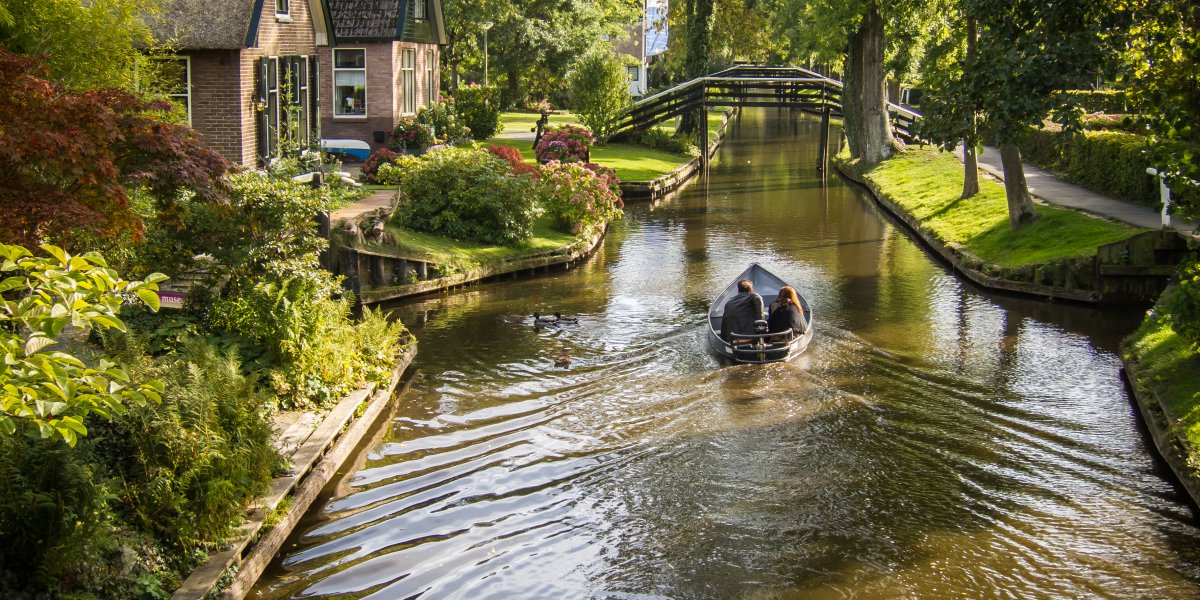
From the Dominee Hylkemaweg parking lot, walk past the welcome sign and onto Binnenpad — the moment cars vanish behind you, the village begins. This single, no-car footpath runs the spine of Giethoorn, with thatched-roof farmhouses on your left, glass-still canals on your right, and wooden arched bridges every fifty paces. Walk slowly: locals are pulling tomatoes out of greenhouses and tying up their boats, and you have the path to yourselves before the buses arrive.
Tip: Arrive by 9 AM sharp — tour buses from Amsterdam unload around 2,000 day-trippers between 10:30 and 16:00, and the bridges become impossible to photograph empty. Stick to the east bank of the canal for the classic mirror-reflection shot of bridge-over-water.
Open in Google Maps →11:00
Entertainment
Continue 3 minutes north along Binnenpad to the small wooden dock at Hans Smit's — you'll see the row of white-and-green electric boats moored at the canal edge. These are 'fluisterboten' (whisper boats): silent electric motors that the Dutch government mandates here to preserve the village's quiet. No license required, no instructor on board — you steer yourself through the 4 km canal network and the linked lake, gliding under the bridges you photographed an hour ago, this time from underneath.
Tip: Take the first boat slot at 11:00 — by 13:00 the canal turns into rush-hour with group-tour barges that block the narrow channels. Steer LEFT at every junction (Dutch rule) and always yield to oncoming boats; the boat is 100% your liability if you scrape someone's hull.
Open in Google Maps →13:00
Food
Step off the boat at Smit's dock and walk 2 minutes north — the wooden bridge in front of Fanfare is your landmark. This is the café-restaurant named after Bert Haanstra's 1958 film 'Fanfare,' which was shot here and put Giethoorn on the map. The canal-side terrace is small and locals know it; the kitchen turns plates fast and the menu is short on purpose. Quick, honest Dutch food before the afternoon push.
Tip: Order the bitterballen (€8, crispy meat croquettes — Dutch national snack) and one savory pannenkoek with bacon (€13) to share. Sit on the canal-side terrace, not the indoor room. By 13:30 the terrace is full — if you're not seated by 13:10, ask for takeaway and eat on the bridge railing instead.
Open in Google Maps →14:00
Neighborhood
Cross the bridge in front of Fanfare and continue 5 minutes north along Binnenpad — the thatched roofs grow denser and lower, the canals narrower. De Olde Maat Uus is the most photographed farmhouse in the Netherlands, a 19th-century peat-farmer's home with reed roof reaching almost to the ground. We're not going inside (the museum interior is small and skippable) — the magic is the cluster of working farmhouses on both sides of the canal, gardens spilling over the water, private wooden bridges leading to each front door.
Tip: Skip the entrance ticket — the iconic exterior is free and the interior is a small dim folk-museum not worth the queue. Stand on the wooden footbridge directly opposite De Olde Maat Uus (Binnenpad 53) at 14:30 for the cover-photo angle: low-afternoon sun lights the thatched roof from the southwest and the canal mirrors the whole cluster.
Open in Google Maps →15:30
Park
From De Olde Maat Uus, turn right onto Jan Hozzenpad and walk east 7 minutes — the canal widens, the houses thin out, and suddenly the path opens onto Bovenwijde, the broad shallow lake that gives Giethoorn its second face. This was a peat-extraction lake that flooded in the 18th century, and reed-cutters still work the edges. The path circles the south shore for kilometers; in spring-summer evenings the water turns flat as glass and the sky burns gold-orange across it. This is where you understand why people stay overnight here.
Tip: Walk Jan Hozzenpad east until the reed beds open up, then keep going to the small wooden viewing platform — locals know it, day-trippers don't. Golden hour begins around 19:30 in May-August; the sun sets over the village skyline to the southwest, silhouetting the thatched roofs against the orange water. Bring mosquito repellent: the lake edge swarms after 19:00 in summer.
Open in Google Maps →19:00
Food
Walk back along the south shore of Bovenwijde for 6 minutes — Pannenkoekenhuis Otterskooi sits exactly where the canal meets the lake, with its own canal-side terrace catching the last evening light. Dutch pancakes here are not dessert — they're a proper full-plate dinner, savory and sweet versions, the meal locals eat after a long working day. The dining room is wood-beamed, the kitchen has been run by the same family for two generations, and the canal water laps the terrace railing.
Tip: Order the spek-en-appel pannenkoek (bacon and apple, €14) — the savory-sweet combination is the Dutch national dish. Reserve the same day via phone before 17:00; without booking you'll wait 45+ minutes on summer evenings. PITFALL WARNING: do NOT eat at the cluster of fast-food shacks along Beulakerweg near the south parking lot — they exist purely for day-tripper foot traffic, charge €12 for cold fries, and the locals avoid them entirely.
Open in Google Maps →
Trip builder
Plan this trip around Giethoorn
Turn this guide into a bookable rail itinerary with FlipEarth.
Keep exploring
Related cities
More in the same country
FAQ
Frequently asked questions
How many days do you need in Giethoorn?
Most travelers enjoy Giethoorn in 1 days, with enough time for headline sights and a slower meal or museum stop.
What's the best time to visit Giethoorn?
The easiest season for most travelers is Apr-Sep, especially if you want good weather and manageable crowds.
What's the daily budget for Giethoorn?
A practical starting point is about €110 per person per day before hotels, then adjust based on museums, dining, and transport.
What are the must-see attractions in Giethoorn?
A good first shortlist for Giethoorn includes Binnenpad Footpath — South to Center Walk, Whisper Boat at Bootverhuur Hans Smit, Grand Café Fanfare.