City Guide
Trakai
Lituania · Best time to visit: May-Sep.
Day-by-day plan
Choose your pace
Duración del viaje
09:00
Neighborhood
From Trakai bus/train station, walk 10 minutes north up Vytauto gatvė and onto Karaimų gatvė — cobblestones, painted wooden cottages on both sides, Lake Galvė flashing through the gaps between houses. This is the only Karaim Turkic community of its size left in the world, brought here in 1397 by Grand Duke Vytautas from Crimea as his personal guard. Pause at the Kenesa (wooden prayer house, 1814) at Karaimų g. 30 — one of just two functioning Karaim prayer houses left in all of Europe.
Tip: Every Karaim house has exactly three windows on its street-facing gable: one for God, one for Grand Duke Vytautas, one for the family. Once you spot the pattern you'll see it on every house from here to Crimea — guidebooks never explain it.
Open in Google Maps →10:30
Landmark
Continue 400 m north on Karaimų gatvė until the painted cottages give way to a grassy mound and red-brick walls poking through the trees. The Peninsula Castle (Pusiasalio pilis) was Grand Duke Vytautas's original 14th-century capital — built before the more famous Island Castle was finished, and once one of the largest medieval fortifications in the Baltics. You walk freely through the ruins; in the soft mid-morning light, with the lake on three sides and no entry fee, the site is yours alone.
Tip: Climb the grassy embankment in the northwest corner — almost no one bothers. From up there you get a near-aerial framing of the keep with Lake Totoriškės directly behind, the angle guidebooks don't have. Best before 12:00 when the eastern sun still strikes the brick head-on.
Open in Google Maps →12:30
Food
Walk 5 minutes back south on Karaimų gatvė — the wooden facade at no. 65 with the hand-painted sign is unmistakable. Kybynlar is a Karaim family business now in its fourth generation; the dough is rolled and crimped in front of you, the fillings baked to order, never sat under a heat lamp. Order two lamb-and-onion kibinai (€3.50 each — a meal between them), one mushroom kibinai (€3 — almost no tour group orders it), and a bowl of krupnik barley-mushroom soup (€5).
Tip: Get them takeaway and walk 100 m to the small wooden pier behind the houses — eat lakeside with the Island Castle peeking through the pines. Indoor seating in summer means a 30-minute queue; takeaway skips it entirely and gives you the better view.
Open in Google Maps →14:00
Landmark
From Kybynlar, walk 5 minutes east to the foot of the peninsula, cross the road bridge, and trace the eastern shore of Lake Galvė north — the trail hugs the water for 2.5 km, the Island Castle sliding into view from a dozen postcard-free angles you'll see in no brochure. Užutrakis Manor (1901) sits on a tongue of land directly across from the castle; the formal French gardens were laid out by Édouard André, the same landscape architect behind Monaco's Casino Square. The grounds are free, the lakefront pavilion walkable, and almost no day-tripper makes it this far.
Tip: Walk the central axis of the French garden all the way to the lakefront pavilion — the Island Castle frames dead-centre at the end of the line of trimmed lawns. This is the single most underrated photo composition in Trakai, and you'll be alone for it. The line only resolves properly when you stand on the pavilion steps, not from the manor.
Open in Google Maps →16:30
Landmark
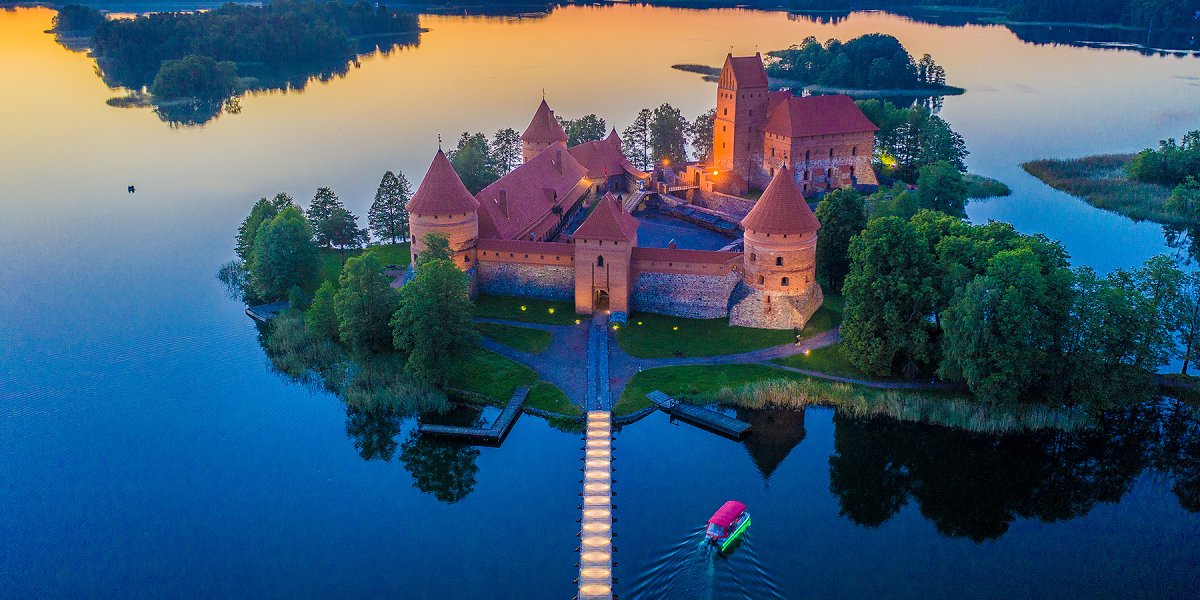
Retrace the eastern shore south for 2.5 km — by now the light has gone warm and the lake glass-still — then turn west and cross the two long wooden footbridges that step you across two small islets onto the castle island. The 14th-century Trakai Island Castle is Eastern Europe's only water castle still standing: red brick, three turrets, the original arched keep, marooned on its own island in the middle of Lake Galvė. Walk the full perimeter loop — the north face has no fences, no crowds, and brickwork still showing 1400s tool marks.
Tip: The famous reflection shot is from the second wooden footbridge looking north — but the cleaner frame is from the rocky beach 80 m west of the bridge: same castle, same reflection, no handrail in shot. Be in position by 18:00 in June, 16:30 in September — that's when the brick goes copper and the lake mirrors perfectly.
Open in Google Maps →19:00
Food
Cross back over both footbridges and walk 200 m south along Karaimų gatvė — the manor-style building with the open lake terrace is unmistakable. Apvalaus Stalo Klubas — "The Round Table Club" — is Trakai's proper sit-down restaurant, with full-frontal Island Castle views from its terrace. Order pan-fried Lake Galvė pike-perch with cep mushroom sauce (€22), start with cold beetroot soup šaltibarščiai (€7 — neon pink, served only May–September), and finish with a shot of local krupnikas honey spirit.
Tip: Reserve a terrace table 1–2 days ahead in summer; ask specifically for the western edge where the castle sits dead-centre in your view as the sun drops behind it. Pitfall: ignore the cluster of cafés near the southern bus stop advertising "kibinai €15" — tour-bus traps with frozen dough and microwaved fillings. Real Trakai kibinai are €3–5 and made to order, like at Kybynlar. Also skip the boat-tour touts at the footbridges: the castle's best moments are on foot at golden hour, not from a 90-minute lake circle for €15.
Open in Google Maps →
Trip builder
Plan this trip around Trakai
Turn this guide into a bookable rail itinerary with FlipEarth.
Keep exploring
Related cities
More in the same country
FAQ
Frequently asked questions
How many days do you need in Trakai?
Most travelers enjoy Trakai in 1 days, with enough time for headline sights and a slower meal or museum stop.
What's the best time to visit Trakai?
The easiest season for most travelers is May-Sep, especially if you want good weather and manageable crowds.
What's the daily budget for Trakai?
A practical starting point is about €55 per person per day before hotels, then adjust based on museums, dining, and transport.
What are the must-see attractions in Trakai?
A good first shortlist for Trakai includes Trakai Peninsula Castle Ruins, Užutrakis Manor & French Gardens, Trakai Island Castle.