City Guide
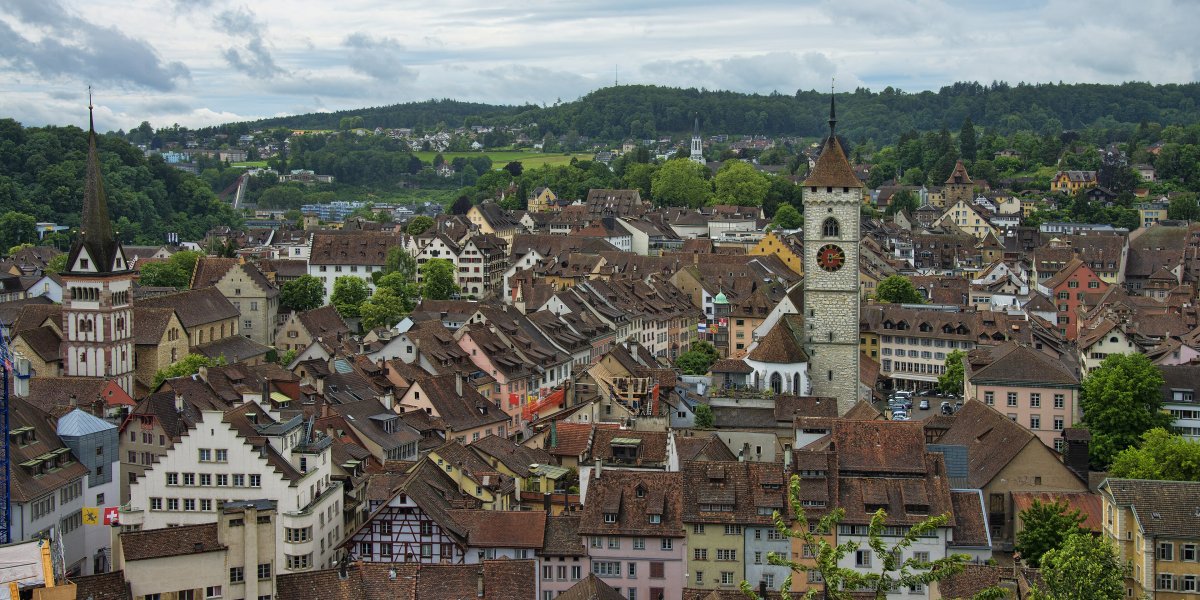
Schaffhausen
Suiza · Best time to visit: May-Sep.
Day-by-day plan
Choose your pace
Duración del viaje
09:00
Landmark
Exit Schaffhausen station to the southeast, cross Bahnhofstrasse, and follow the signposted stone staircase up through the Munotvineyard — a 12-minute climb that opens onto the only fully circular Renaissance fortress in Switzerland (1564–1589). Walk the rampart, then enter the central keep: the spiral ramp inside was built wide enough for horses to ride up, and it still delivers you to a 360° terrace where the old town's red roofs frame the Rhine bending south toward Germany. Fallow deer graze in the dry moat below — listen for the bells before you spot them.
Tip: Take the spiral horse-ramp inside the keep instead of the modern external stairs — most visitors miss it and shoot straight up the metal staircase. The ramp is dimly lit, smells of stone, and gives you the keep entirely to yourself for 90 seconds.
Open in Google Maps →10:30
Neighborhood
Descend the Munot's south slope via the wooden Schmiedstube gate, drop into Unterstadt, and turn right onto Vordergasse — 7 minutes door to door. You now have under your feet the highest density of oriel windows (Erker) anywhere in Switzerland: timbered, frescoed, gilded — every facade a 16th-century guild bragging publicly. Stop at Vordergasse 65 for Haus zum Ritter, where Tobias Stimmer's 1568 Renaissance frescoes still cover the entire street wall. Continue west to Fronwagplatz, passing the painted Goldener Ochsen and the iron-grilled Schmiedstube guildhall.
Tip: Arrive between 10:30 and 11:30 — the sun is east-southeast and the side-light on Vordergasse rakes across the carved oriels, revealing depth that flat midday sun erases. Count the 17 mythological figures on Haus zum Ritter from the bench across the street; standing too close, you miss the upper register entirely.
Open in Google Maps →12:00
Food
Two minutes west along Vordergasse delivers you to Fronwagplatz and Sturzenegger, the 1928 butcher counter that protects the Schaffhauser Bratwurst — a snow-white veal sausage with its own cantonal IGP, distinct from the heavier Zürcher version. Order one Schaffhauser Bratwurst with a crusty Bürli roll and a smear of senf, eat it standing at the chrome counter inside, then take a coffee out to the benches around the Mohrenbrunnen fountain. This is what Schaffhauser eat on a working lunch.
Tip: Order Bratwurst mit Bürli (CHF 9.50), not the platter — locals eat it one-handed with mustard only; the ketchup bottle on the counter is for German tourists. Skip the upstairs lunch room and stay at the metal counter where the apprentice butchers grill in front of you.
Open in Google Maps →13:30
Landmark
Walk 6 minutes south on Münstergasse back to Schaffhausen station, take the S33 toward Winterthur, and step off at Schloss Laufen am Rheinfall — an 8-minute ride that drops you directly inside the castle compound. From the courtyard, a glass-floored elevator lowers you to the Känzeli platform, where you hover a metre above 600 cubic metres of water per second. Walk down the wooden Belvedere stairs to the second platform — the spray hits your face, the basalt under your feet vibrates, and Europe's most powerful waterfall fills your entire field of view.
Tip: Skip the crowded Känzeli and walk 30 steps further down to the lower wooden platform — same water curtain, half the people, and the rainbow that forms between 13:30 and 14:30 (sun south-southwest) arches right through your frame. Buy the combined platform-plus-boat ticket at the upper kiosk to bypass the long ticket line at the dock below.
Open in Google Maps →16:00
Entertainment
From the Belvedere, the marked path drops you down 80 cut-stone steps to the boat dock. Board the small yellow Mändli (not the bigger blue ferry — only the Mändli lands at the central rock) for the 4-minute crossing through the curtain of mist to the Mittlerer Felsen, the basalt tooth splitting the falls in two. Climb the iron stair carved into its interior to the Swiss flag at the summit — 40 metres above the river, the wind tears every voice away, and from up there the falls are entirely yours.
Tip: Last Felsen-rock boat in summer leaves the dock at 18:00 (17:00 in May/Sep), and the queue swells after 16:30 — board the 16:00 sailing exactly. The interior stair is one-way at the top: if a group is descending, wait at the half-landing, otherwise you'll meet them at the narrowest gap with nowhere to step.
Open in Google Maps →18:30
Food
Re-board the Mändli for the 3-minute crossing to Schlössli Wörth, a 13th-century customs house perched on its own islet 40 metres from the falling water. The terrace runs along the railing where the Rhine accelerates into the cataract — order the Schaffhauser Rheinforelle (Rhine trout, CHF 42) and a glass of Hallauer Blauburgunder from the Klettgau valley vines you passed by train this morning. As the light turns amber on the basalt, the day-trip buses are long gone and the falls thunder for an audience of about thirty.
Tip: Reserve at least 10 days ahead and specify 'Aussenterrasse mit Wasserfallblick' — only the front row of 8 tables actually faces the cataract; the rest see the islet's back garden. Pitfall warning: ignore the 'Rhine Falls Combi-Ticket' touts on the Neuhausen approach road — it bundles a CHF 12 car-park fee you don't need; the S33 train drops you free inside the south gate, saving CHF 15 per head.
Open in Google Maps →
Trip builder
Plan this trip around Schaffhausen
Turn this guide into a bookable rail itinerary with FlipEarth.
Keep exploring
Related cities
More in the same country
FAQ
Frequently asked questions
How many days do you need in Schaffhausen?
Most travelers enjoy Schaffhausen in 1 days, with enough time for headline sights and a slower meal or museum stop.
What's the best time to visit Schaffhausen?
The easiest season for most travelers is May-Sep, especially if you want good weather and manageable crowds.
What's the daily budget for Schaffhausen?
A practical starting point is about €120 per person per day before hotels, then adjust based on museums, dining, and transport.
What are the must-see attractions in Schaffhausen?
A good first shortlist for Schaffhausen includes Munot Fortress, Rhine Falls Viewing Platforms (Schloss Laufen).