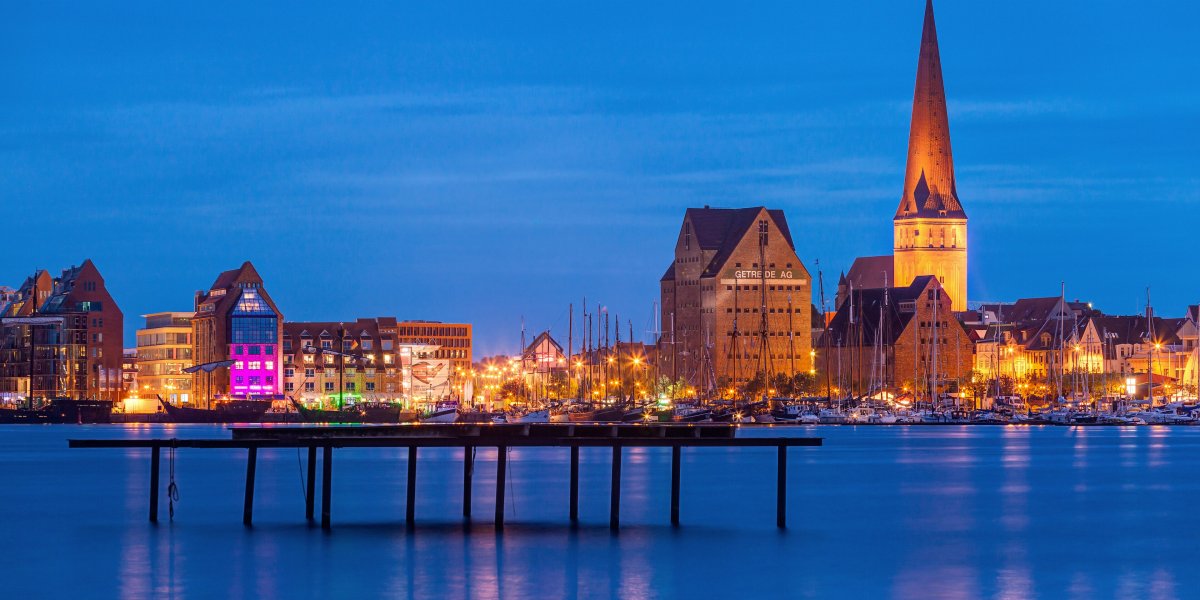
City Guide
Rostock
Alemania · Best time to visit: May-Sep.
Day-by-day plan
Choose your pace
Duración del viaje
09:00
Landmark
Begin at the surviving 14th-century brick western gate while the morning light still hits its red facade head-on. Walk east down Kröpeliner Straße — the linden-shaded pedestrian spine that slices the medieval old town in a perfect straight line — through Universitätsplatz with its bronze Brunnen der Lebensfreude fountain (locals call it the 'porno-brunnen' — you'll see why), ending at the rose-pink Renaissance arcades of the Town Hall on Neuer Markt. This 1 km walk is Rostock in a single stroke: gate, university, square.
Tip: Shoot Kröpeliner Tor from Wallanlagen park to the south — you'll get the full seven-tier brick silhouette framed by old city moat trees, with no tram cables overhead. The east face is in shadow until 11:00, so morning is non-negotiable for this angle.
Open in Google Maps →11:00
Religious
From the southeast corner of Neuer Markt, duck through the brick alley behind the Town Hall — 3-minute walk to the soaring brick-gothic St. Mary's. Entry is free; walk straight past the nave to the towering astronomical clock behind the altar, built in 1472 by Hans Düringer and still running on its original medieval gearwork — the only one in the world that has never been mechanically rebuilt.
Tip: Arrive by 11:50 and stand to the left of the altar rail. At noon sharp, the twelve apostles parade across the upper face — the door slams shut on Judas, who is left out forever. It lasts 90 seconds and happens only once a day. Drop 2 EUR in the box; a sacristan winds the clock by hand every morning, and that money is what keeps it alive.
Open in Google Maps →12:45
Food
Exit Marienkirche north through Schnickmannstraße — 8-minute downhill walk past gabled merchant houses to the working Hanseatic harbor. Grab a fischbrötchen (5–6 EUR) at the Kutterfisch stall near Pier 1, facing the moored Likedeeler tall ship. This is the North German walking lunch: pickled fish, raw onion, brioche bun, eaten standing at the quay wall.
Tip: Order Matjes (sweet Dutch-style herring) if you've never had pickled fish before — it's the gateway. Skip Bismarck (vinegar-cured, sharp) on a first try. Locals never sit down for this; eat it leaning on the harbor wall watching the ferries — the smell of diesel and brine is half the experience.
Open in Google Maps →14:30
Landmark
Tram 6 from Lange Straße to Rostock Hbf (10 min), then S1 S-Bahn to Warnemünde (22 min — buy the Tageskarte for 7 EUR). Exit the station, cross the small drawbridge over the Alter Strom canal lined with fishing cutters, and the postcard reveals itself: the white 1898 Leuchtturm beside the swooping 1968 mushroom-shaped Teepott pavilion — Baltic kitsch and East German modernism in a single frame.
Tip: Climb the lighthouse (4 EUR, May–Sep, last entry 18:30) — 135 steps for the only view that puts the beach, the harbor mouth, the red-roofed fishermen's quarter and a passing cruise ship in one shot. The seaward platform is windward; do the photo loop counter-clockwise so the sun is behind you over the harbor.
Open in Google Maps →17:00
Park
From the Teepott, walk straight down the wooden boardwalk onto the sand and turn left toward the long concrete Westmole pier — 1.2 km along Germany's widest beach (150 m of fine white sand) to the harbor mouth, where cruise ships and the Scandlines ferries to Gedser thread the narrow channel within 30 meters of the pier tip.
Tip: Walk barefoot — the sand holds warmth past 19:00 even in May. If a Scandlines ferry departs while you're on the pier (every 2 hours, on the half-hour), wave and the bridge crew will sound the horn back. The far west end of the beach (past Strandhotel Hübner) is the FKK nudist section — keep that in mind if you wander.
Open in Google Maps →19:30
Food
Cut back from the Westmole through the dunes onto Seestraße — 12-minute walk to Alter Strom, the canal of fishing boats lined with seafood restaurants. Fischers Alm sits at Am Strom 105, two-thirds down on the inland side: dark wood, fishing nets on the ceiling, half the dining room is locals from Rostock who drive the 12 km out for dinner.
Tip: Order the fried Scholle Müllerin Art (whole Baltic plaice in browned butter with bacon and salt potatoes, 22 EUR) — this is the dish that defines this coast, not pasta. Pair with a Rostocker Pilsner. No reservation needed before 19:30; after that, expect 30 min wait. Pitfall: avoid the restaurants on the boardwalk side of the channel with photo-menus and hawkers out front — they're double the price for frozen fish from a different ocean. The local rule: real Warnemünde fish kitchens don't need to advertise.
Open in Google Maps →Saltar al día
09:00
Landmark
Begin at the heart of medieval Rostock while Neuer Markt still belongs to delivery vans and dog walkers, not tour groups. The Rathaus is a Hanseatic curiosity — seven 13th-century Brick Gothic spires hide behind a pink Baroque arcade bolted on three centuries later. Walk a slow loop around the square to spot the gabled merchant houses, rebuilt after WWII bombing using the original 15th-century blueprints.
Tip: Stand on the south side of Neuer Markt directly opposite the Rathaus — this is the only angle where you can see both the Baroque arcade and the seven Gothic spires poking up behind it. The shot disappears after 10:30 when coach groups arrive.
Open in Google Maps →10:00
Religious
Cross Neuer Markt heading north along Ziegenmarkt — three minutes and the cathedral's massive brick silhouette fills the lane. Inside this 13th-century giant of Brick Gothic you'll find a bronze baptismal font from 1290, a Baroque organ Bach reportedly played, and the 1472 astronomical clock — the only one of its era in the world still running on its original mechanism. At precisely 12:00 noon, the twelve apostles parade out from a hidden door behind the clock face while a single figure of Judas remains forever locked outside.
Tip: Take a position in the south transept by 11:50 for the noon parade — most visitors crowd directly in front of the clock, but the side angle lets you see both the moving apostles and the calendar disc spinning below. The current disc runs until 2150; the previous one had to be replaced when its dates ran out in 2017.
Open in Google Maps →12:30
Food
Exit Marienkirche through the south door and walk five minutes north along Wokrenterstraße — Rostock's narrowest medieval lane, lined with the oldest preserved Hanseatic merchant houses in the city. Zur Kogge has fed sailors and dockworkers since 1722 inside a low-beamed room shaped like a ship's hull, complete with rigging, hanging lanterns, and a portrait gallery of 19th-century sea captains. Order the Mecklenburger Rippenbraten (slow-braised pork ribs with apple-cabbage, €18) and a Sanddorn-Sekt aperitif (€6) made from the orange sea-buckthorn berries that grow wild along the Baltic dunes.
Tip: Skip the reservation — doors open at 11:30 and the corner table by the porthole windows goes to whoever walks in first. Avoid the printed Fischsuppe; the kitchen's pride is meat dishes, and regulars order the Labskaus (sailor's hash with red beets and pickled herring) instead.
Open in Google Maps →14:00
Neighborhood
From Zur Kogge, walk three minutes south through Hopfenmarkt to Universitätsplatz, where the Brunnen der Lebensfreude (Fountain of the Joy of Life) — a controversial 1980 GDR sculpture of nude figures locals nicknamed 'Pornobrunnen' — still draws sunbathing students every afternoon. Behind it stands the 1419 main university building, the oldest in continuously German-speaking Northern Europe. Walk the full length of Kröpeliner Straße westbound, a broad pedestrian artery lined with surviving Baroque merchant gables, until the 14th-century Kröpeliner Tor brick gate rises at the far end of the avenue.
Tip: Climb the three internal floors of Kröpeliner Tor (€2.50 at the small gate museum on level 1) for the only elevated view of the old town's red-tiled roofs that doesn't require a church tower queue. Most tourists pass through the arch without realizing the gate itself is climbable.
Open in Google Maps →16:00
Museum
Retrace Kröpeliner Straße eastbound for ten minutes, then duck left at Hopfenmarkt into Klosterhof — a hidden cloister courtyard most visitors walk straight past. The museum lives inside Kloster zum Heiligen Kreuz, a Cistercian convent founded in 1270 by Queen Margaret of Denmark whose vaulted cloisters have survived seven centuries of war intact. Inside: Hanseatic merchant silver, Northern European panel paintings from the workshop of Lucas Cranach, and the original carved figures rescued from Marienkirche's medieval altar.
Tip: Admission is completely free year-round, a fact most guidebooks omit — combined with its 18:00 closing time, this is the quietest serious museum in any Hanseatic city. Head straight to room 7 on the upper floor for the 14th-century convent kitchen still showing soot on its vault from cooking fires.
Open in Google Maps →19:30
Food
Leave the cloister through the gate and walk eight minutes north downhill — cross Lange Straße, descend Schnickmannstraße, and you emerge directly onto the Stadthafen where freighters dock against the old harborfront. Borwin sits on the upper floor of a converted dock warehouse with floor-to-ceiling windows facing the Warnow river. Order the Ostsee-Steinbutt (Baltic turbot fillet with brown-butter potatoes, €34) and a glass of dry Riesling from Saale-Unstrut, Germany's northernmost wine country, only 400 km south.
Tip: Book a window seat for sunset — the Warnow faces west and the harbor cranes catch the last light around 20:30 in summer. Skip the touristy Ratskeller on Neuer Markt, and avoid the schnitzel chains along Kröpeliner Straße catering to coach groups: they look local, but the menus print in five languages and the kitchens reheat frozen plates from a central commissary.
Open in Google Maps →10:00
Landmark
Take S-Bahn S1 from Rostock Hbf — 22 minutes, departing every 15, ending right at the Warnemünde promenade. From the station, walk five minutes north along Bahnhofstraße and the white 31-meter lighthouse rises directly ahead at the river mouth. Built in 1898 from glazed brick to survive Baltic storms, it is still operational; climb the 135 spiral steps for a 360° view of the harbor entrance, the open Baltic, and the curve of beach stretching west toward Markgrafenheide.
Tip: Arrive at 10:00 sharp when the lighthouse opens — by 11:30 cruise-ship passengers from the AIDA terminal flood the spiral staircase and the climb becomes a slow shuffle. From the top platform, look northeast for a free preview of the Westmole pier you'll walk later in the afternoon.
Open in Google Maps →11:15
Neighborhood
Descend the lighthouse and walk three minutes south to the Alter Strom — Warnemünde's former main harbor channel, now lined with bobbing wooden fishing cutters where families still sell smoked fish straight off the boats. Wander east one block to Alexandrinenstraße, the village's oldest lane, where 18th-century thatched-roof fishermen's cottages sit shoulder-to-shoulder with their original blue shutters still intact. The narrow lanes branching off it — Kirchenstraße, Mühlenstraße — open into small courtyards almost no day-tripper discovers.
Tip: The fishing cutters numbered 7 through 12 along Alter Strom still smoke fish on board — look for small chalkboards reading 'Geräucherter Fisch frisch heute.' A whole smoked mackerel bought directly from the deck costs €5; the same fish on the menu of the restaurants three meters away costs €14.
Open in Google Maps →13:00
Food
From Alexandrinenstraße, walk two minutes north along Am Strom to the original smokehouse where Warnemünde fishermen have cured their catch over alder and beech wood since 1928. Order the Fischbrötchen mit geräuchertem Aal (smoked-eel sandwich on rye, €6) and the Backfisch-Teller (battered Baltic plaice with remoulade and potato salad, €13) and eat them outside on the wooden benches facing the channel. The woodsmoke clings to your jacket all afternoon and you'll be glad it does.
Tip: Order the Aal (eel) over the more common Lachs (salmon) — the smokehouse cures eel from Mecklenburg's inland lakes using a method registered with the EU as Protected Designation of Origin. Six other smokehouses line Alter Strom, but only this one and Fischhalle still use traditional wood-burning ovens; the others switched to electric long ago.
Open in Google Maps →14:30
Park
From the smokehouse, walk three minutes west across the lighthouse plaza — Germany's widest beach (150 meters of fine white sand) opens directly ahead, stretching three kilometers westward. Walk out onto the Westmole, the granite breakwater jutting 500 meters into the Baltic, and sit at the very end to watch cargo ships and the AIDA cruise liner slide past at arm's length on their way into the harbor channel. The afternoon brings clearer water and warmer sand than the morning, when Baltic fog often lingers along the shoreline.
Tip: Rent a Strandkorb (covered wicker beach chair, €10/half-day) from any of the orange beach huts — locals consider them essential against the Baltic wind, and the leeward shelter is what separates a beautiful afternoon from a shivering one. The Strandkorb keepers also store your shoes free if you want to walk the wet sand barefoot.
Open in Google Maps →17:00
Museum
Walk five minutes back inland along Alexandrinenstraße — the Heimatmuseum occupies one of the village's original fisherman's cottages from 1767, kept exactly as it was when a Warnemünde family lived in it. The wooden box-beds built into the walls, the soot-blackened kitchen, the ship-captain's chest stuffed with brass nautical instruments and Bibles in seven languages — it is the most intimate portrait of how Baltic fishing villages actually lived before the cruise ships came. Closes at 18:00, so this is the natural close of the day-trip arc.
Tip: Ask the desk attendant to open the cellar — it's not on the standard route, but inside is a working 18th-century salt-cod brining basin still smelling faintly of brine. The museum closes promptly at 18:00; arriving by 17:00 gives a relaxed full hour without rushing.
Open in Google Maps →19:00
Food
Walk seven minutes northwest along Seestraße to the white wedding-cake building rising directly off the dune line — Strandhalle has been Warnemünde's seafront ballroom-restaurant since 1909, and the curved windows of the upper dining room face the open Baltic at the exact compass point where the summer sun sets. Order the Mecklenburger Ostseeforelle (Baltic sea trout with samphire, €28) and finish with Rote Grütze mit Vanillesoße (red berry compote with vanilla cream, €8) — the dessert of every Baltic grandmother since 1850.
Tip: Reserve a sea-side window table at least 48 hours ahead (+49 381 5193 6193) — summer sunset over the Baltic lands at 21:30 and the room fills by 19:30. Avoid the cruise-ship promenade restaurants along Seepromenade between Hotel Neptun and the lighthouse: their windows face the cruise terminal rather than the open sea, and their kitchens exist mainly to feed AIDA passengers on two-hour port stops with overpriced photocopied menus.
Open in Google Maps →
Trip builder
Plan this trip around Rostock
Turn this guide into a bookable rail itinerary with FlipEarth.
Keep exploring
Related cities
More in the same country
FAQ
Frequently asked questions
How many days do you need in Rostock?
Most travelers enjoy Rostock in 1 days, with enough time for headline sights and a slower meal or museum stop.
What's the best time to visit Rostock?
The easiest season for most travelers is May-Sep, especially if you want good weather and manageable crowds.
What's the daily budget for Rostock?
A practical starting point is about €85 per person per day before hotels, then adjust based on museums, dining, and transport.
What are the must-see attractions in Rostock?
A good first shortlist for Rostock includes Kröpeliner Tor & Old Town Spine, Warnemünde Leuchtturm & Teepott.