City Guide
Olympia
Grecia · Best time to visit: Apr-Oct.
Day-by-day plan
Choose your pace
Duración del viaje
09:00
Landmark
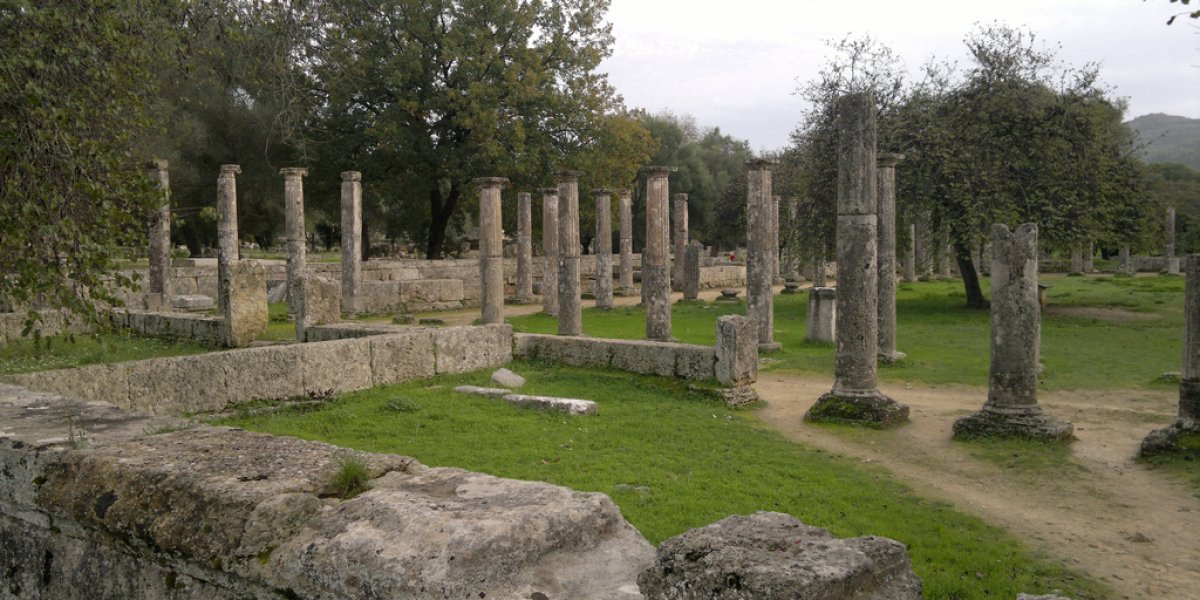
Walk south down Praxitelous Kondili from the modern town for 8 minutes, cross the Kladeos bridge, and enter the archaeological site at opening before the cruise buses arrive. Head straight west into the Altis to the Heraion — the oldest temple here (600 BC), where the Olympic flame is still lit by 11 priestesses every four years. Continue past the Philippeion (the only round building of the sanctuary, built by Alexander the Great's father) to the Workshop of Phidias, where the gold-and-ivory Statue of Zeus — one of the Seven Wonders — was sculpted.
Tip: Buy the combined site ticket online the night before — saves a 15-minute queue at the cashier. The black hearth-stone in front of the Heraion is THE flame-lighting spot; at 09:15 the low sun lights its standing column warm gold from the south side.
Open in Google Maps →10:15
Landmark
Walk 5 minutes east through the Altis past fallen column drums the size of small cars — these are the ruins of the Temple of Zeus, which once housed the 13-meter chryselephantine god, one of the Seven Wonders. Continue east through the Krypte, the vaulted athletes' tunnel — and you burst out into the original Olympic Stadium, a flat lane of red earth between grass embankments. Run it: the 192.27-meter track is exactly the distance that crowned the very first Olympic champion in 776 BC.
Tip: Time your run for 11:00 — the first coach groups cluster at the Zeus columns then, leaving the Stadium momentarily empty. Sprint from the tunnel end toward the judges' bema (that's the direction ancient athletes raced) and have someone wait at the bema for the iconic finishing-line photo.
Open in Google Maps →11:45
Park
Backtrack 3 minutes west and pick up the pine-shaded path that climbs the small hill behind the Heraion. Fifteen minutes up through aleppo pines brings you to the wooden bench at the summit of Kronion, the hill sacred to Cronus, Zeus's father. From here the entire sanctuary lies below you as one readable map — Heraion, Philippeion, the fallen Zeus columns, the Stadium beyond — every stone you just walked over.
Tip: Almost no one bothers with Kronion — you'll have it to yourself even in peak August. It is also the only true panoramic angle for photos of the whole archaeological area, and the pine canopy makes it the coolest spot in the site.
Open in Google Maps →13:00
Food
Exit the site through the main gate, cross the Kladeos bridge again, and walk 8 minutes north up Praxitelous Kondili — Pegasus sits on the corner where the pedestrian section begins, shaded outdoor tables under a vine canopy. Skip the printed menu: ask for a pork gyros pita (€4) and a small Greek salad (€8), washed down with the house-made lemonade. Fast, honest food cooked by the family that owns the place.
Tip: Order the pork gyros, never the chicken — the pork is marinated overnight in red wine and oregano and that is the dish locals come for. Avoid the three restaurants directly facing the site entrance: same gyros, double the price, frozen pita.
Open in Google Maps →15:00
Landmark
Walk back south down Praxitelous Kondili, cross the Alfeios River bridge — the same river where ancient athletes purified themselves before competing — and continue along the quiet road shaded by cypresses. Twenty minutes brings you to a marble stele standing alone in an olive grove: Pierre de Coubertin's heart is buried here, by his own request when he revived the modern Olympic Games in 1896 (the rest of him lies in Lausanne). Behind the stele rises the International Olympic Academy, where every Olympic torchbearer trains.
Tip: The walk along the Alfeios is half the experience — late-afternoon sun filters through the cypresses and lights the river silver around 16:00. Continue 200 meters past the stele to the IOA's hilltop monument for the long view down the Olympia valley toward the sea.
Open in Google Maps →19:30
Food
Walk the same road back into modern Olympia — 25 minutes, arriving just as the streetlamps come on along Praxitelous Kondili. Anesi is a third-generation family taverna where the lamb is slow-roasted in a wood oven from dawn. Order the kleftiko (slow-roasted lamb shank wrapped in parchment, €18) and the moussaka (€11), with a half-carafe of local Peloponnese rosé — and finish with the complimentary semolina halva the owner brings out after midnight gestures.
Tip: Arrive at 19:30 sharp — by 20:30 the coach groups returning from cruise day-trips arrive together and the kitchen slows by 40 minutes. Ask for the small back terrace, not the street front. And the pitfall: avoid any restaurant in town advertising a 'Traditional Greek Night with Dancing' — €40 per head for pre-cooked plate food and a recorded bouzouki track.
Open in Google Maps →
Trip builder
Plan this trip around Olympia
Turn this guide into a bookable rail itinerary with FlipEarth.
Keep exploring
Related cities
More in the same country
FAQ
Frequently asked questions
How many days do you need in Olympia?
Most travelers enjoy Olympia in 1 days, with enough time for headline sights and a slower meal or museum stop.
What's the best time to visit Olympia?
The easiest season for most travelers is Apr-Oct, especially if you want good weather and manageable crowds.
What's the daily budget for Olympia?
A practical starting point is about €85 per person per day before hotels, then adjust based on museums, dining, and transport.
What are the must-see attractions in Olympia?
A good first shortlist for Olympia includes Temple of Hera & the Sacred Altis, Temple of Zeus & Run the Ancient Stadium, Pierre de Coubertin Stele & the Olive Grove of the IOA.