City Guide
Novi Sad
Serbia · Best time to visit: May-Sep.
Day-by-day plan
Choose your pace
Duración del viaje
09:00
Landmark
Cross Varadin Bridge from the city side and climb the cobblestone ramp to the upper fortress — the 12-minute uphill walk is your warm-up, and the river view widens with every switchback. Often called the 'Gibraltar on the Danube,' this 17th-century Austro-Hungarian citadel is one of the largest preserved fortresses in Europe, crowned by an upside-down clock tower whose big hand marks the hours so sailors could read time from the river. You skip the underground tunnels and the museum interiors today — the panorama of Novi Sad's red rooftops from the upper rampart is the only photograph you came for.
Tip: Walk past the clock tower to the wall directly behind it — tour groups crowd the front for the clock selfie, but the city panorama is shot from the back wall, with the Danube curving below and the church spires lining up. Be there by 09:30, before the 11:00 bus groups roll in from Belgrade.
Open in Google Maps →11:45
Food
Descend the fortress on the north slope and cross back over Varadin Bridge — pause mid-bridge to shoot the citadel from the only angle that never tires, then walk five minutes along Mileve Marić to a 24-hour bakery that has fed three generations of Novi Sad. Aladin is the city's burek institution: flaky phyllo pies the size of your face, filled with cheese, meat, or apple, eaten standing at the counter with a yogurt drink. This is fuel, not theater — twenty minutes here and you are back on the street with the city ahead of you.
Tip: Order burek sa sirom (cheese burek, ~€2) with a glass of jogurt (drinking yogurt, ~€1) — that is how locals do it. Meat burek gets heavy and gummy after 11:00; cheese is the daytime move. Eat standing; sitting at the counter is for old men with newspapers, not for you on a clock.
Open in Google Maps →12:30
Religious
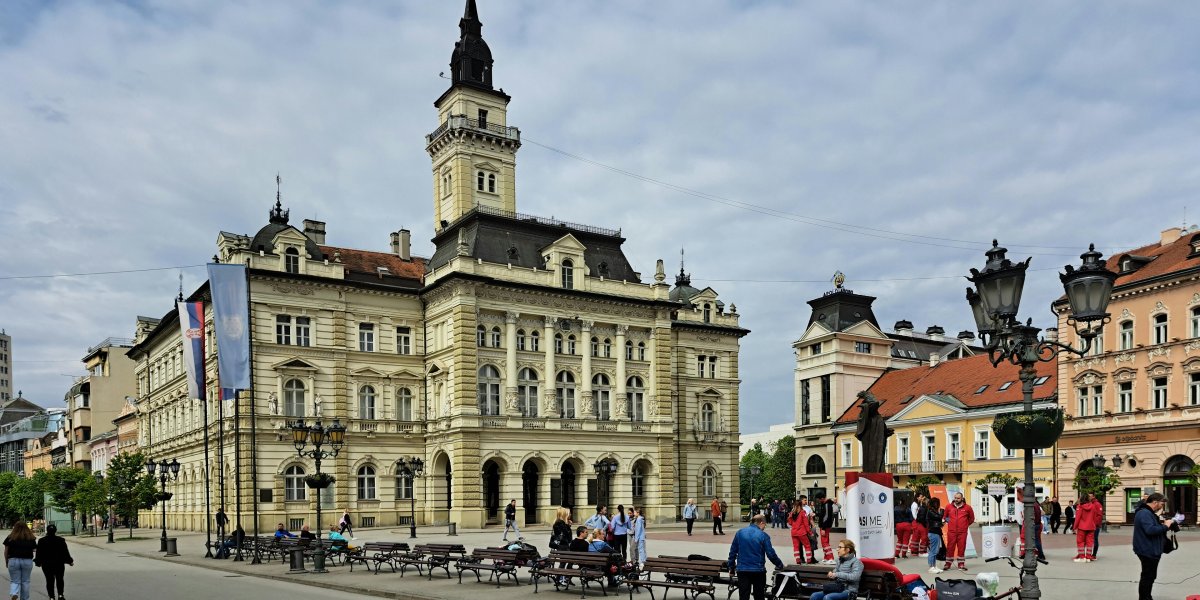
From Aladin, walk five minutes east along Mileve Marić — the neo-Gothic spire breaks the skyline a block before you arrive, and you emerge directly at the south end of the city's main square. Trg Slobode is framed by two facing landmarks: the 1894 Name of Mary Church, whose sandstone facade glows pink under midday sun, and the neo-Renaissance City Hall opposite, both presided over by the bronze statue of poet Svetozar Miletić mid-gesture. Locals call it 'the Catholic Church' though most of the city is Orthodox — a quiet reminder of the Habsburg layer beneath the Serbian present.
Tip: Stand at the south fountain end of the square for the composition that fits church spire and city hall clock tower in one frame — both buildings in line, the statue between them. The north end is where every tourist stops; the south end is where the photograph actually works.
Open in Google Maps →13:45
Neighborhood
Walk through the archway at the northeast corner of Liberty Square — you step onto cobblestones and the noise drops by half. Zmaj Jovina is the city's pedestrian artery, a 200-meter stretch of pastel facades, sidewalk cafes, and the occasional accordion player, terminating at Vladičanski Dvor — the Serbian Orthodox bishop's palace, its salmon-pink Byzantine facade closing the street like a final sentence. Stop for a Turkish coffee halfway down; this is where Novi Sad slows down and so should you.
Tip: Sidewalk cafes on Zmaj Jovina charge €2.50 for an espresso — walk one block onto parallel Dunavska Street for the same coffee at €1.20, served by the same kind of waiter in the same kind of apron. The premium is purely 'tourist street.' Save it for the view of the bishop's palace, not for the caffeine.
Open in Google Maps →15:45
Park
From the Bishop's Palace, continue east on Pašićeva for five minutes — the urban grid breaks open and you walk into a leafy 19th-century park that feels twice the size it actually is. Dunavski Park has shaded paths around a small lake, weeping willows leaning to the water, and the city's most-photographed bust of poet Đura Jakšić watching the swans. Late afternoon light filters sideways through the trees and locals fill the benches — sit for twenty minutes, watch the city breathe, and you understand why Tito called Novi Sad Serbia's most beautiful city.
Tip: Sit on the benches around the lake, not on the central lawn — the lawn fills with dog-walkers at 17:00, and the willow-side benches catch the only good sideways light of the day, the 'green hour' before the sun drops behind the fortress across the river.
Open in Google Maps →19:30
Food
From Dunavski Park, walk five minutes north on Sutjeska — the street narrows, the lighting softens, and the wrought-iron sign appears on your right. Plava Frajla ('The Blue Lady') is the place locals send visitors when they want them to taste real Vojvodina cooking: karađorđeva šnicla (rolled veal stuffed with kajmak, ~€14) is the dish you order, riblja čorba (Danube fish soup, ~€6) is the starter, washed down with a glass of Iločki Traminac from the Croatian side of the river. The interior is 1920s parlor — lace curtains, dark wood, oil lamps — and one well-spent dinner here is worth more than a day of average meals.
Tip: Reserve 24 hours ahead by phone (not email) and ask for the back garden in summer. Avoid the riverfront restaurants on Sunčani Kej below the fortress — they target day-trippers with English-only menus, padded bills, and a 'rakija on the house' that quietly appears as €8 on the check; the real Vojvodina cooking sits in residential blocks like this one, two streets back from any tourist's map.
Open in Google Maps →Saltar al día
09:00
Park
Begin at the wrought-iron gate on Dunavska Street — the morning chestnut canopy is doing what it has done for 130 years. Founded in 1895 as the old quarter's green lung, Dunavski Park hides a swan pond, a stone bridge, and the small bust of poet Branko Radičević. Early morning belongs to dog walkers, chess players, and grandmothers feeding sparrows — you see the city wake up before the tourist day begins.
Tip: Cross to the swan pond's stone bridge before 09:30 — the willow reflections on the water are the most photographed corner of the park and it empties only at this hour. Locals call this spot the 'mali most' (little bridge).
Open in Google Maps →10:30
Landmark
Exit the park's southern gate and walk five minutes west along Dunavska — the spire announces the square before you arrive. Liberty Square (Trg Slobode) is the beating heart of the city: the neo-Gothic Name of Mary Church (Crkva Imena Marijinog), built 1893-95 with a 76-metre spire that remains Novi Sad's tallest, faces the City Hall across a pedestrianised plaza. Step inside for the kaleidoscopic stained glass; the interior is small but luminous.
Tip: The honest postcard angle is not from inside the square but one block east at the corner of Modene and Zmaj Jovina — the spire frames perfectly against pastel facades, and the morning sun hits the south face of the church from 10:30 to 11:30.
Open in Google Maps →12:30
Food
Walk three minutes down Modene to the corner of Zmaj Jovina — the battered wooden sign of Toster Bar hasn't changed since the nineties and that is the entire point. This counter joint is a Novi Sad institution: toasted sandwiches that locals queue for, paired with cold Jelen beer at noon without anyone judging you. The 'Šnenokle' (ham, kashkaval, sour cream) and the 'Pikant' (spicy chicken with ajvar) are the cult orders.
Tip: Arrive at 12:30 sharp before the 13:00 student wave. Order the Šnenokle and a homemade limunada for ~5€ total. Cash preferred. Don't try to sit — it's a stand-at-the-counter joint and standing is the experience.
Open in Google Maps →14:00
Museum
From Toster Bar walk seven minutes back up Zmaj Jovina and right onto Dunavska — the museum is the imposing ochre palace at number 35-37. The Museum of Vojvodina tells the layered story of this multicultural plain: Roman silver, Habsburg porcelain, a haunting WWII section, and Serb-Hungarian-Slovak-Rusyn folk costumes that explain why this region feels unlike anywhere else in the Balkans. The crown jewel is three gilded Roman parade helmets discovered in nearby fields, dating to the 4th century.
Tip: Skip the temporary exhibitions on the ground floor and head straight to the third-floor Roman gallery — the parade helmets sit at the back-right under separate spotlighting and merit fifteen unrushed minutes. Audio guides in English are at the desk for 200 RSD.
Open in Google Maps →16:30
Neighborhood
Walk four minutes south down Dunavska to where it meets Zmaj Jovina — you have just stepped onto the city's living room. The pedestrian street of pastel 19th-century facades runs from the cathedral to the imposing red-brick Bishop's Palace, with a bronze poet Jovan Jovanović Zmaj in the middle. Walk slowly: side lanes (Pašićeva, Grčkoškolska, Mihajla Pupina) reveal hidden courtyards, the city's best small bookshops, and balconies with laundry that haven't met a tourist guide.
Tip: By 17:30 the facades turn amber and locals start the korzo (evening stroll); join the slow flow rather than fight it. Duck into Grčkoškolska Street for the prettiest unmarked courtyards — the gates are usually open and residents won't mind a quiet look.
Open in Google Maps →19:30
Food
From the Zmaj Jovina-Dunavska corner walk six minutes south-west along Modene and Ćirila i Metodija — the cobalt-painted facade is visible from a block away. 'The Blue Lady' (Plava Frajla) is Novi Sad's most beloved traditional Vojvodinian house: hand-painted blue walls, tamburica musicians from 20:00, and dishes that have not been modernised in three decades. Order the šaran u rerni (Danube carp baked with onions, ~15€) and finish with štrudla od maka (poppy seed strudel) and a glass of Fruška Gora rosé.
Tip: Reserve a day ahead and ask for the 'salon plave Frajle' (the front blue room, where the band plays) — the back courtyard lacks the soul. Tourist trap warning: avoid the cafes around Trg Slobode and Dunavska that display English menus on sidewalk easels; they charge 40-50% more and serve frozen pljeskavica that locals would never touch.
Open in Google Maps →09:30
Landmark
Start at the Riva embankment and walk twelve minutes south across the Varadinski Most — the fortress grows larger ahead and the morning mist still lies on the Danube below. Petrovaradin Fortress, the 'Gibraltar of the Danube,' is one of Europe's largest preserved fortresses, built by the Habsburgs 1692-1780 against the Ottomans. Its famous Drunken Clock on the upper bastion has the small hand showing hours and the large hand minutes — reversed — so river boatmen could read the time from far downstream.
Tip: Skip the main pedestrian gate and take the stone ramp from the bridge's south end — you'll emerge behind the clock tower with the panorama of the old town across the river before the tower itself, and that order of reveal matters. Be there before 11:00 when tour buses arrive.
Open in Google Maps →11:30
Museum
From the clock tower walk four minutes north along the upper bastion to the small wooden door marked 'Podzemne Galerije.' Beneath the fortress lies a 16-kilometre labyrinth of military tunnels on four levels — a hidden underground city built to withstand siege. Only one kilometre is open, by lantern-led guided tour: powder magazines, listening galleries, and acoustically engineered corridors designed to amplify enemy footsteps from above.
Tip: Buy the 11:30 English tour ticket at the small kiosk by the entrance ten minutes before the hour — the guide will not wait. Wear a light jacket; temperature is a steady 12°C year-round, and bring a phone torch for the unlit side passages the guide points to.
Open in Google Maps →13:00
Food
From the tunnel exit walk six minutes downhill through the fortress's south sallyport into Petrovaradin Lower Town — the smell of fresh bread on Štrosmajerova will guide you the last two blocks. Stara Pekara, 'The Old Bakery,' has worked the same wood-fired oven since 1860, and you can still see the brick mouth from the counter. The burek sa sirom (flaky cheese pastry, ~1.5€) and proja (cornbread with kashkaval) are the local lunch: grab a slice, eat on a bench in the square outside.
Tip: Arrive at 13:00, the moment the second daily bake comes out. Ask for 'burek sa sirom, topao' (hot cheese burek) so they pull from the new tray. Pair it with a small bottle of kiselo mleko (drinking yogurt) — the proper Serbian way and the whole lunch stays under 4€.
Open in Google Maps →14:30
Neighborhood
From the bakery's small square walk three minutes south down Štrosmajerova into the cobbled core of the Lower Town (Donji Grad). This is the Baroque time capsule almost no tourist sees: ochre-coloured 18th-century houses, a Franciscan monastery with a peaceful courtyard, narrow lanes where laundry hangs between balconies and cats sleep on warm window ledges. Officers of the fortress lived here, and many doorways still bear original Habsburg coats of arms above the stone lintels.
Tip: Walk Beogradska Street first then loop back via Vladike Platona — the latter has the prettiest hidden courtyards. Look up at the carved stone door lintels dated 1750s-1780s, and slip into the Franciscan monastery courtyard on Šajkaška for five minutes of complete silence.
Open in Google Maps →17:00
Park
From Lower Town walk twelve minutes downstream along the Danube path — the river widens, sand replaces stone, and Štrand opens up. This is Novi Sad's beloved urban Danube beach, where locals have summered for over a century: a 700-metre crescent of fine sand, paddle-tennis courts, a wooden boardwalk facing the old town skyline. Even non-swimmers come for the late-afternoon coffee with the city directly opposite.
Tip: Walk to the boardwalk's western end (closest to the fortress) for the sunset shot of the century — fortress on the left, cathedral spire on the right, the Danube glowing pink between them around 20:00 in summer. Order a domaća limunada at the kiosk; it's a third of city prices.
Open in Google Maps →19:30
Food
From Štrand walk fifteen minutes back across the Varadinski Most as the city lights come on along the embankment — Project 72 is on Kosovska, two blocks behind Liberty Square. Owned by a Fruška Gora vintner, this industrial-chic wine bar serves elevated Vojvodina cuisine: wild boar goulash (~12€), homemade tarhana soup, and a flight of three Fruška Gora wines (~10€) that turns dinner into a regional masterclass. The room is small, the staff knows every grape on the list, and you leave understanding Serbian wine for the first time.
Tip: Reserve a day ahead — only ten tables in the front room. Ask for the 'Fruška Gora flight' and request the rare Probus from Kovačević among the three. Tourist trap warning: do not be tempted by the riverside grill restaurants at the foot of the bridge with laminated photo menus — they charge triple for grilled meat that any modest neighbourhood kafana in town serves better and fresher.
Open in Google Maps →
Trip builder
Plan this trip around Novi Sad
Turn this guide into a bookable rail itinerary with FlipEarth.
Keep exploring
Related cities
More in the same country
FAQ
Frequently asked questions
How many days do you need in Novi Sad?
Most travelers enjoy Novi Sad in 1 days, with enough time for headline sights and a slower meal or museum stop.
What's the best time to visit Novi Sad?
The easiest season for most travelers is May-Sep, especially if you want good weather and manageable crowds.
What's the daily budget for Novi Sad?
A practical starting point is about €70 per person per day before hotels, then adjust based on museums, dining, and transport.
What are the must-see attractions in Novi Sad?
A good first shortlist for Novi Sad includes Petrovaradin Fortress.