City Guide
Limassol
Chipre · Best time to visit: Apr-Oct.
Day-by-day plan
Choose your pace
Duración del viaje
09:00
Park
Begin at the east end of Molos, where Cyprus's longest seafront ribbon stretches west: 3 km of date palms, shallow reflecting pools, and twelve large-scale sculptures by Cypriot artists. The morning sun comes off the sea at a low oblique angle, lighting the bronze pieces from the east — your first photographs of Limassol, before the heat. Locals are out jogging and the air still smells of last night's jasmine; this is the city's living room and the only honest way to enter it.
Tip: The sculpture pieces are best shot between 09:00 and 10:00, when the east-low sun rakes across the east-facing bronzes — by 11:00 the light flattens. Skip the seafront cafés for coffee; the same espresso is 60% cheaper one block inland on Christodoulou Chatzipavlou Street.
Open in Google Maps →11:00
Landmark
Continue west along Molos with the Mediterranean on your left — about 30 minutes — until the castle's squat stone tower appears behind the masts of the Old Port. We're outside only: circle the Frankish-Ottoman fortress where Richard the Lionheart married Berengaria of Navarre in 1191, mid-Crusade. The stone Carob Mill complex on its north flank is where the city traded its sweetest export for four centuries — read the bilingual plaque under the bougainvillea, then frame the keep through the carob-mill arches for the cleanest medieval shot of the trip.
Tip: Mid-morning sun hits the east face of the keep at the cleanest angle — wait until 11:15 for the shadow line to sharpen. The Carob Mill's inner stone courtyard (entrance unmarked, just walk through) frames the castle through an arched doorway — the single best composition of medieval Limassol you'll find, and 90% of visitors miss it.
Open in Google Maps →12:30
Food
Step out of the castle courtyard and Karatello is 30 metres to your right, inside the restored 1900 Carob Mill — high stone vaults, iron beams, an inner courtyard shaded by olive trees. The kitchen serves the meze that Limassolians actually eat at lunch: sheftalia (Cypriot lamb-and-pork crépinette, 4 €), warm halloumi saganaki (9 €), and a half-litre of Cypriot rosé. A quick lunch by Cyprus standards — 45 minutes if you skip dessert and order à la carte.
Tip: Arrive at 12:30 sharp — by 13:30 the courtyard fills with cruise-ship groups bussed in from the port. Ask for the small bougainvillea courtyard table, not the indoor stone hall (cooler and quieter). Skip the meze set menu at €28 — it's portioned for tourists; order three à-la-carte plates and you'll eat better for less.
Open in Google Maps →14:00
Neighborhood
Head north from the castle along Eirinis Street for five minutes — the alleys narrow, shop signs switch to Greek script, and the twin bell towers of Agia Napa Cathedral rise over a small palm-fringed square. Photograph the marble façade from the southeast corner where the bougainvillea frames the door. Then lose yourself afterwards in the lanes behind the cathedral — Genethliou Mitella and Ankara Street hide three independent jewelers, two vintage bookshops, and a coffee roaster whose smell hits you a block before you see the door.
Tip: By 16:00 the west-low sun catches the bell-tower face at a perfect golden angle — wait for it. The 'I ❤️ Limassol' photo sign in the cathedral square has a permanent queue of teenagers and ruins every wide shot — frame the cathedral from the northeast steps to crop it out entirely.
Open in Google Maps →16:30
Landmark
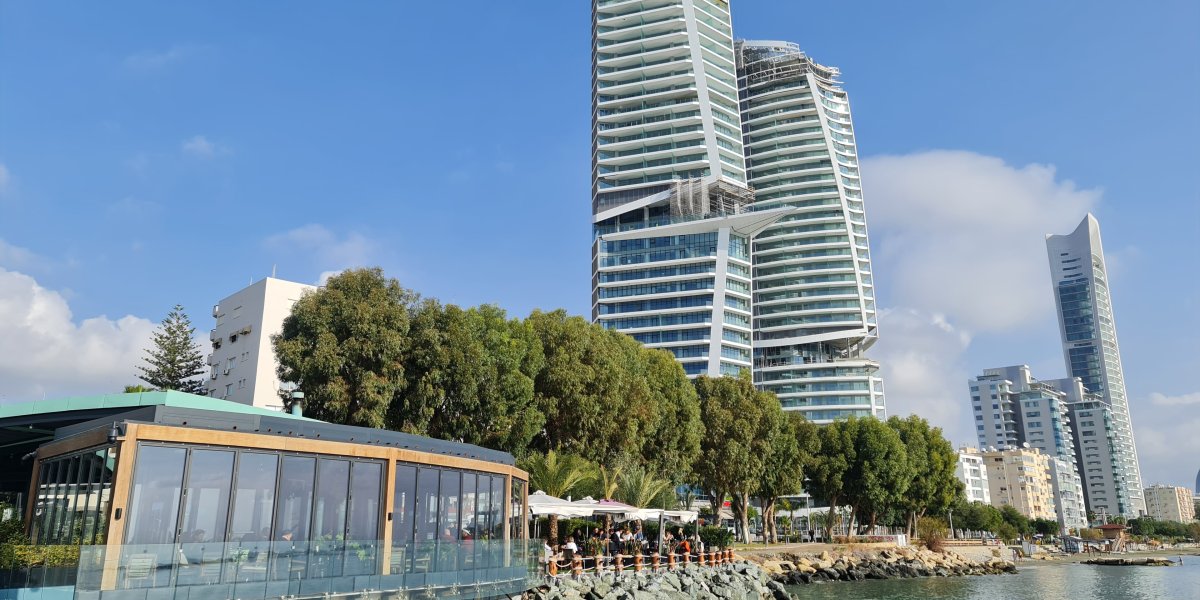
Walk south from the cathedral back toward the sea — eight minutes through the old town's last lanes — and the city opens onto a glittering forest of yacht masts, glass-and-stone restaurants, and palm-lined quays. Cyprus's only luxury marina is unapologetically modern, but at 18:00 the late sun turns every white hull gold and the rigging starts to chime in the offshore breeze. Walk the full boardwalk and out to the tip of the eastern breakwater — the city's skyline behind you, open Mediterranean ahead.
Tip: Walk all the way to the tip of the eastern breakwater — 12 minutes out from the boardwalk entrance — for the only west-facing sunset frame in Limassol, with the Troodos foothills as backdrop. Sunset is 19:30 in summer, 17:00 in winter; arrive 25 minutes before. Most visitors stop at the boardwalk halfway and miss the actual view.
Open in Google Maps →19:00
Food
Pyxida sits at the marina's inner edge, 200 metres back from where you watched the sun drop into the bay. The city's most-respected fish house — same family since the 1950s — does whole-fish grilling over olive-wood embers in an open kitchen you can see from the terrace. Order the grilled sea bass (29 €) and a starter of marides (crisp-fried whitebait, 13 €), washed down with cold Xynisteri white from the Troodos villages. Budget 45-55 € per person; reserve a terrace table facing the boats.
Tip: Reserve 24 hours ahead — Pyxida fills by 20:00 every night in season. Pitfall: the cluster of identical-menu restaurants further along the marina boardwalk (the ones with photographed dishes laminated on the menu) overcharges by 40% and uses frozen fish from Greece — a classic Mediterranean port trap. Pyxida buys at dawn from the old-port fleet; ask the waiter what came in that morning.
Open in Google Maps →Saltar al día
09:00
Landmark
Begin at the castle's south gate, the original Crusader entrance to a 14th-century Lusignan stronghold. This is where Richard the Lionheart married Berengaria of Navarre in 1191 after his fleet was blown ashore — the only English royal wedding ever held outside England. Inside is Cyprus's finest medieval museum: weapons, gravestones, and a 7th-century Byzantine fresco; climb to the rooftop for your first panoramic read of the city.
Tip: Arrive 10 minutes before the 09:00 opening — at that hour the chapel room (where the wedding is said to have happened) is entirely yours, before the cruise-ship crowds arrive around 10:30.
Open in Google Maps →10:45
Religious
Exit the castle's north gate and walk 5 minutes up Genethliou Mitella Street, past carob warehouses now galleries, into the Old Town's heart. Agios Napa Cathedral rises in honeyed limestone, its 1903 bell towers framing a far older Byzantine icon of the Panagia tis Napas, said to grant safe voyages — locals still light a candle before any flight. Linger in the square where pensioners take their coffee, then weave through Saripolou's narrow lanes.
Tip: Step inside and look up at the iconostasis — the gold leaf was funded by Limassol's wine-merchant families in 1906, and each carved grape cluster represents a different vineyard. No flash photos.
Open in Google Maps →13:00
Food
Two minutes south of the cathedral, hidden in a renovated stone house on Vasileos Konstantinou — Ta Piatakia ('the little plates') is where every Limassolian sends out-of-town guests. Order the kleftiko-stuffed pittakia (slow-roasted lamb, €4.50 each), saganaki halloumi straight from the pan, and the rabbit stafado with cinnamon and pearl onions (€16). The shaded courtyard sits beneath a 100-year-old mulberry.
Tip: Skip the 'full meze' — that's the tourist trap. Pick 4-5 small plates à la carte and you'll eat better for half the price. Order their house Xynisteri (€5/glass), a local white from the Krasochoria hills.
Open in Google Maps →15:00
Museum
Walk 5 minutes back south to the castle — the Carob Mill is the long honey-stoned warehouse hugging its eastern wall. Until the 1950s this was the engine of Cyprus's 'black gold' export trade (30,000 tons of carob pods a year), and the original grinding wheels and presses are preserved in the Cyprus Carob Museum. The surrounding buildings hold the Evagoras Lanitis Centre and sculpture courtyards backing onto the medieval section of the Old Harbour walls.
Tip: Buy a bag of pasteli (carob-and-sesame brittle, €3) from the museum shop — made by a single co-op in nearby Anogyra and hard to find elsewhere. The carob-syrup-wine tasting is a gimmick; the syrup is great in coffee, but the wine is one-note sweet.
Open in Google Maps →17:00
Neighborhood
Continue 5 minutes south past the Old Fishing Port into Limassol Marina, the only Mediterranean development where superyachts moor at the front doors of private villas. Walk the curving Castle Walk promenade westward; from 17:30 in summer the light turns gold across the masts and a steady south-westerly comes off the open sea. Stop at the lighthouse pier where the Troodos Mountains float blue on the inland horizon.
Tip: Walk to the very tip of the breakwater (unsignposted, just past the lighthouse) — December through March this is the only spot in Limassol where the sun sets directly into the open sea. The marina shops shutter at 19:00 sharp, but the promenade is yours all night.
Open in Google Maps →20:00
Food
Walk 5 minutes north back to the Carob Mill — Karatello occupies the warehouse's southern half, the highest-ceilinged dining room in town with original iron beams overhead. This is where Cypriot wedding parties book the courtyard, and you'll eat smoked sheftalia (€14, charcoal-grilled minced pork in caul fat) and louvi me lahana (black-eyed peas with chard, €9), both as they have been cooked in village kitchens for centuries. Pair with a glass of Commandaria (€7), the world's oldest named wine still produced 35 km north.
Tip: Reserve ahead — Karatello fills by 20:30 every night, including Mondays. Ask for the house Maratheftiko (€28/bottle), the indigenous red that pairs perfectly with sheftalia. Final warning: the 'live bouzouki' tavernas around Saripolou Square charge a €15 cover and serve pre-frozen meze — beautiful courtyards, terrible food. Avoid.
Open in Google Maps →09:30
Museum
Start the day inland — a 15-minute walk north of the castle up Anexartisias brings you to a quiet 1948 limestone building at the edge of the Municipal Garden. Three small halls cover 9,000 years of district finds: the Chalcolithic cruciform figurine from nearby Erimi (4,000 BCE), terracotta horse-and-rider votives from Amathus, and Roman glass still iridescent in the case. It's compact enough to see thoroughly in 90 minutes, and there are never crowds.
Tip: Spend ten minutes in front of Case 11 — the Amathus gold pectoral and earrings found in a 7th-century BCE tomb just outside Limassol, by far the museum's quiet masterpiece. Closed Sundays — schedule your weekend accordingly.
Open in Google Maps →11:30
Park
Step out of the museum and walk 3 minutes east into the garden — the city's only large green space, laid out by the British in 1900 around carob and Indian-fig trees now over a century old. In late February the orange blossoms perfume the entire north entrance; in September the open-air rotunda hosts the city's famous Wine Festival. Skip the sad little zoo (€2) and linger instead by the Wine Festival Pavilion and the old British bandstand.
Tip: Walk to the southern end where the open-air theatre stands — the bougainvillea wall behind the stage is the most photogenic spot in the garden at midday, when light pours through the magenta petals.
Open in Google Maps →13:00
Food
Walk 10 minutes south down Anexartisias — the city's pedestrian shopping spine — until you reach the old town's edge near Spartis Street. Mavri Helona hides in a 1920s former grocery: five tables inside, ten more under a pergola of grapevines. Order the koupes (cracked-wheat shells stuffed with minced pork, €1.20 each — get four), the spicy village loukaniko sausage (€8), and a Keo beer (€3); locals start filling the place at 13:30.
Tip: No English menu, no website — the chalkboard at the door is the menu. Point to whatever the next table ordered; nothing costs more than €12. Cash only.
Open in Google Maps →14:45
Park
Walk 8 minutes south to the seafront — Molos park stretches a full kilometre east of the Old Port, an artificial reed-lined headland that locals built in 2014 over an unsightly customs yard. The sculpture path winds past 16 bronze and steel works by Cypriot artists; George Kyriakou's three-figure 'Conversations' looking out to sea is the most photographed. Walk all the way to the eastern end where the shallow reflecting pool mirrors the sky.
Tip: Best photo angle is from the wooden viewing platform 200 m east of 'Conversations' at 16:00 — the sun lights the figures from behind and doubles in the reflecting pool. If your feet are tired, hire a bike from Pavlos Liasides Square (€5/hour) — it's the fastest way to cover all 3 km of seafront.
Open in Google Maps →17:15
Park
Continue east along the promenade past the Old Port lighthouse — in 35 minutes on foot (10 by bike) you reach Dasoudi, where Limassol's only urban pine forest meets a 1.5-km dark-sand Blue Flag beach. The eucalyptus grove behind it was planted by the British in the 1950s, and the scent at golden hour is what every Limassolian associates with summer. Walk west along the firm sand right at the water's edge as the light goes amber.
Tip: For the clearest sunset photo, stand on the small wooden pier 100 m east of the main beach bar — October to March the sun sets directly over the Akrotiri salt lake, and you'll see distant flamingoes silhouetted against the orange. Skip the loungers (€5) unless you'll swim; the free pine-shaded zone behind has better views anyway.
Open in Google Maps →20:00
Food
Walk 15 minutes west along Spyrou Araouzou Street — Pyxida sits in a low whitewashed building behind a bougainvillea hedge, run by the Christodoulou family since 1989. There is no written menu: the waiter brings whatever the boats landed that morning as a 14-16-plate fish meze, ending with the catch of the day grilled with rock salt. Expect octopus carpaccio, sea urchin (ahini) with lemon, fried whitebait, and the red mullet (€18/portion); pair with the local Aphrodite Xynisteri white (€16/bottle).
Tip: Order the 'fish meze' set (€38pp, two-person minimum) — à la carte costs more and you miss the small plates. Pyxida fills entirely by 20:30 even off-season; reserve by phone at least 24 hours ahead, they don't take online bookings. Final warning: avoid the 'fish restaurants' along Molos with sea-view terraces and English menus — most serve imported frozen tilapia at €30 a portion.
Open in Google Maps →
Trip builder
Plan this trip around Limassol
Turn this guide into a bookable rail itinerary with FlipEarth.
Keep exploring
Related cities
More in the same country
FAQ
Frequently asked questions
How many days do you need in Limassol?
Most travelers enjoy Limassol in 1 days, with enough time for headline sights and a slower meal or museum stop.
What's the best time to visit Limassol?
The easiest season for most travelers is Apr-Oct, especially if you want good weather and manageable crowds.
What's the daily budget for Limassol?
A practical starting point is about €90 per person per day before hotels, then adjust based on museums, dining, and transport.
What are the must-see attractions in Limassol?
A good first shortlist for Limassol includes Limassol Castle (Medieval Castle) & Carob Mill Square, Limassol Marina Boardwalk & Breakwater.