City Guide
Kyiv
Ucrania · Best time to visit: May-Sep.
Day-by-day plan
Choose your pace
Duración del viaje
08:00
Religious
Begin at Arsenalna metro and walk eight minutes south along tree-lined Lavrska Street — the gold-tipped Great Bell Tower lifts above the bluff long before you arrive. The Lavra (UNESCO, 1990) has been Eastern Orthodoxy's spiritual heart since 1051: a labyrinth of seventeenth-century baroque churches set on a cliff over the Dnipro. Morning light turns the domes molten gold and the cobbled courtyards stay quiet until tour coaches descend after ten.
Tip: Pay the 40 UAH ticket and climb the 239 steps of the Great Lavra Bell Tower — the panorama over the river bluff and seventeen domes is the single best photo of your day. Skip the Caves themselves on a layover; they're dark, slow-moving, require head coverings, and eat 90 minutes you don't have.
Open in Google Maps →11:00
Religious
Walk forty-five minutes northwest through Mariinsky Park, past the Verkhovna Rada and the pistachio-green Mariinsky Palace, then down Instytutska Street — the path hugs the river bluff with open views over Podil's rooftops. Saint Sophia, founded in 1037 by Prince Yaroslav the Wise, is the only surviving structure of medieval Kyivan Rus and Ukraine's other UNESCO treasure. From Sofiyivska Square you stand between Sophia's pale bell tower and St. Michael's sky-blue Golden-Domed Monastery — thirteen domes in a single frame.
Tip: Stand at the foot of the Bohdan Khmelnytsky monument in the centre of Sofiyivska Square — this angle puts the bell tower against clean sky with no cars or wires in the frame. The exterior is the masterpiece; skip the interior on a one-day visit, the eleventh-century frescoes deserve a separate trip.
Open in Google Maps →12:30
Food
Walk eight minutes east on Volodymyrska then south onto Bohdana Khmelnytskoho — you'll smell the deep-fried dough a block before you see the line. Kyivska Perepichka has fried the same sausage-in-dough roll from a single window at #3 since 1981, and the queue has never once disappeared. It is Kyiv's most beloved street snack, eaten standing on the pavement like every office worker on a smoke break.
Tip: Order one 'perepichka' for 50 UAH (about €1.20) — there is no menu, no choice, no English, cash only. The line looks intimidating but moves in five minutes; the gossiping locals around you are half the experience. Eat it immediately while it's blistering hot.
Open in Google Maps →13:30
Landmark
Walk five minutes down Bohdana Khmelnytskoho to Khreshchatyk, the city's grand Stalinist-era boulevard, and step out into the sweep of Maidan Nezalezhnosti. This square is Ukraine's emotional epicentre — site of the Orange Revolution in 2004 and the Revolution of Dignity in 2014, where the Heavenly Hundred died on these very cobbles. Walk slowly along the Alley of the Heavenly Hundred uphill behind the conservatory; the portraits, blue-and-yellow flags, and candles tell more than any museum.
Tip: Cross to the eastern side of the square to frame the Independence Monument against the wedding-cake Hotel Ukraina behind — Kyiv's postcard angle. On weekend afternoons Khreshchatyk closes to traffic and becomes a pedestrian promenade, which is when locals actually claim the space.
Open in Google Maps →15:00
Neighborhood
Walk fifteen minutes north up Mykhailivska Street — pause for five minutes at St. Michael's Golden-Domed Monastery for the sky-blue facade — then continue along Desyatynna to Saint Andrew's. Bartolomeo Rastrelli's baroque masterpiece (1754) crowns the bluff where, by legend, the Apostle Andrew planted a cross and prophesied a great city. From here you descend Andriyivskyy Uzviz — Kyiv's Montmartre — a curving cobbled lane of artists, easels, the Bulgakov House at #13, and nineteenth-century facades, all the way down to Podil.
Tip: Climb Saint Andrew's exterior viewing platform (50 UAH) for the day's best Dnipro panorama — left light at this hour, the river silver behind Podil's red roofs. Then walk the full descent stopping at the Bulgakov Museum exterior (#13) and the street murals near #34. The afternoon sun behind you lights every facade head-on.
Open in Google Maps →19:00
Food
Halfway down the descent, a wooden gate at #19 opens onto Kanapa's terraced garden, with views over the tiled roofs of Podil. This is Kyiv's most serious Ukrainian restaurant: a slow-food kitchen sourcing from small farms across the country, reimagining borscht, vareniki, and salo with twenty-first-century craft. The vibe is candlelit, unhurried, and the kind of place Kyivans book for anniversaries — a perfect close to the power-walk day.
Tip: Reserve a terrace table at least two days ahead — sunset over the Dnipro is the meal's best course. Must-order: borscht with smoked pear (220 UAH / €5), homemade vareniki with sour cherries (180 UAH / €4), and the original Chicken Kyiv done right (450 UAH / €11); budget €25-35 per person with a glass of Ukrainian wine. Pitfall warning: every other restaurant on Andriyivskyy Descent serves frozen pelmeni at tourist prices — Kanapa is the only authentic kitchen on the lane. Politely refuse the 'amber jewelry' and 'Soviet medal' hawkers along the descent; prices are inflated tenfold and the goods are reproductions.
Open in Google Maps →Saltar al día
09:00
Museum
Begin at the 09:00 opening — the moment the gates unlatch, walk straight to the central nave; the 11th-century Orant Mary mosaic catches the eastern light through the apse window for only 20 minutes after opening, and the upper galleries stay nearly empty until 09:30. Yaroslav the Wise founded this cathedral in 1037, and the 260 square meters of Byzantine mosaic preserved inside are the largest surviving anywhere outside Hagia Sophia. The Bell Tower climb (separate ticket) gives the only elevated frame that places the cathedral, St. Michael's domes, and the Dnipro in a single shot.
Tip: Buy the combined ticket (cathedral + frescoes + bell tower + grounds) at the small kiosk to the left of the main gate, not the central window where tour groups queue. From the third gallery of the 76-meter bell tower, St. Michael's eleven golden cupolas line up perfectly with the cathedral foreground — Kyiv's only true postcard skyline shot. Indoor photography requires a separate 50 UAH permit; staff check politely but firmly.
Open in Google Maps →11:00
Religious
Exit St. Sophia's main gate and cross Sofiyivska Square diagonally past the Bohdan Khmelnytsky equestrian statue — 5 minutes door to door. At 11:00 the sun has climbed high enough to ignite the eleven gilded cupolas against the cobalt walls, and the inner courtyard becomes the most photographed view in Kyiv. Stalin demolished this 12th-century monastery in 1934; what stands now was painstakingly rebuilt and reconsecrated in 1999.
Tip: Walk straight through the gate-tower and turn around — that is the postcard angle, the bell tower framing the cathedral. Inside, the silver reliquary of St. Barbara is the original, returned from the Hermitage in 2001. The Memorial Wall to the right of the bell tower is updated weekly with photographs of fallen defenders — pause there silently; it is not a photo subject.
Open in Google Maps →13:00
Food
Walk 6 minutes south from St. Michael's down Volodymyrska, then cut west onto Bohdana Khmelnytskoho — you will see the queue before you see the kiosk. Since 1981 this single window has fried one item: a hand-shaped pillow of yeast dough wrapped around a juicy garlic-pork sausage (Перепічка з ковбасою, 40 UAH / €0.95), and Kyivans still line up here at lunch hour. Eat it standing on the corner with a paper napkin — that is the entire ritual, and the most authentic two euros you will spend in Ukraine.
Tip: One perepichka satisfies; two will defeat you. The line looks long but moves in under 6 minutes — never skip it because of length. Cash only and exact change is appreciated; chase it with a kvas from the adjacent stall (15 UAH), the fresh-pressed rye drink that is slightly sour and better than it sounds.
Open in Google Maps →14:30
Neighborhood
Walk 12 minutes north up Volodymyrska from the perepichka kiosk, then turn left on Desyatynna — you emerge at the foot of Saint Andrew's Church, Rastrelli's candy-blue baroque atop the hill. Below begins 720 meters of curving cobblestone tumbling down to Podil, lined with artists' easels, vyshyvanka stalls, and four-century-old houses leaning against each other like old friends — this is Kyiv's Montmartre. Stop midway at the Bulgakov Museum (number 13, the author's childhood home) and the One Street Museum to understand why every Kyivan has at least one love story tied to this lane.
Tip: Bargain on art and embroidery — opening prices float 30-40% above what locals pay; smile, offer half, settle in the middle. Beware stalls selling 'antique' Soviet militaria — most are reproductions from Borshchahivka workshops on the city's edge. At the bottom in Kontraktova Square, take the Funicular (8 UAH / €0.20) back up to Mykhailivska Hill — it spares your knees and glides over a panoramic stretch of the Dnipro.
Open in Google Maps →17:30
Landmark
From the top of the Funicular, walk 8 minutes south down Mykhailivska and Hrushevskoho — you arrive as the western sun rakes across the granite of the Independence Monument and lights the spray of the Lyadski Gates fountain. This 28,000-square-meter square is the emotional center of modern Ukraine: where the 2004 Orange Revolution gathered, where the 2014 Revolution of Dignity bled, and where 102 photographs of the Heavenly Hundred remain mounted on Instytutska Hill above. Stand at the central Berehynia column and read the square clockwise — every monument tells a chapter.
Tip: Walk up Instytutska Street to the Heavenly Hundred memorial — the photographs of those killed by snipers in February 2014 — between 18:00 and 19:00, when local visitors come to lay fresh flowers; the atmosphere is far more powerful than at midday. From the column base, look back south down Khreshchatyk for the golden-hour shot of the boulevard glowing under low sun.
Open in Google Maps →19:30
Food
From the Berehynia column, walk 90 seconds north into the Globus underground mall — the entrance on level -1 is an unmarked wooden door; the reservation confirmation tells you exactly how to find it. Inside, three rooms recreate three Ukrainian uprisings (1709 Mazepa, 1918 People's Republic, 2014 Maidan), and the food is fiercely national: Halushki dumplings with smoked duck (380 UAH / €9), Mariupol borscht with smoked pear (320 UAH / €7.50), Crimean Tatar chebureki (290 UAH / €7). Budget 1,400-1,800 UAH (€35-45) per person with a glass of homemade horilka infusion.
Tip: Reserve 48 hours ahead via Instagram DM @ostannya_barykada — walk-ins are politely turned away; this place is full every night. Ask for the 'Maidan room' and the seat beside the cobblestone — it was salvaged from the actual barricade on Instytutska Street, February 2014. Pitfall warning on the square: avoid the costumed photo-touts near the Lach Gate (Cossacks, bears, painted mascots) — they demand €5-10 after a snap, sometimes aggressively; and cafés directly on Maidan mark up beer and food by 200%, so walk one block off to Mala Zhytomyrska or Borysa Hrinchenka for honest pricing.
Open in Google Maps →09:00
Religious
Arrive at the Holy Gates by 09:00, the moment the Upper Lavra opens — the morning sun slants directly into the bell tower courtyard and the white facade of the Cathedral of the Dormition glows against the green hills above the Dnipro. This is Eastern Orthodoxy's most sacred monastery on Slavic soil, founded in 1051, with two underground cave systems where mummified monks — including Nestor the Chronicler, who wrote the first history of Rus' — rest in glass coffins. Plan three hours: Upper Lavra above ground, then descend to the Near Caves first, Far Caves second; the caves are silent and candle-lit, the most extraordinary 40 minutes on this itinerary.
Tip: Buy your candle (10 UAH) at the kiosk before entering the caves — phones off, no flash, and you will need a free hand to hold both the candle and a head covering (free wraps at the cave entrance for women). Skip the Microminiature Museum (a small tourist gimmick); go instead to the Refectory Church for its post-Byzantine frescoes. Modest dress is mandatory: men no shorts, women no bare shoulders and no trousers — wrap skirts loaned at the gate.
Open in Google Maps →12:30
Landmark
Exit the Lavra's southern Economic Gate and walk 12 minutes south along the bluff path of Ivana Mazepy — Soviet-era T-34 tanks, helicopter gunships, and a MiG-23 line the open-air corridor leading to the 102-meter titanium colossus. Renamed the Ukraine Mother Monument in 2023 (her shield was swapped from the Soviet emblem to the Ukrainian trident, clearly visible at close range), she still raises her sword over the Dnipro and remains the third-tallest statue in Europe. The terrace beneath gives the cleanest panoramic view of left-bank Kyiv across the river.
Tip: Skip the elevator to the shield observation deck — long queue, dirty glass, inferior view; walk the free north-side terrace instead, where the angle places the Lavra's gold domes in the foreground with the Dnipro behind. The open-air exhibition is being expanded to include captured Russian equipment from the current war (a destroyed BMP-2 and a downed Orlan drone among them) — display rotates monthly. Photography of these exhibits is permitted; uniformed personnel nearby are not.
Open in Google Maps →14:00
Food
Walk 10 minutes back north along Ivana Mazepy — Tsarske Selo sits directly opposite the Lavra's main gate, inside a 19th-century wooden khutir estate; it has been the most respected traditional Ukrainian restaurant in the city since 1996. Order the borscht with garlic pampushki (340 UAH / €8), Chicken Kyiv in its true form — boneless breast, molten herb-butter core, hand-breaded golden crust (520 UAH / €12), and salo on rye with chilled horilka (180 UAH / €4). Budget 800-1,200 UAH per person (€20-30) with a drink — extraordinary value for the standard of the kitchen.
Tip: From May to September, sit in the back garden — wooden tables under cherry trees, traditional musicians most weekends. Do not order Chicken Kyiv anywhere else in Ukraine after this — this is the version Ukrainian chefs themselves measure by. Reservations recommended only on weekends; on weekday lunch you can walk in straight to the garden tables.
Open in Google Maps →16:00
Park
From Tsarske Selo, walk 18 minutes northwest along Ivana Mazepy and Mykhaila Hrushevskoho — you arrive as afternoon light turns the palace's turquoise and white baroque into a wedding cake. Rastrelli designed it in 1744 for Empress Elizabeth, and it remains Ukraine's ceremonial presidential residence; the park behind, with linden alleys leading to the Lovers' Bridge over Parkova Road, gives the most restful 90 minutes on the entire itinerary. The pedestrian bridge midway offers a free panorama back over the Dnipro and the Motherland Monument you stood under two hours earlier.
Tip: The palace interior opens to the public only on Heritage Days (mid-September) — for now, the façade and gardens are the experience. Cross to the Park of Eternal Glory adjacent — the Tomb of the Unknown Soldier eternal flame and the rose garden lie 5 minutes off the main path and almost no tourist finds them. Avoid Parkova Road on weekends after 17:00, when couples padlocking the railing crowd the bridge; weekday afternoons are serene.
Open in Google Maps →17:30
Landmark
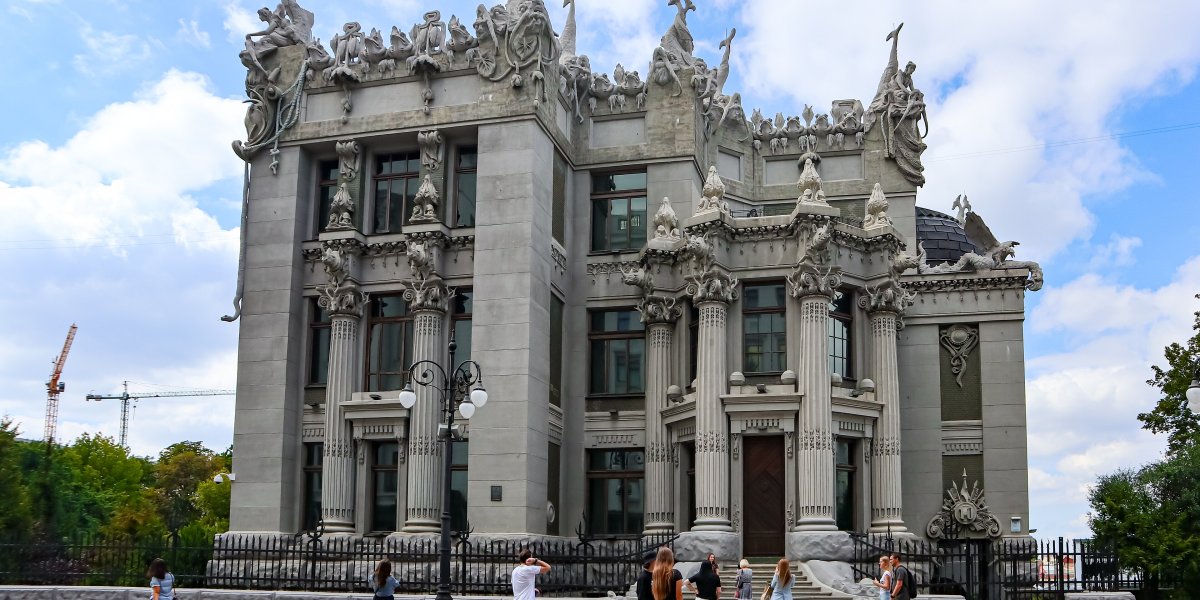
Walk 8 minutes northwest up Mykhaila Hrushevskoho, then turn onto pedestrian Bankova — the street ends in front of the strangest building in Kyiv. Architect Vladyslav Horodetsky built it in 1903 as his personal residence, plastering every façade in cement rhinos, dolphins, mermaids, antelopes, hunting trophies, and frogs — an Art Nouveau bestiary perched on a steep four-story slope. Now used for state ceremonial functions, the exterior is the experience: walk a full circle around the building and look up — each side hides a different creature.
Tip: The best photo angle is from the upper end of Bankova at the chamber stairs — the chimaeras silhouette against the sky and the slope reveals the building's hidden four-story drop on the back side. Bankova is closed to vehicles and lightly patrolled; do not approach the Presidential Office complex 50 meters east — uniformed guards there are not for photos. The bench on Ivan Franko Square opposite has the only public seat with a clear view of the entire façade.
Open in Google Maps →19:30
Food
Walk 8 minutes south on Lypska, then turn down Mechnikova — Honey occupies a quiet courtyard at number 1A, behind a wooden gate easy to miss. Chef Dmytro Borisov's flagship rewrites Ukrainian classics with modern technique: buckwheat risotto with smoked salo and pickled forest mushrooms (520 UAH / €12), wild boar with sour cherry and beet (790 UAH / €18), cold borscht with crayfish and ramson (360 UAH / €8.50). Average 1,800-2,400 UAH (€45-60) per person including a glass of Ukrainian wine from the Beykush winery list.
Tip: Reserve via Instagram DM @honey_restaurant 24-48 hours ahead — they confirm in English within an hour. From May to September ask for the courtyard terrace — the interior is good but the courtyard, lit by warm filament bulbs strung between the buildings, is the reason to come. Pitfall warning in Lypky district: the 'Ukrainian Souvenir' shops along Lyuteranska aggressively sell mass-produced amber and lacquer at triple price — real vyshyvanka and quality crafts cost a fraction at the Andriyivskyy Descent stalls or the official Vsi Svoi store on Khreshchatyk 27.
Open in Google Maps →Saltar al día
10:00
Religious
Begin at the wooden gates on Volodymyrska Street—the bell tower opens right at ten and the morning queue is still thin. Inside the 11th-century cathedral, the mosaics of the Orant Virgin and Christ Pantocrator hold their breath under a thousand years of candle smoke. Climb the 76-meter bell tower last: from the top, golden St. Michael's faces you across the square and the whole upper town spreads out like a map you can read.
Tip: Buy the combo ticket (cathedral + bell tower + grounds) at the cashier left of the main gate—the separate-ticket queue inside wastes 20 minutes. Head to the bell tower at exactly 10:00 before the 11:30 coach groups arrive; the southwest corner of the gallery gives the postcard angle of St. Michael's blue façade framed by the cathedral's belfries.
Open in Google Maps →13:00
Food
Exit St. Sophia's south gate and walk two minutes south on Volodymyrska—Spotykach hides behind an unmarked red door at No. 16, beside a row of antique-style storefronts. Inside is a Soviet-era kitchen done with tongue in cheek: house-infused horilkas line the walls and waitresses in headscarves serve the food Kyiv grandmothers actually cook. Order the borscht with pampushky garlic buns (₴180 / €4.50) and the homemade varenyky with sour cherries (₴220 / €5.50); €15–20 with a horilka tasting flight.
Tip: Reserve a window booth a day ahead via their Instagram DMs—walk-ins at 13:00 wait 20 minutes. Ask for the house spotykach (cherry-infused horilka) chilled, not at room temperature; it is the dish the restaurant is named for, and the waitress will pour a free shot if you order varenyky alongside.
Open in Google Maps →15:30
Religious
From Spotykach, walk five minutes north up Volodymyrska and cross Sofiyivska Square diagonally—the cobalt-blue walls of St. Michael's rise across Mykhailivska Square. Built in 1108, dynamited by Stalin in 1937, and rebuilt brick by brick after 1999, the monastery is Kyiv's clearest answer to forgetting: gold inside, blue outside, with the bell tower carillon ringing the hour. Walk through the inner courtyard to the viewpoint platform behind—the Dnipro, the left bank, and the funicular all open up at once.
Tip: Cathedral entry is free; the small mosaic museum in the south wall (₴50 / €1.20) holds 12th-century mosaic fragments rescued before demolition—most tourists never find it. Bells ring on the hour 15:00–17:00; stand directly under the bell tower at 16:00 for the full carillon, then step to the rear terrace for the Dnipro view before the funicular crowds arrive.
Open in Google Maps →18:00
Landmark
Walk south down Mykhailivska Street for six minutes—the slope reveals Maidan Nezalezhnosti like a curtain rising, with the winged Berehynia atop the Independence Monument at the head of Khreshchatyk Boulevard. At 18:00 the granite warms low gold, office crowds thin, and candles flicker along the slope up Instytutska Street where the Heavenly Hundred fell in February 2014. Take the free underground passage tour beneath the square to read the dignity-revolution timeline panels in the Globus mall layer.
Tip: The Heavenly Hundred memorial begins one block uphill on Instytutska Street—walk the full length and read every photograph; this is where the Revolution of Dignity was fought house by house. Do not photograph mourners. The 30 minutes between Maidan and dinner are for free strolling down Khreshchatyk—the boulevard is pedestrianized on weekends.
Open in Google Maps →19:30
Food
Re-enter the Globus underground mall from Maidan's central pavilion—Ostannya Barykada (The Last Barricade) hides behind an unmarked door on Level -3 and you must say the password 'Slava Ukraini' to pass. Inside is a candlelit cave-restaurant founded by veterans of three Ukrainian revolutions, serving the most ambitious modern Ukrainian cooking in the city. Order the Kyiv-style chicken with foie-gras butter (₴480 / €12) and the Crimean Tatar yantyk lamb pastry (₴280 / €7); €25–35 with natural wine.
Tip: Reserve via ostannia-barykada.com 48 hours ahead—the dining room seats only 60 and Friday–Saturday are booked solid. PITFALL: avoid the Khreshchatyk 'Ukrainian buffet' chains (Puzata Khata and lookalikes near Maidan)—they jack tourist prices to €15 a tray. Around Maidan, decline the 'photo with costumed Cossack' touts; they will demand €20 the moment you smile.
Open in Google Maps →10:00
Religious
Take a 12-minute taxi to the Lavra's Holy Gates on Lavrska Street; the Caves welcome visitors only from 09:00, so a 10:00 arrival still beats the noon coach tours. Founded in 1051 in a hand-dug hillside cave, the Lavra is two monasteries in one—the Upper with the gilded Dormition Cathedral, the Lower with the Near and Far Caves where 120 mummified saints rest under glass. Climb the 96-meter Great Bell Tower first for the panorama, then descend to the Caves carrying a beeswax candle for light.
Tip: Women borrow a free headscarf at the cave entrance (mandatory); men need long trousers even in summer. The Near Caves are emptiest 10:30–11:30; the Far Caves involve a 15-minute walk through orchards and most groups skip them—which is exactly why you should go. Buy your beeswax candle (₴15 / €0.40) at the cave-entrance kiosk, not from grounds vendors who charge triple.
Open in Google Maps →13:30
Food
Exit the Lavra by the western gate and walk three minutes downhill on Lavrska Street—Tsarske Selo sits in a carved-wood Cossack estate just below the monastery walls. This is the place Kyivan families take their grandparents: live-fire ovens, embroidered tablecloths, and a bandura player most lunches. Order the salo trio with rye bread and horseradish (₴260 / €6.50) and the slow-braised lamb in clay pot (₴480 / €12); €15–22 per person with kvass.
Tip: Ask for a table on the upper wooden veranda—the lower hall fills with tour groups at 13:00 sharp. The hand-folded varenyky with potato and forest mushroom (₴220 / €5.50) run out by 15:00; order them with sour cream and crispy onions, and ask for the house kvass on tap rather than the bottled version.
Open in Google Maps →15:30
Museum
Walk south along the Lavra's outer wall for eight minutes through Pecherska Lavra Park—the path opens onto the 62-meter titanium silhouette of the Motherland Monument, sword raised against the sky. The museum at her base is one of Europe's most powerful war collections: an upper Hall of Memory, lower weapon halls, and a viewing platform on the Motherland's shield reached by interior elevator. At 15:30 the light pulls long shadows across the Alley of Heroes outside, perfect for the silent procession of bronze reliefs.
Tip: Buy the 'shield-level' panorama ticket at the lower cashier (₴100 / €2.50)—most tourists never know it exists, and the view of the Dnipro from the Motherland's shoulder is the single best aerial of Kyiv. The hand-level climb up the sword is closed to civilians; the shield platform is the highest legal viewpoint in the city.
Open in Google Maps →18:00
Landmark
Walk fifteen minutes north along the ridge path through Vichnoyi Slavy Park—the Dnipro stays on your right, the afternoon sun gilding the eastern bank. The Holodomor Memorial appears as a slender 30-meter bronze Candle of Memory rising from a black-stone plaza, commemorating the four million Ukrainians starved to death in Stalin's engineered famine of 1932–33. Visit the underground Hall of Memory first (free, closes 18:00), then return to the plaza at 18:30 as golden hour turns the candle stalk fire-orange against the river.
Tip: Inside the Hall of Memory, a single ceiling oculus lights a wooden room with the names of villages erased by the famine; speak in whispers, Ukrainians come here to mourn. The 30 minutes of free strolling time fit naturally along the river-edge path between the Holodomor Memorial and the Glory Park flame to the south—the ridge walkway is signposted in English.
Open in Google Maps →19:30
Food
Order an Uklon ride from the Holodomor Memorial—seven minutes downhill brings you to Pervak on Rohnedynska Street. The restaurant occupies a pre-revolution merchant cellar styled as a 19th-century Kyiv tavern, with a tiled stove, lace curtains, and costumed waitresses who curtsy—the most reliable old-school Ukrainian kitchen in the city. Order the salo carpaccio (₴320 / €8) and the classic Kyiv chicken cutlet with potato 'pure' (₴520 / €13); €22–30 with a nastoyanka flight.
Tip: Reserve by phone (+380 44 235 0952)—Pervak is the dinner choice of Kyiv business families and walk-ins at 20:00 wait an hour. Order the 12-flavor nastoyanka tasting (₴480 / €12, fruit-infused vodkas) and let the waitress explain each—Ukraine's closest equivalent to a sommelier flight. PITFALL: do not flag street taxis from Mariinsky Park or Lavra car parks after dark—unmetered drivers quote €30 for a €5 ride; walk to Klovska metro or use the Uklon app (English UI, card-paid).
Open in Google Maps →10:00
Religious
Begin at the top of Andriyivskyy Descent—St. Andrew's Church rises on its hill, Rastrelli's 1754 baroque masterpiece the color of bluebells and gold. The interior reopened in 2021 after a multi-year restoration; climb the wraparound observation gallery for the highest church balcony in Kyiv, where Podil opens below, the Dnipro curls east, and the cobblestone street drops away under your feet. At 10:00 the morning sun catches the east-facing iconostasis full-on.
Tip: Buy the gallery climb (₴100 / €2.50) at the side entrance—most visitors only see the interior and miss the wraparound balcony. The 192 steps are narrow and steep but the photo from the southeast corner (down the Andriyivskyy curve toward Kontraktova Square) is the postcard you actually want. Avoid the souvenir kiosk at the church gate—identical icons cost a third of the price further down the descent.
Open in Google Maps →11:30
Neighborhood
Step out of St. Andrew's and the cobblestone descent begins at your feet—this is the 720-meter ribbon Bulgakov called 'the most extraordinary street in the world.' Walk slowly: Bulgakov's house museum at No. 13 (the Turbin family's address in The White Guard), the One Street Museum at No. 2B, and a continuous spine of icon painters, vyshyvanka tailors, and amber stalls. Give it ninety minutes—stopping is the point.
Tip: Buy embroidery and amber from the artists in the upper third of the descent (between No. 34 and No. 22)—they are the actual makers; lower-third stalls near Kontraktova resell factory pieces at upper-town markups. A genuine linen vyshyvanka shirt is ₴2500–4000 (€60–100); anything cheaper than that is polyester. Bulgakov's house museum (₴100 / €2.50) is worth the 30-minute detour if you have read 'The Master and Margarita.'
Open in Google Maps →13:30
Food
Halfway down the descent, at No. 19, an unmarked green gate opens into Kanapa—a hidden courtyard restaurant in a 19th-century townhouse with its own herb garden and beehives. Chef Yevhen Klopotenko's manifesto is forgotten Ukrainian recipes rebuilt with farm-direct ingredients. Order the cold beetroot kholodnyk with quail egg (₴280 / €7) and the buckwheat-stuffed roast quail (₴620 / €15.50); €18–28 with natural wine from Zakarpattia.
Tip: Reserve a garden table 48 hours ahead at kanapa.kiev.ua—the interior is fine but the courtyard with bee-hum and apple-tree shade is the actual experience. Ask the waiter for the seasonal 'chef's tasting plate'—it is not on the printed menu and the kitchen builds it from whatever the morning market brought in.
Open in Google Maps →15:30
Neighborhood
Continue down the last 200 meters of Andriyivskyy Descent—it spills you onto Kontraktova Square, Podil's heart since the 18th century, with the rotunda of the Mohyla Academy on your right and the merchant arcades around you. Walk three minutes west to the white-walled Florivsky Convent, Kyiv's oldest functioning women's monastery (1566), where Princess Natalia of Russia once took the veil and whose back gardens are usually empty. End with a 20-minute stroll down Sahaidachnoho Street to the river embankment—your free time, well spent.
Tip: The Florivsky Convent cemetery (uphill behind the main church) holds the graves of Kyivan nobility from the 17th–19th centuries—the gate looks closed but the iron handle turns; visitors are welcome until 17:00. If the convent's small kiosk is open, buy a fresh medovukha (honey wine, ₴80 / €2)—nuns brew it on site and it does not travel beyond these walls.
Open in Google Maps →19:30
Food
Walk seven minutes north along Sahaidachnoho Street—Musafir occupies a courtyard storefront founded by Crimean Tatar families forced to flee after Russia's 2014 annexation, preserving a cuisine that travels with them in exile. The kitchen serves the dishes Crimean Tatar grandmothers stretch out for guests: stews slow-cooked, dough rolled by hand, and pilaf as the centerpiece. Order the chebureki (fried meat pies, ₴180 / €4.50) and the lamb plov with quince (₴380 / €9.50); €15–22 with homemade compote.
Tip: Ask the staff which dish reminds them most of home—it is the one to order on a second visit, and they are happy to talk about Crimea over tea. Musafir serves no alcohol (halal kitchen) which is one reason the room feels right—pair the plov with the rose-petal kvass instead. PITFALL: avoid the loud 'beer garden' venues lining Sahaidachnoho after 22:00—several add unmarked '€10 cover' charges to foreigners' bills; walk back via Kontraktova metro one block north rather than the unlit river embankment after dark.
Open in Google Maps →
Trip builder
Plan this trip around Kyiv
Turn this guide into a bookable rail itinerary with FlipEarth.
Keep exploring
Related cities
More in the same country
FAQ
Frequently asked questions
How many days do you need in Kyiv?
Most travelers enjoy Kyiv in 1 days, with enough time for headline sights and a slower meal or museum stop.
What's the best time to visit Kyiv?
The easiest season for most travelers is May-Sep, especially if you want good weather and manageable crowds.
What's the daily budget for Kyiv?
A practical starting point is about €60 per person per day before hotels, then adjust based on museums, dining, and transport.
What are the must-see attractions in Kyiv?
A good first shortlist for Kyiv includes Maidan Nezalezhnosti (Independence Square).