City Guide
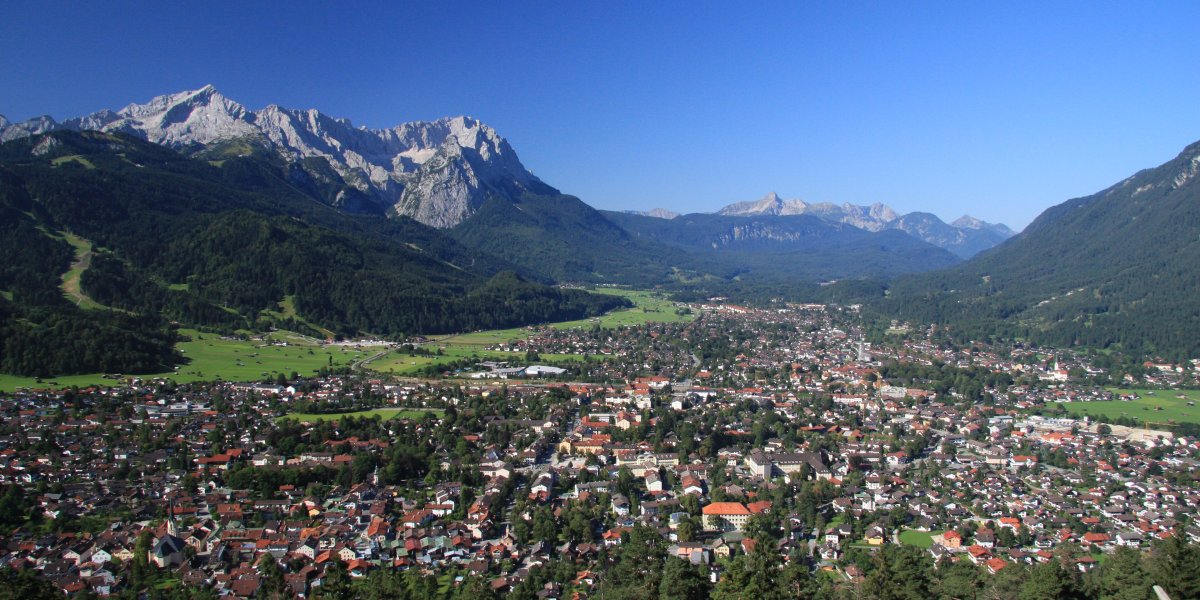
Garmisch-Partenkirchen
Alemania · Best time to visit: Jun-Sep, Dec-Mar.
Day-by-day plan
Choose your pace
Duración del viaje
08:15
Landmark
Board the historic Bayerische Zugspitzbahn cog railway at Garmisch Bahnhof — the 75-minute climb past Lake Eibsee and the final stretch tunnelled through the mountain itself is half the experience. At 2,962 m you stand on Germany's highest point, with a 360-degree view stretching from the Italian Dolomites to the Swiss Alps, and the gold summit cross sitting within reach. The summit platform is rarely empty, but the first hour after the Gletscherbahn cable car opens is the only window where the cross photo comes without strangers in it.
Tip: Sit on the right side of the cog train going up for unbroken Eibsee views, and pack a fleece — the summit hovers near freezing even in August when Garmisch is in t-shirts. Go up via cog rail and down via the Eibsee cable car for a complete loop without backtracking.
Open in Google Maps →12:30
Food
Five minutes east of the Bahnhof along Bahnhofstraße, turn into Achenfeldstraße — Krönner has been at this corner since 1929 and is where Garmisch locals stop for a Brotzeit between errands. Skip the table service and head to the counter for warm Leberkäse pressed into a Semmel (€5), then a slice of Mohnstrudel (€4) from the pastry case for the walk south. Average spend €10-15, no reservation possible.
Tip: The counter to the right of the entrance moves twice as fast as the table service — point at what you want, eat standing, and you are back on the street in twenty minutes. Their Krönner-Bonbon (handmade caramel) makes the only edible souvenir worth carrying out of town.
Open in Google Maps →13:30
Neighborhood
Two blocks south of Krönner, turn into Frühlingstraße — the lane is barely 200 m long but holds the densest concentration of Lüftlmalerei in Bavaria, the fresco tradition where biblical scenes and hunting tableaux are painted directly onto plaster facades. Early afternoon sun lights the south-facing walls at exactly the angle the eighteenth-century painters worked to, with the Wetterstein massif framed at the far end of the street. Free, no ticket, no queue.
Tip: Numbers 1, 13, and 15 hold the most elaborate murals — the house at number 15 covers three full stories and is the single most photographed exterior in town. Stand on the east side of the street to get the painted facade plus the mountains in one frame.
Open in Google Maps →14:45
Landmark
Walk south-east 25 minutes along the Loisach river path — you cross the meadows where the 1936 Olympic torch arrived, with the Wetterstein wall rising directly ahead the whole way. The ski jump was rebuilt in 2007 in steel and concrete but still hosts the Four Hills Tournament every January 1st; climb the external staircase to the judges' tower for a vertiginous view down the inrun and across to the Zugspitze you stood on this morning.
Tip: Skip the small museum and walk the perimeter clockwise — the south-east corner directly under the inrun gives the same dramatic upward angle the TV cameras use during competition, and the landing slope is the only place in town where you understand the scale of a 140 m jump.
Open in Google Maps →15:45
Park
Continue south-east 15 minutes past the Olympic stadium, following the Partnach river upstream to the ticket booth at the mouth of the gorge. The 700 m walkway is bolted into the limestone walls of a slot canyon where the river falls 80 m through waterfalls and ice-carved tunnels — the cleft is so narrow that even at mid-afternoon the light angles in vertically and turns the rising spray into rainbows. Last entry 17:30.
Tip: You will get wet — bring a rain shell or hood, the spray from the loudest waterfall section soaks unprotected hair in 30 seconds. Walk the gorge in and back out the same way (the upper Eckbauer loop adds 90 minutes and is not worth it on a one-day visit); the cleanest exit photo is at the far end looking back through the mouth toward Garmisch.
Open in Google Maps →19:00
Food
Walk 25 minutes north along the Partnach and across the bridge into Partenkirchen — the painted village half of the town — onto Ludwigstraße, where the facades grow more elaborate the further you go. Fraundorfer has occupied number 24 since 1820, its facade itself a Lüftlmalerei masterpiece; order the Schweinshaxe (roast pork knuckle, €22) with a Kaiserschmarrn to finish (€12), paired with a Maß of dark Werdenfelser beer. Average spend €30-45, reservation essential.
Tip: Reserve ahead — Wednesday, Friday, and Saturday nights have live zither and yodeling that books out a week in advance, and the long benches mean you may be seated with a Bavarian family who will adopt you by the second beer. Tourist-trap warning: the cluster of alpine-themed restaurants on Marienplatz near the Bahnhof are coach-tour traps serving frozen Schweinshaxe at €30 — Ludwigstraße is where locals actually eat, and Fraundorfer is the anchor.
Open in Google Maps →Saltar al día
07:45
Landmark
Board the cog train at Bayerische Zugspitzbahn station in Garmisch — the carriage climbs through pine forest, past Eibsee, then tunnels through the rock face of the mountain itself before emerging onto the glacier plateau at Zugspitzplatt; transfer to the Gletscherbahn cable car for the final lift to 2962 m. At the summit you stand on Germany's highest point with a four-country panorama: the Bavarian Alps, Tyrol, the Dolomites' distant teeth, and Switzerland's icy spine. Catching the 07:35 train means you reach the summit cross before the 10:00 tour-bus wave and the cloud build-up that swallows the view by lunchtime almost every summer day.
Tip: Buy the Gipfelticket online the night before (saves the ticket-window queue) and ride UP via cog train, DOWN via the Seilbahn Zugspitze cable car to Eibsee — the descent over the cliff is a 10-minute glass-walled freefall view that the cog train can't match. Wear a fleece even in August; the summit terrace is around 5 °C.
Open in Google Maps →11:45
Park
Step straight off the cable car and the turquoise mirror is right there — Eibsee is the color of a swimming pool because of fine limestone dust suspended in the snowmelt. Walk the short eastern arc of the lake-loop trail (the full circuit is 7 km, but the first 15 minutes give you the postcard angle with Zugspitze rising directly out of the water behind you). Late morning is the only moment of the day when the sun lights both the lake surface and the north face of the mountain — by 14:00 the peak goes into shadow.
Tip: The photo everyone wants is from the small wooden jetty 200 m south of the Eibsee-Pavillon — walk past the boat rental dock, the second jetty (not the first) has the cleanest reflection because no swimmers use it. Skip the rowboat rental unless you have 90 minutes; the queue back to shore at noon eats the time you need for lunch.
Open in Google Maps →12:45
Food
Walk one minute back toward the cable-car station — the long timber-and-glass pavilion built right on the shoreline is unmissable. The terrace looks straight at the Zugspitze and the food is honest Bavarian rather than tourist-trap: order the Kaiserschmarrn (shredded sugared pancake with plum compote, around 14 €) and a half-portion of Käsespätzle (Alpine cheese noodles with crisp onions, around 13 €) to split, washed down with an Augustiner Helles on tap. Budget 25-35 € per person; arriving at 12:45 puts you ahead of the 13:30 cable-car offload when every table fills within four minutes.
Tip: Ask the host for a 'Seeterrasse' table and specifically the row closest to the railing — the second row sits behind a planter that ruins the lake view in photos. No reservations are taken for lunch, so the only lever you have is timing.
Open in Google Maps →14:45
Neighborhood
Take the cog train back to Garmisch-Partenkirchen Bahnhof (40 min), exit south across Bahnhofstraße, and in eight minutes you're on Frühlingstraße — the photogenic spine of old Garmisch. Every house on this lane is painted in Lüftlmalerei: trompe-l'œil baroque frescoes of saints, hunters, and biblical scenes climbing up the gables, a folk-art tradition unique to this corner of Bavaria. Mid-afternoon light hits the south-facing facades dead-on, which is the only time the painted columns and shadows look three-dimensional rather than flat.
Tip: The most elaborate facade is house number 17 (the apothecary scene) — stand on the opposite curb, not directly underneath, to fit the whole fresco in frame. Continue two minutes north onto Sonnenstraße for two more painted houses most visitors miss because they turn back at Marienplatz.
Open in Google Maps →16:30
Religious
From the top of Frühlingstraße, cross the small bridge over the Loisach and follow the riverside path five minutes upstream — the squat white tower with a copper onion dome sits behind a stone wall. The old St. Martin (deconsecrated as the parish church in 1734 but still standing) hides a remarkable interior: late-Gothic frescoes from around 1450, including a Christopher fresco nearly 8 m tall, and ribbed vaulting blackened by five centuries of candle smoke. Late afternoon sun comes through the south windows and lights the Christopher panel directly — the only hour it's properly visible.
Tip: The door looks locked but is usually just heavy — push the iron handle firmly. Donations box is by the entrance (2 € is appropriate). The custodian closes the door at 17:30 sharp; don't arrive after 17:15 or you won't have time to walk the nave.
Open in Google Maps →19:30
Food
Retrace the riverside path back into Garmisch old town and turn into Bankgasse — five minutes total — to the low timber doorway of Zum Wildschütz, the tavern that locals book when they want serious Bavarian game. The signature is Wildschütz-Pfandl (a sizzling iron pan of venison medallions with cranberry, spätzle, and red cabbage, around 28 €) and a starter of homemade Leberknödelsuppe (liver dumpling broth, around 7 €). Budget 35-50 € per person with a half-liter of Tegernseer Hell.
Tip: Reserve by phone two days ahead — the dining room has only nine tables and walk-ins are turned away from 19:00 on weekends. Ask for the 'Stube' room rather than the front parlor; that's where the Stammgäste (regulars) sit and you'll hear actual Werdenfels dialect. Avoid the cluster of pizzerias one block east on Klammstraße — they triple their prices in ski season and the reviews online are mostly paid.
Open in Google Maps →09:00
Landmark
Take bus 1 or 2 from Garmisch to the Skistadion stop — ten minutes — and the ski jump rises in front of you like a concrete sail. Built for the 1936 Winter Olympics and rebuilt for the 2008 World Cup, the jump tower is open to climb (310 steps to the inrun platform) and the view from the top looks back across the entire valley to the Zugspitze massif. Morning is the only time the inrun stands in shade with the valley in sun behind it — the contrast you want for the photograph.
Tip: Buy the 4 € stadium ticket at the kiosk by the spectator stand, not at the tower base; same ticket, no queue. Walk down the inrun on the way back (it's steeper than it looks from below) — standing where the jumpers land gives you the scale that the postcards don't.
Open in Google Maps →10:30
Park
From the stadium parking lot, follow the gravel river path upstream — twenty minutes of easy walking through meadow before the cliffs close in. The Partnach Gorge is a 700-meter slot canyon where the river thunders through limestone walls 80 m high, traversed by a rock-hewn path with tunnels and dripping overhangs. The morning sun reaches into the gorge between 10:30 and 12:00; before that it's pitch dark inside, after that the rock walls go flat. Loop back via the higher Eiserne-Brücke path for a view down into the chasm you just walked through.
Tip: Wear shoes with grip and bring a light waterproof — the spray inside the gorge is constant and the path is wet year-round. The upper loop via Eiserne Brücke adds 30 minutes and is the part most day-trippers skip; you'll have it almost alone. Do NOT pay for the horse-carriage shuttle at the entrance (15 € one way for a 25-minute ride) — the walk to the gorge mouth is flat and prettier on foot.
Open in Google Maps →13:00
Food
Walk back along the Partnach to the Olympic stadium, then 15 minutes north into Partenkirchen to land on Ludwigstraße — the painted main street — at the doorstep of Werdenfelser Hof. The kitchen does the dish that defines this valley: Geröstete Knödel mit Ei (sliced bread dumplings pan-fried with onion and folded into egg, a peasant-classic reborn, around 14 €) alongside a portion of fresh Saibling (Alpine char from a local stream, around 22 €). Budget 25-35 € per person.
Tip: The front tables on Ludwigstraße are the obvious draw but the inner Stube has a tiled ceramic stove (Kachelofen) from 1846 — ask for 'einen Tisch in der Stube' if it's cold. Lunch service ends at 14:00 sharp and they will not seat you at 13:55.
Open in Google Maps →14:30
Neighborhood
Step straight out the door — Ludwigstraße is the painted, cobbled main street of the Partenkirchen half of town and arguably the most photogenic stretch of folk-art architecture in southern Bavaria. Houses 8, 22, 24, 45, and 65 carry the most elaborate Lüftlmalerei (the trompe-l'œil baroque tradition); house 24 is the legendary Gasthof Fraundorfer where you'll eat dinner. Early afternoon places the sun behind you as you walk north — every facade you face is fully lit, with no backlighting.
Tip: Walk only the right (east) side of the street going north, then the right side coming back south — that way you photograph the opposite (sunlit) side both times and avoid backlit shots. The small lane Ludwigstraße-to-Sonnenbergstraße has a hidden frescoed Madonna on a corner wall most tour groups walk straight past.
Open in Google Maps →16:15
Museum
Halfway down Ludwigstraße at number 47, a five-minute walk from where you've been browsing, stands a beautifully preserved 16th-century burgher house — now the regional museum of the Werdenfelser Land. Six floors trace the valley's identity: carved farmhouse interiors, fearsome wooden Perchten masks from the midwinter ritual processions, original Lüftlmalerei studies, and the Olympic costumes from 1936. Late afternoon is right: the museum closes at 18:00 and the upper-floor rooms have north-facing windows that turn dim and atmospheric in the last hour.
Tip: Closed Mondays — verify your day. The carved 'Schöne Stube' (panelled parlor) on the third floor is the don't-miss exhibit; sit on the bench opposite and look up at the ceiling beam dated 1665. The museum is unstaffed on individual floors, so take the printed English handout at the entrance — there are no wall labels in English.
Open in Google Maps →19:30
Food
Two minutes back up Ludwigstraße to house number 24 — the most elaborately frescoed facade on the street and, behind that door, the most theatrical dinner in Garmisch-Partenkirchen. Fraundorfer has been run by the same family since 1820 and on most evenings a small folk troupe performs Schuhplattler (the slap-dance) and zither music between courses. Order the Schweinshaxe (roast pork knuckle with dumpling and dark beer gravy, around 24 €) — the dish this house is famous for — and start with a board of Brotzeit (cured meats, smoked sausage, Obatzda cheese, around 16 €). Budget 35-55 € per person.
Tip: Reserve at least three days ahead — this is the single most booked-out restaurant in town and they take phone reservations only. Ask specifically for the Stube (the inner wood-panelled room) where the performers actually play; the front rooms only hear the music through the wall. The folk show is genuinely earned by 200 years of family tradition — but watch out for the cluster of cafés directly opposite that have copied the painted facade look and charge 7 € for a coffee they reheat in a microwave; they are tourist traps, not the real thing.
Open in Google Maps →
Trip builder
Plan this trip around Garmisch-Partenkirchen
Turn this guide into a bookable rail itinerary with FlipEarth.
Keep exploring
Related cities
More in the same country
FAQ
Frequently asked questions
How many days do you need in Garmisch-Partenkirchen?
Most travelers enjoy Garmisch-Partenkirchen in 1 days, with enough time for headline sights and a slower meal or museum stop.
What's the best time to visit Garmisch-Partenkirchen?
The easiest season for most travelers is Jun-Sep, Dec-Mar, especially if you want good weather and manageable crowds.
What's the daily budget for Garmisch-Partenkirchen?
A practical starting point is about €150 per person per day before hotels, then adjust based on museums, dining, and transport.
What are the must-see attractions in Garmisch-Partenkirchen?
A good first shortlist for Garmisch-Partenkirchen includes Zugspitze Summit via Bayerische Zugspitzbahn, Große Olympiaschanze.