City Guide
Dusseldorf
Alemania · Best time to visit: May-Sep.
Day-by-day plan
Choose your pace
Duración del viaje
09:00
Landmark
Begin at the north end of the Kö, where chestnut trees lean over the kilometer-long ornamental canal that splits Düsseldorf's catwalk boulevard in two. The morning sun catches the water and the boutique windows are just being polished — Chanel, Cartier, Tiffany on the east bank, the Kö-Bogen's curving green facade by Daniel Libeskind to the north. Walk south past the bronze Tritonenbrunnen fountain; the canal itself, mossy-banked and lined with bridges, is the real attraction.
Tip: Cross to the west bank between 9:00–10:00 — the rising sun lights up the east-facing shopfronts and they reflect in the canal water. The southern end (Graf-Adolf-Platz) is the prettiest stretch; the northern Kö-Bogen II green facade is best photographed from the steps of the Schauspielhaus.
Open in Google Maps →11:00
Food
Cut east through the Schadow-Arkaden passage, then three blocks down Immermannstraße past Japanese bookstores and a hundred-yen shop — a nine-minute walk that drops you into Europe's largest Japanese quarter. Naniwa is a tiny twelve-seat counter where Sony executives queue alongside students; the tonkotsu broth is reduced for sixteen hours, the gyoza pan-fried with a lacy skirt. Order Tonkotsu Ramen (€13.50) and Pan-fried Gyoza (€6.50) — fast in, fast out.
Tip: Arrive at 11:30 on the dot — that is opening, and by 12:15 the queue wraps around the block. No reservations, cash and card both fine. If the line is already long, walk one block north to Takumi (also excellent, identical price point).
Open in Google Maps →12:30
Neighborhood
Walk west along Schadowstraße for fifteen minutes, slip past the Stadtmuseum's red-brick gables, and the cobbles begin — you have entered the half-square-kilometer warren of 260+ pubs that locals call the longest bar on earth. Cut through Bolkerstraße (Heinrich Heine was born at no. 53), surface onto Marktplatz under the baroque Rathaus, then push through to Burgplatz on the Rhine where only the 13th-century Schlossturm survives a long-vanished palace. Don't miss the bronze Radschläger boys mid-cartwheel facing the river — the city's mascot since 1288.
Tip: Skip souvenir-clogged Bolkerstraße for the side lanes: Ratinger Straße has the most local-favored pubs (Füchschen, Im Goldenen Kessel), and Hunsrückenstraße at the Marktplatz end is where after-work Düsseldorfers actually drink. Climb the free spiral inside the Schlossturm for a window-framed view of the Rhine — no queue, almost no tourists.
Open in Google Maps →15:00
Landmark
Pick up the Rheinuferpromenade at Burgplatz and walk south along the river — 2 km, twenty-five minutes — past the Apollo cabaret tent and under the Rheinkniebrücke until Gehry's three twisting towers rise on your left. Silver, white, terracotta — clad in stainless steel and brick, their facades buckling like funhouse mirrors against a sky full of construction cranes. The harbor below has flipped from coal docks to rooftop bars and starchitect offices; David Chipperfield, Helmut Jahn and Steven Holl all built here too.
Tip: For the postcard shot of all three Gehry buildings in one frame, stand on the small pedestrian bridge directly in front of the Hyatt Regency. Afternoon light between 15:00–17:00 hits the polished silver facade head-on — the reflections of the white and terracotta neighbors warp across it like liquid mercury.
Open in Google Maps →17:30
Landmark
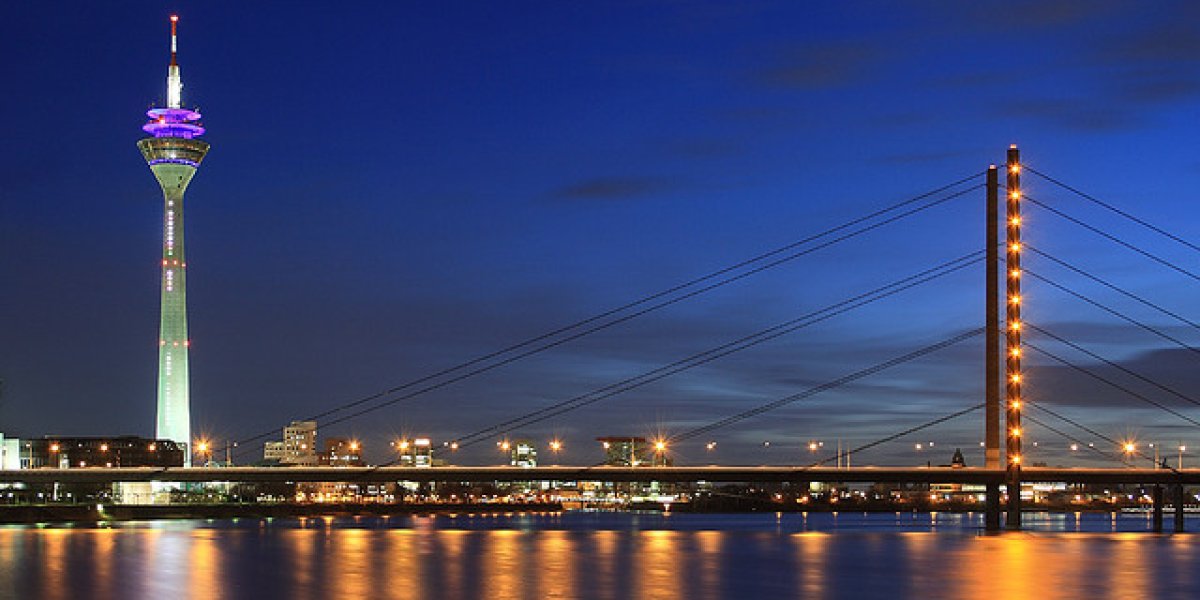
Walk back south along the harbor edge for six minutes — the 240-meter concrete spike is impossible to miss, and the row of round portholes running up its shaft is in fact the world's largest decimal clock. The observation deck up top delivers a 360° sweep from the Ruhr smokestacks in the north to Cologne Cathedral on the southern horizon on a clear day. Stay for sunset — the Rhine turns molten orange and the Gehry trio below begins to glow.
Tip: Book the timed online ticket the night before — €9 vs €11 at the door and you skip the elevator queue. Aim for the slot 90 minutes before sunset (check the day's time — 17:30 in winter, 21:30 in June); the west side of the deck is the sunset side, so head there first, then circle counter-clockwise as the city lights come on.
Open in Google Maps →19:30
Food
Hop the U78 or U79 tram from Polizei/Kniebrücke back to Heinrich-Heine-Allee — four minutes underground — and walk one block to the carved wooden door on Berger Straße. Brewing on this exact spot since 1862, Uerige is the cathedral of Altbier — a dark, copper-colored top-fermented ale found nowhere else on earth. The Köbes (waiters in blue aprons) carry tray-fulls of 200 ml glasses and will keep slamming fresh ones down until you put a coaster on top to surrender. Order the Sticke Altbier (€2.40/glass), Schweinshaxe with crackling (€16.50), and Reibekuchen — crisp grated-potato pancakes with apple sauce (€9.50).
Tip: No reservations accepted — arrive by 18:30 to claim a wooden table inside; after 20:00 the standing crowd spills into the street and you'll drink elbow-to-elbow on the cobbles (which is, honestly, the more authentic experience). Cash preferred. Pitfall warning: avoid the chain-style 'Brauhaus' pubs marketed to tour groups along Bolkerstraße — they pour mass-produced Altbier at double the price and microwave the Schweinshaxe. Same street at night, watch your pockets — pickpockets work the dense after-dark crowds.
Open in Google Maps →Saltar al día
10:00
Landmark
Begin where the city began — at the foot of the Schlossturm, the only tower that survived the 1872 fire that destroyed the old electoral palace. From the Rhine railing here you'll see the river bending north toward Oberkassel and the Altstadt waking up: soft light, few cyclists, and all the postcard angles before the tour groups arrive.
Tip: Pay €3 to climb the Schlossturm's small upper deck — most tourists walk straight past without realizing there's a 360° rooftop view of the Altstadt up there. The kiosk café opposite does the cheapest Rhine-view cappuccino in town at €2.80.
Open in Google Maps →11:00
Museum
Walk inland three minutes from Burgplatz along Mühlenstraße — you'll pass the bronze Stadterhebungsmonument worth a quick glance — and arrive at the black granite cube on Grabbeplatz. K20 holds one of the world's deepest Paul Klee collections, rooms of Picasso and Kandinsky, and the Joseph Beuys works locals are genuinely proud of.
Tip: Skip the audio guide and head straight upstairs to Room 12 — Beuys's Palazzo Regale lives here and is almost always empty before noon. The €5 combo ticket with K21 is only worth buying if you're certain you'll visit both within the same week.
Open in Google Maps →13:00
Food
Exit K20 onto Heinrich-Heine-Allee and walk five minutes northeast along Ratinger Straße — you'll cross the medieval Ratinger Tor city gate before reaching the dark-wood facade of Im Füchschen, brewing on this exact spot since 1640. Locals slide onto the long communal benches; the unspoken rule is to keep a coaster on top of your glass when you're done, or the Köbes (waiter) will keep dropping fresh Altbiers in front of you until midnight.
Tip: Order the Schweinshaxe mit Sauerkraut (€18.50) — a crackling-skinned pork knuckle the size of your head — or the lighter Halve Hahn (€7.50), which despite its name is a rye roll with aged Dutch cheese, mustard and raw onions. The Altbier is €2.50 and you'll be served whether you ask or not.
Open in Google Maps →15:00
Landmark
From Im Füchschen walk south down Hunsrückenstraße for four minutes into the Altstadt's medieval core. Three stops in tight sequence: the Marktplatz with its bronze equestrian Jan Wellem (the city's flamboyant 17th-century elector), the Renaissance arcade of the Altes Rathaus, and St. Lambertus Basilica with its famously twisted spire — a wooden frame that warped in 1815 and the city never bothered to straighten.
Tip: Walk around the back of St. Lambertus to find Mertensgasse — Düsseldorf's quietest medieval lane, where locals pass through but tourists rarely do. The cobblestone slope photographs beautifully against the twisted church spire, especially mid-afternoon when the light hits the copper roof.
Open in Google Maps →17:00
Neighborhood
Two minutes south of St. Lambertus you'll hit Bolker Straße — the spine of what locals call die längste Theke der Welt, the longest bar in the world, with over 260 pubs packed into half a square kilometer. Heinrich Heine was born at number 53 (now a small bookshop). Settle into a sidewalk Altbier at Brauerei Kürzer or Schlüssel as the locals arrive around 18:00 and the street fills with the clink of small glass mugs.
Tip: Avoid any bar with an English menu taped to its window — the real breweries (Schlüssel, Kürzer, Schumacher's Goldener Kessel) post nothing and serve only Altbier. Pace yourself: each glass is just 0.25L but they arrive every four minutes whether you ordered or not; two coasters on top of the empty glass is the universal signal that you're done.
Open in Google Maps →19:30
Food
Cross from Bolker to Berger Straße — a one-minute walk — and step into Düsseldorf's most famous brewery, pouring Altbier on this corner since 1862. A maze of dark-wood rooms spills out into a cobbled courtyard, Köbes weave through with trays of small glasses, and you can see the copper kettles brewing behind a glass partition.
Tip: Order the Sticke (a stronger seasonal Altbier, €3) if it's on tap — only brewed twice a year and unavailable anywhere else. For food, the Reibekuchen mit Apfelmus (potato pancakes with apple sauce, €9) is the local favourite. Pitfall warning: never eat at the riverside Rheinpromenade restaurants facing the water — they are uniformly tourist-priced and the food is mediocre; an honest brewery dinner in the Altstadt runs €25-35 a head.
Open in Google Maps →10:00
Shopping
Begin at Düsseldorf's grandest avenue — the Kö — an 87-metre-wide boulevard split down the middle by a willow-shaded canal that was once the city moat. The east side is the famous luxury parade (Tiffany, Cartier, Dior, Chanel); the west side is calmer, with chestnut trees and benches over the water. Mornings are when locals actually walk here, before the tour buses arrive at eleven.
Tip: Skip the much-hyped Kö-Bogen mall (Daniel Libeskind, retail-focused) and instead walk to the southern end of the canal where the bronze Triton Fountain sits — that's the postcard angle, with willows arching over the water. Use the west side for shade and photos, the east side strictly for window-shopping.
Open in Google Maps →11:30
Park
Walk north along Kö's canal for five minutes until it merges into the green expanse of Hofgarten — Germany's first public park, opened in 1769. Cross the small bridge and head northeast through the linden allée to Schloss Jägerhof, a small pink rococo palace that today houses the Goethe-Museum. Even if you skip the museum, the manicured rose parterre out front is one of the city's most photogenic corners.
Tip: Find the Märchenbrunnen (Fairy-Tale Fountain) tucked in the western corner of Hofgarten — a small bronze grouping of Brothers Grimm characters that almost no tour mentions. Mid-morning is best, when sunlight cuts through the canopy and catches the green patina on the figures.
Open in Google Maps →13:00
Food
Walk south out of Hofgarten back toward the city, then continue 8 minutes down Oststraße — Japanese signage starts appearing as you cross Klosterstraße. Naniwa is unmarked-looking from the street but locals have queued here since 1985 for arguably the most authentic ramen west of Tokyo: 20 seats, communal tables, no reservations, no English fuss.
Tip: Order the Shoyu Ramen (€14) — soy-based broth, chashu pork, marinated egg, house-pulled noodles — and the Karaage fried chicken (€9) as a starter. Arrive by 13:00 sharp or after 14:00 to dodge the worst queue (Japanese office workers from nearby firms pack the place between 13:15 and 13:45). Cash strongly preferred.
Open in Google Maps →14:30
Neighborhood
Step out of Naniwa onto Oststraße and within a single block you're in Little Tokyo — Immermannstraße runs east-west, Klosterstraße crosses it north-south, and together they form the spine of Europe's largest Japanese community: over 8,000 residents, three Japanese schools, an entire ecosystem of bookstores, supermarkets and izakayas. Browse the Shochiku Japanese supermarket, Hoshino's bookstore stacked with manga and stationery, and the Black Forest cake shop run by a Japanese pastry chef.
Tip: Hidden gem: the second-floor OCS bookstore at Immermannstraße 35 stocks washi paper and rare Japanese design magazines you won't find anywhere else in Germany. Pop into Takumi 2 around the corner for matcha soft-serve (€4.50) — locals will swear it beats anything in Harajuku.
Open in Google Maps →16:30
Landmark
Take Tram 706 two stops to Stadttor, or walk 25 minutes south along Berliner Allee — you'll cut across the new Kö-Bogen II green-roof structure on the way. You arrive at MedienHafen, the former industrial harbour reinvented by Frank Gehry in 1998: his three Neue Zollhof buildings (white plaster, red brick, mirror-polished steel) lean and twist as if mid-dance, and the polished facade shimmers best in late-afternoon light. Climb the 240-metre Rheinturm next door for the city's only proper aerial view; in summer the sun doesn't set until almost 21:00.
Tip: Photograph the Gehry buildings from the small footbridge on the harbour's south side around 18:30 — the polished-steel building reflects the entire harbour back at you. Skip the rotating Rheinturm restaurant (overpriced and mediocre) and buy the €9 observation-deck-only ticket instead.
Open in Google Maps →19:30
Food
Walk west along the harbour edge for six minutes — past the silver Gehry building — to Am Handelshafen 15. Lido sits directly on the water with a glassed-in terrace facing the Rhine and the city skyline, lit by lanterns as dusk settles. The kitchen is Mediterranean and locally famous for its risottos and salt-baked fish.
Tip: Reserve the terrace 2-3 days ahead (booked solid on weekends) and request the Wasserseite — the water-facing side. Must-orders: Branzino al sale (€36, salt-crusted sea bass cracked open at the table) and the Risotto ai funghi (€22). Pitfall warning: avoid the MedienHafen restaurants with neon signs and outdoor TV screens — they target the after-work corporate crowd and charge a 40% premium on generic Italian.
Open in Google Maps →
Trip builder
Plan this trip around Dusseldorf
Turn this guide into a bookable rail itinerary with FlipEarth.
Keep exploring
Related cities
More in the same country
FAQ
Frequently asked questions
How many days do you need in Dusseldorf?
Most travelers enjoy Dusseldorf in 1 days, with enough time for headline sights and a slower meal or museum stop.
What's the best time to visit Dusseldorf?
The easiest season for most travelers is May-Sep, especially if you want good weather and manageable crowds.
What's the daily budget for Dusseldorf?
A practical starting point is about €90 per person per day before hotels, then adjust based on museums, dining, and transport.
What are the must-see attractions in Dusseldorf?
A good first shortlist for Dusseldorf includes Königsallee, MedienHafen — Frank Gehry's Neuer Zollhof, Rheinturm Observation Deck.