City Guide
Dinant
Bélgica · Best time to visit: May-Sep.
Day-by-day plan
Choose your pace
Duración del viaje
09:00
Landmark
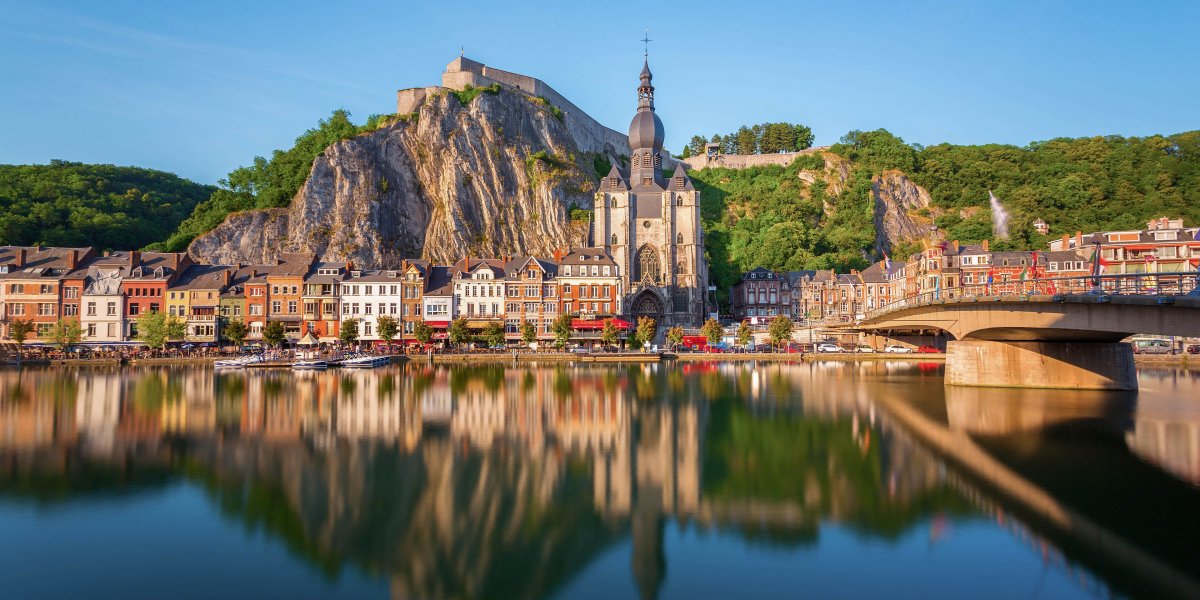
From Dinant station, cross the Meuse via Pont Charles de Gaulle and walk 6 minutes north along the riverbank promenade — the cliff face looms directly above with the church's pear-shaped dome glowing at its foot. Take the cable car up first while your legs are fresh, walk the upper terrace for the panoramic view (Meuse curving south, town pressed flat against the cliff, Ardennes rolling away to the horizon), then descend the 408 steps that dump you straight into the church square. Skipping the citadel museum interior is the right call on a day trip — the view itself is the entire point.
Tip: Cable car UP, 408 steps DOWN — never the other way. Going down, you watch the church's pear-shaped dome rise to meet you frame by frame, which is the signature Dinant photograph. The cable car opens at 10:00 most of the year (09:00 in July-August), so if you arrive in shoulder season, start with the staircase climb instead and use the cable car only on descent.
Open in Google Maps →11:15
Religious
You're already there — the 408-step staircase deposits you at the church's back wall in under a minute. Walk around to Place Reine Astrid for the full façade: Gothic stone, the unmistakable pear-shaped onion dome (a Mosan oddity — you won't see another like it anywhere in Belgium), and the citadel cliff rising vertically behind. Step inside briefly for the blue-violet stained glass above the choir; the rest of the interior is austere and not worth more than a few minutes.
Tip: The dome reads like a stone version of a Russian onion — but the trick angle is NOT in front of the church. Walk 50 meters out onto Pont Charles de Gaulle and shoot back: dome + 408-step staircase + cliff face + citadel walls stack into a single vertical frame. This is the actual postcard shot, and late morning gives you front-lit stone before the cliff goes into shadow.
Open in Google Maps →12:00
Food
From the church square, head 3 minutes north onto Rue Grande, Dinant's pedestrianized spine — the frituur sits among the souvenir shops with its fryer fans humming through the open door. This is a proper Belgian frituur, not a tourist gimmick: hand-cut frites double-fried in beef tallow, served in a paper cone, eaten standing up on a riverside bench. The whole meal takes 15 minutes; use the rest to walk the right bank.
Tip: Order a regular cone with sauce andalouse — mayo, tomato, peppers — which is what locals actually eat; never ask for ketchup (they'll serve it but quietly judge you). The frites should come out dark gold, not pale: that's the beef tallow telling you they're real. If you want the full Belgian gut-bomb, ask for a mitraillette (baguette split lengthwise, stuffed with frites, sausage, and sauce) — but only if you're skipping a real dinner.
Open in Google Maps →13:15
Landmark
Continue 4 minutes north along Rue Grande as it becomes Rue Adolphe Sax — the street itself is decorated with painted saxophones at every doorway, so you can't miss it. The birthplace of Adolphe Sax (inventor of the saxophone, 1814) is a small exterior monument with bronze sculptures, plaques, and street installations rather than a museum — perfect for a no-interior day. On the way, stop at Maison Jacobs (Rue Grande 147), the historic couque bakery operating continuously since 1860, for a box of the local hard-honey biscuit to carry away.
Tip: Couque de Dinant is the hardest 'cookie' you will ever encounter — never bite it. Locals suck on it like a hard candy until it softens; biting has sent more than one tourist to the dentist. At Maison Jacobs, ask for a small fish-shaped couque (€5 a box) rather than the giant decorative wheels — those are wall art, not food. The honey is from Ardennes beekeepers and the recipe genuinely hasn't changed in 160 years.
Open in Google Maps →14:30
Landmark
Backtrack 3 minutes south along Rue Adolphe Sax to the bridge — the rows of life-sized, brightly painted saxophones lining the railing (each representing a different country, painted in its flag) announce themselves from a block away. Walk the bridge slowly photographing each, then continue across to the left (west) bank and follow the riverside promenade south. From the left bank between 15:30 and 17:00, the east-facing cliff turns honey-gold in side-light and you finally get the full Dinant composition in one frame: citadel walls, cliff face, dome, bridge, Meuse reflection.
Tip: The single best photograph of Dinant exists from one specific spot — the left-bank riverside path roughly 200 m south of the bridge, where the river curves slightly and the citadel, cliff, church dome, and bridge all align in receding planes. Shoot around 16:30 in summer for warm side-light on the cliff; it's east-facing, so it goes flat-gray the moment the sun drops behind the ridge (usually around 17:30 in June-August). Cross the bridge a second time on foot for a different angle on each saxophone — the painted details only resolve up close.
Open in Google Maps →18:30
Food
From the bridge, cross back to the right bank and walk 4 minutes south along Rue Georges Cousot — the restaurant's walled garden terrace sits directly beneath the citadel cliff with tables facing the Meuse. This is where Dinantais take visiting in-laws: a proper Wallonian kitchen, river views, none of the language-menu nonsense. Order the Ardennes trout meunière (€22) or the carbonnade flamande slow-cooked in Leffe (€19) — the latter is the regional dish and pairs with a Maredsous Trappist beer from the abbey 30 km upriver.
Tip: Pitfall warning: skip the brasseries on Place Reine Astrid with menus printed in six languages and waiters waving you in from the doorway — they serve frozen mussels at €28 to tour-bus crowds and outright skip the regional dishes. Le Jardin de Fiorine takes reservations (call the morning of, especially May-September), and the Meuse-facing terrace tables go first — ask for 'côté rivière'. The kitchen closes at 21:30 on weeknights, so aim to be seated by 19:00 if you want a dessert and the last train back.
Open in Google Maps →
Trip builder
Plan this trip around Dinant
Turn this guide into a bookable rail itinerary with FlipEarth.
Keep exploring
Related cities
More in the same country


FAQ
Frequently asked questions
How many days do you need in Dinant?
Most travelers enjoy Dinant in 1 days, with enough time for headline sights and a slower meal or museum stop.
What's the best time to visit Dinant?
The easiest season for most travelers is May-Sep, especially if you want good weather and manageable crowds.
What's the daily budget for Dinant?
A practical starting point is about €80 per person per day before hotels, then adjust based on museums, dining, and transport.
What are the must-see attractions in Dinant?
A good first shortlist for Dinant includes Citadel of Dinant, Maison de Monsieur Sax, Pont Charles de Gaulle.