City Guide
Baku
Azerbaiyán · Best time to visit: Apr-Jun, Sep-Oct.
Day-by-day plan
Choose your pace
Duración del viaje
09:00
Landmark
Zaha Hadid's flowing white curves rise from the plaza like a wave frozen mid-crest, and at 9:00 the morning light still rakes from the east, catching every fold before midday flattens them. Walk a slow loop around the southern flank where the structure swells most dramatically — this is the most photographed contemporary building in the Caucasus, and the only one whose every angle invents a new form. No need to step inside; the architecture is the masterpiece.
Tip: From the gentle rise on the southern side (off Heydər Əliyev prospekti, near the public parking lot) you get the whole building in one frame — the same composition every architecture photographer leaves with. Be done by 10:30: from 11:00 the wedding-photo parties take over the plaza and your clean shots are gone.
Open in Google Maps →12:30
Food
Walk southwest through Yasamal and Nəsimi for about 90 minutes (≈4.5 km), descending past Soviet apartment blocks that give way to oil-boom mansions and the leafy boulevards of central Baku — a slow urban transect of three centuries. Firuze, a traditional spot just east of Fountains Square, fills its vine-shaded courtyard with locals at lunch; order the yarpaq dolması (grape-leaf rolls, 9 AZN) and a plate of qutab with greens and pomegranate (6 AZN) — Baku's two essential dishes, eaten in under an hour and back on your feet.
Tip: Skip the English menu and point at what the neighbouring tables are eating — the daily lamb plov is the strongest off-menu order. Ask for 'sərin su' if you want cold tap water (it arrives unrequested but lukewarm). Budget 20-30 AZN per person (~12-18 EUR); cash is welcomed but card works.
Open in Google Maps →13:30
Neighborhood
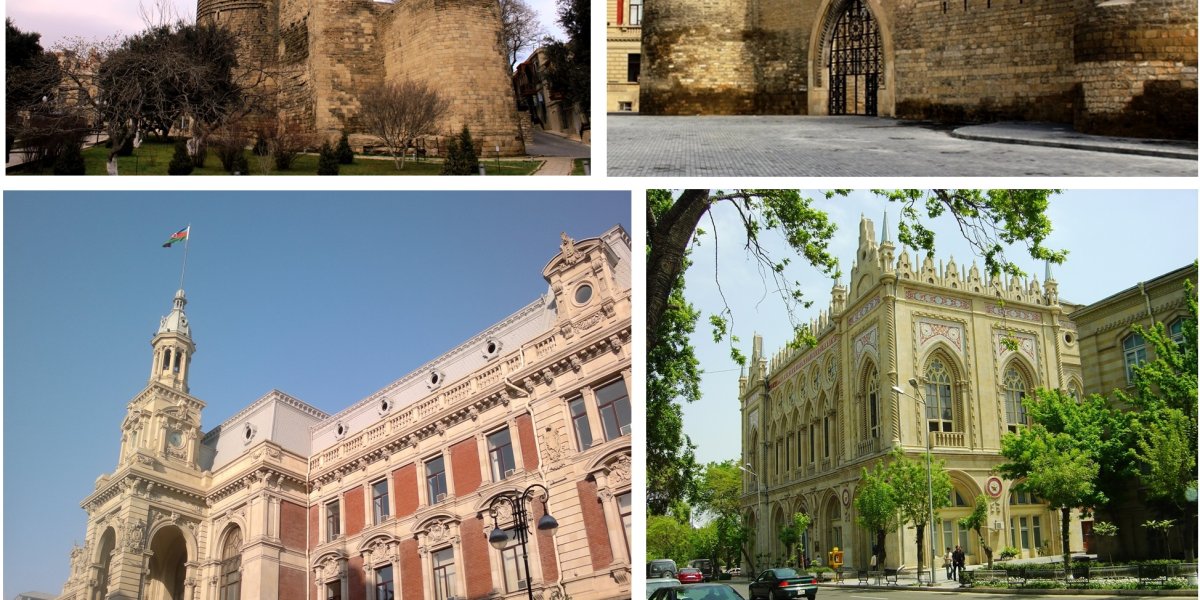
Walk south from Firuze for 8 minutes down İstiqlaliyyət and the medieval walls rise abruptly from the modern boulevard — pass through the double-arched Qoşa Qala gate and the 20th century simply evaporates. Inside Icherisheher (the UNESCO-listed walled Inner City) you wind through honey-sandstone alleys past the Shirvanshahs' Palace exterior to the base of the Maiden Tower, a centuries-old cylinder whose true purpose no scholar has ever settled. Mid-afternoon sun rakes the stone at the perfect angle for photos.
Tip: Slip into the narrow alleys behind the Palace courtyard rather than the main tourist drag — that's where the carpet weavers actually live and where cats outnumber visitors three to one. The 'James Bond house' (from The World Is Not Enough) is on Asəf Zeynallı küçəsi — a small bronze plaque on a corner wall, easy to miss but unmistakable once you spot it.
Open in Google Maps →16:00
Park
Exit Icherisheher through the southern gate by the Maiden Tower, cross Neftçilər prospekti and you are on the Bulvar — one of the longest urban waterfronts on the planet. Walk east along the Caspian past the brick-vaulted Little Venice canals (skip the gondola, it's a tourist gimmick) and the upturned-carpet form of the Azerbaijan Carpet Museum. The afternoon Xəzri wind cuts in sharply off the sea — locals will tell you it's why Baku has no mosquitos, and they're not entirely joking.
Tip: Push past where most tour groups turn back — at the State Flag Square end the promenade goes reliably empty and the Caspian feels biggest. The 'Mirvari' (Pearl) modernist café halfway along has the most photogenic seafront view but mediocre coffee; just sit on the public benches and let the wind do its thing.
Open in Google Maps →18:00
Park
Backtrack 800 metres west along Bulvar to the funicular station at Neftçilər prospekti — the one-minute ride (1 AZN) lifts you to Dağüstü Park, the clifftop edge from which the entire city spreads to the sea. Walk five minutes north along Şəhidlər Xiyabanı (Martyrs' Lane), the somber memorial avenue for the dead of Black January 1990 and the Karabakh war, ending at the eternal flame just as the sun drops behind the Bibi-Heybət headland. Turn around at full dark and the three Flame Towers begin their nightly LED choreography — flickering flames, then waving Azerbaijani flags, then pixelated bonfires sweeping the skyline.
Tip: Arrive by 18:45 to catch blue hour — about 25 minutes when the sky still holds color and the Flame Towers photograph best (any later and the camera blows out the LEDs against black sky). The light show runs in 10-minute cycles, so wait through at least two. **Pitfall warning:** avoid the 'Highland Park' restaurant at the top terminus — the view is excellent but the food is wildly overpriced tourist fare, and the taxi rank up here quietly charges triple the meter rate. Take the funicular back down.
Open in Google Maps →20:00
Food
Take the funicular down and walk 12 minutes east along Neftçilər, then back into Icherisheher through the southern Şamaxı gate — Mugham Club is tucked inside the restored 14th-century Mulţani Karvansaray, its stone alcoves dimly lit by candle lanterns around an open courtyard. Order lyulya kebab (12 AZN), the saffron-yellow Şah plov hidden under a crisp rice crust (28 AZN), and a carafe of Madrasa, the deep pomegranate-red Azerbaijani wine. From 20:00 the mugham trio plays tar, kamancha and daf — request 'Sarı gəlin' and watch the room quietly fall still.
Tip: Reserve a table before lunch via WhatsApp (number on Google Maps) — the small alcove tables along the courtyard wall fill first and are by far the most atmospheric; ground-floor center tables sit right next to the musicians' speaker. Skip the wine list and order the carafe of house red. Budget 60-80 AZN per person (~35-45 EUR) including wine; cards accepted.
Open in Google Maps →Saltar al día
10:00
Landmark
Begin at the heart of Old Baku, where this 12th-century cylindrical fortress has guarded the Caspian shoreline for nine centuries. Climb the eight floors on narrow stone stairs to the rooftop terrace; the panorama frames the entire walled Icherisheher, the curving bay, and the Flame Towers rising on the hill behind.
Tip: Arrive right at the 10:00 opening — cruise-ship groups pour in after 11:00 and the spiral staircase becomes one-way traffic. Buy the combined ticket (15 AZN) at the booth; it also covers the Palace of the Shirvanshahs, saving you a second queue an hour later.
Open in Google Maps →11:30
Museum
Exit the tower base and walk 6 minutes uphill along Asef Zeynalli Street — you will pass active carpet workshops with weavers at their looms, worth pausing for. The 15th-century royal complex of the Shirvanshah dynasty is Azerbaijan's masterpiece of Islamic architecture: UNESCO-listed, remarkably intact, and including the throne hall, the divan-khane, a royal mausoleum carved with Persian inscriptions, and the tomb of court astronomer Seyid Yahya Bakuvi.
Tip: Use the combined ticket from the Maiden Tower so you can skip the queue. The shah's bath ruins on the lower terrace are the most photogenic feature — around midday, sunlight falls through the broken domes and casts perfect circular spotlights on the stone floor.
Open in Google Maps →13:30
Food
Two minutes downhill from the palace on Asef Zeynalli Street — look for the carved wooden door and stone arches with locals' bicycles parked outside. A long-running Old City fixture for proper Azerbaijani home cooking: order the qutab (paper-thin stuffed flatbreads, choose lamb-and-onion, 6 AZN per pair) and a clay pot of dolma (vine leaves with lamb and rice, 14 AZN), finishing with armudu tea poured from a charcoal samovar.
Tip: Sit in the back stone-vaulted room rather than the streetside terrace — the temperature drops 5°C and the alley touts can't shout into your meal. Reserve a table by 13:00 on weekends or arrive before 13:30 — by 14:00 the courtyard is full.
Open in Google Maps →15:00
Park
From Firuze, walk 8 minutes northwest on Qiz Qalasi Street, exit the Old City through the Double Gates, and cross Neftchilar Avenue to the funicular station; the cable car climbs in 4 minutes for 1 AZN, dropping you straight at Martyrs' Lane. Sehidler Xiyabani commemorates Azerbaijanis killed in the 1990 Soviet crackdown and the Karabakh wars — an avenue of black granite portraits leading to an Eternal Flame. Beyond it, Highland Park's terrace gives the city's best free panorama: the entire Old City below, the curving Bulvar, and the Caspian stretching out.
Tip: Walk past the eternal flame to the white marble Turkish Martyrs' Memorial — almost no tourists make it that far, and its western terrace gives an uncluttered shot of the city with the bay behind. Locals deliberately arrive after 16:00 in shoulder season to avoid midday glare bouncing off the Caspian into every photo.
Open in Google Maps →16:30
Landmark
From Highland Park, walk 5 minutes west along the cliff path — the three flame-shaped towers rise directly ahead, with the Fairmont Baku occupying the central one. Up close, you realize the entire facades are LED panels that loop animated flames, pouring water, and the Azerbaijani flag from sunset on; take the elevator inside the Fairmont to 360 Bar on floor 19, where a slowly rotating lounge completes a full city panorama every 90 minutes.
Tip: A single coffee (10 AZN) or cocktail (18 AZN) is enough to hold a table — no dress code at this hour but no shorts after 19:00. The LED light show on the towers begins about 30 minutes after sunset; step back outside to the Highland Park terrace to watch it from below — the angle is far better from outside than through the bar's tinted glass.
Open in Google Maps →20:00
Food
Walk down the stone steps from Highland Park into the Old City — 12 minutes through narrow lantern-lit alleys that deliver you to Kichik Qala Street. Mugam Club occupies a 14th-century caravanserai of stone-vaulted rooms around an open courtyard once used by Silk Road traders; order saffron plov with lamb and dried fruit (28 AZN) and lamb shashlik off the pit (24 AZN), and stay for the live mugham musicians (Azerbaijan's UNESCO-listed traditional vocal music) who perform nightly from 20:30.
Tip: Reserve via WhatsApp +994 50 220 47 47 the morning of — courtyard tables fill first and are quieter than the indoor balcony. Do not order from the laminated 'tourist set menu' — ask for the regular à la carte; same dishes run 30% cheaper. Pitfall warning: the carpet sellers who approach you at the alley exit with a 'free tea, family workshop' pitch end at a fixed-price tourist shop a block away — politely refuse and walk on, and the same goes for the unmarked taxis that idle near Old City gates after 22:00 (call a Bolt instead).
Open in Google Maps →09:00
Park
Bulvar is a 16-kilometer waterfront promenade — among the world's longest urban seafronts — and Baku locals genuinely use it every morning for jogging and tea. Start at the Crystal Hall end and walk east; halfway you reach Little Venice, a 1960 Soviet-built network of canals modeled on the Italian originals, where 5-AZN gondola rides loop a quiet circuit beneath stone bridges.
Tip: Walk on the Caspian side of the boulevard before 10:00 — the sun is behind you, the wind off the water is still cool, and Flame Towers reflect cleanly in the high-tide pools for the best mirror shot of the day. Skip the Caspian Pearl tower at the far western end (long entry queue, mediocre view) — Highland Park yesterday gave you the same panorama for free.
Open in Google Maps →10:30
Museum
Continue east along the boulevard for 8 minutes — the building looks like a rolled carpet on its side, impossible to miss against the seafront. The world's first museum dedicated entirely to carpet weaving, with 14,000 pieces across three floors; start on the top floor (kelim flatweaves, oldest pieces) and spiral down to contemporary work, finishing at the silk carpet wall on floor 2 — pieces so finely woven they catch the light differently with each step you take.
Tip: The English audio guide (3 AZN) is essential — without it you will miss the symbol decoding, where every motif tells a tribal story. Live weavers demonstrate on the ground floor between 11:00 and 13:00; ask them about regional differences (Tabriz vs. Quba vs. Karabakh) — they speak more English than the wall labels and explain knot densities in a way that makes the rest of the museum suddenly readable.
Open in Google Maps →12:30
Food
Walk 12 minutes north from the museum, crossing Neftchilar Avenue and uphill on Murtuza Mukhtarov Street — you pass the wedding-cake Mukhtarov Palace, a 1912 oil-baron mansion that is now the city's marriage registry. Dolma is the modern Baku address for the dish it is named after, run by a chef who reinterprets traditional Azerbaijani recipes without faking them; order the trio of dolma (grape leaf with lamb, eggplant, and tomato — 24 AZN), the warm dovga soup with mint and yogurt (8 AZN), and finish with a shekerbura pastry.
Tip: Book a table the night before via Instagram DM (@dolma_restaurant) for the upstairs section — quieter and with a view of the kitchen pass. Stick to dolma and dovga at lunch and save the kebabs for a heavier dinner spot; the kitchen handles the slow-simmered dishes better than the grill.
Open in Google Maps →14:30
Museum
Order a Bolt taxi outside Dolma — 12 minutes and roughly 5 AZN to Heydar Aliyev Avenue; the building reveals itself slowly as you approach, the white curves seeming to grow out of the ground. Zaha Hadid's 2012 masterpiece is a single uninterrupted curving white surface that won the world's top architecture award; inside, six exhibition floors flow as one continuous space, with the Classic Cars hall on the lower level holding Azerbaijani presidents' Cadillacs and ZIL limousines, and rotating contemporary art on the upper galleries.
Tip: Walk the entire perimeter of the building before entering — the south-facing curve catches the afternoon sun and is the only angle without scaffolding-tourists in the shot. The interior architecture is the actual exhibition; if you are short on time, skip the upper art galleries and spend the time on the main staircase and the long curving ramp that defines the building's geometry.
Open in Google Maps →17:30
Neighborhood
Bolt back from the Heydar Aliyev Center — 15 minutes to Fountains Square (Favvarelar meydani), arriving at the eastern end of Baku's pedestrian retail spine. Nizami Street runs 3 km west, lined with 19th-century oil-boom mansions in pale limestone, all now flagship stores or cafés; locals come at sunset for the promenade, ice cream from Baki Dondurma, and people-watching from the square's fountain steps.
Tip: Step into the open courtyard of the Sahil Hotel building (corner of Nizami and Khagani) — the original 1900s Caucasian tile work and stained-glass dome are untouched, security never minds, and almost no tourist looks up. Decline any 'free Azerbaijan tea tour' that recruits on the square; they all end at a high-pressure carpet sale where the price triples once the door closes.
Open in Google Maps →19:30
Food
Walk 6 minutes north from Fountains Square along Tarlan Aliyarbeyov Street — Chinar's black-and-gold facade is on the corner, and the line of black SUVs out front is the local sign that you are at the right address. This is where Baku's young professionals book a table to celebrate something: pan-Asian and Azerbaijani plates with confident execution, and a soundtrack that turns into a soft club after 22:00 — order the lamb-stuffed dolma with sumac-tomato glaze (32 AZN), black cod with miso (62 AZN), and a glass of the local Madrasa red (12 AZN).
Tip: Reserve via WhatsApp +994 50 200 11 11 for 19:30 — by 21:00 the room fills and the music doubles. Pitfall warning: the unmarked taxis idling outside Chinar and the dolmus minibuses around Fountains Square run foreigner rates of 3-5x meter price — always call a Bolt or Uber. Also avoid the 'antique amber' and 'silk carpet' kiosks lining Asef Zeynalli Street in the Old City after dark, which mark up 300-400% on cruise-passenger nights; the Carpet Museum gift shop is fixed-price, certified, and ships internationally.
Open in Google Maps →Saltar al día
10:00
Landmark
Enter the Old City through the Qosha Qala double gate and follow the descending stone lane five minutes south — the 29-meter cylindrical tower appears suddenly between low rooftops. Built into the 12th century, this is Baku's oldest standing monument and its true original purpose is still debated by archaeologists. Climb the eight floors of spiraling staircases for a panorama where the medieval walls below meet the Caspian to the east and the Flame Towers to the west, all in one frame.
Tip: Arrive five minutes before the 10:00 opening — be the first inside before the cruise tour buses pull up at 10:30 and the narrow spiral stair becomes single-file traffic. The rooftop's best photo angle is the northwest corner, where the tower's medieval silhouette frames the three Flame Towers in a single shot.
Open in Google Maps →11:30
Museum
Exit Maiden Tower north and climb eight minutes uphill through ascending stone alleys — you will pass the small Sınıq Qala minaret on the way, the oldest mosque of the Caucasus, dating to 1078. The 15th-century Shirvanshahs' palace is a UNESCO masterpiece of Shirvani architecture combining royal residence, mosque, mausoleum, the open-air divan-khana courtroom, and an extraordinary underground bathhouse. The internal museum holds Shirvanshah-era weaponry and calligraphy worth slowing down for.
Tip: Visit the divan-khana's domed pavilion between 11:30 and 12:30 when the sun strikes the carved muqarnas directly. Skip the audio guide and instead head straight to the underground bathhouse first — most visitors miss it entirely, and you can have the cold-room and hot-room chambers to yourself.
Open in Google Maps →14:00
Food
Walk three minutes east from the palace gate down Kichik Qala alley — the restaurant occupies the 14th-century Bukhara Caravanserai, with tables ringing a vaulted stone courtyard where Silk Road merchants once stabled their camels. Order the lamb-and-pumpkin dolma (12 AZN) and the qutab with lamb and herbs (8 AZN); the pomegranate-and-walnut sauce that comes with the dolma is the dish itself. Bottomless bread arrives straight from the tandir oven beside the front arch.
Tip: Skip the menu's 'tourist set' — order à la carte to taste twice the food at half the price. Ask the waiter for ayran (salted yogurt drink, 3 AZN) instead of water with the dolma; it is the local pairing and cuts the richness perfectly. Average budget 25 euros per person.
Open in Google Maps →16:00
Neighborhood
Step out of the caravanserai and turn left into Kichik Qala küchəsi — within thirty seconds you have vanished into a maze of stone lanes where film crews still shoot period dramas (the 1969 Soviet comedy 'The Diamond Arm' was filmed along this street). Loop past Juma Mosque with its restored 17th-century minaret, then drift through the Asef Zeynalli alley with its 'famous filming' wall plaques. The walls themselves are the destination here — every doorway hides a carved Persian inscription or a Soviet film still.
Tip: The afternoon light between 16:30 and 17:30 falls perfectly into the caravanserai courtyards — this is the hour photographers wait for. Do not stop at the carpet shops touting 'antique Shirvan rugs' along Kichik Qala; the genuine carpets are at the Carpet Museum tomorrow, and these alley shops sell synthetic-dye reproductions at antique prices.
Open in Google Maps →19:30
Food
From the alleys you have been wandering, step thirty meters back to the Multani Caravanserai — Mugam Club occupies the same vaulted stone hall. Live mugham performance begins at 20:00 nightly; a traditional saz-tar-kamancha trio plays from a raised wooden platform while you eat. Order the lamb saj cooked tableside on a domed iron skillet (35 AZN for two) and finish with sweet sherbet and pakhlava layered with walnut and saffron.
Tip: Reserve a table for 19:30 and request the second arch from the back — you face the musicians directly but are far enough that conversation is still possible. PITFALL WARNING: Outside the Old City walls along Neftchilər prospekti, several restaurants display 'traditional folk show' signs in English — these are tourist traps with 60 AZN minimums and reheated food. The genuine mugham experience happens inside Old City venues like this one; never outside.
Open in Google Maps →10:00
Museum
Walk ten minutes south from the Old City along the boulevard — the museum is unmissable, designed by Austrian architect Franz Janz to resemble a rolled carpet unfurling onto the Caspian shore. The collection moves chronologically from 17th-century Karabakh and Shirvan weavings up to contemporary work; the third-floor demonstration loom shows the knot-tying process in real time. Don't skip the small carpet-restoration workshop visible through the glass partition on level two — three women working on a damaged 19th-century Quba carpet, audible silk being trimmed.
Tip: Enter exactly at 10:00 opening — by 11:00 the cruise groups arrive and the narrow ramped galleries become congested. The single greatest piece is the 17th-century Ovchuluq (Hunting) carpet on the second floor — ask the guard for 'ovchuluq xalchasi' if you cannot spot it. Closed Mondays.
Open in Google Maps →13:00
Food
Exit the museum and walk twelve minutes north along the boulevard then up Üzeyir Hajibəyli küchəsi — Sumakh sits in a converted 19th-century mansion. This is upscale Azerbaijani done right; the kitchen sources lamb from the Şəki mountain villages and herbs from the Quba foothills. Order the dushbara (tiny lamb dumplings in clear broth, 14 AZN) and the saffron plov with caramelized chestnut and dried apricot (28 AZN) — Azerbaijan's national dish, done as it should be.
Tip: Reserve the wood-paneled second-floor terrace via WhatsApp the morning of — it is the only quiet section. The set lunch menu served 12:00-15:00 is identical to dinner at 30 percent less. Pair the plov with a glass of Madrasa red, an Azerbaijani indigenous grape that the sommelier will steer you to the drinking-now vintage.
Open in Google Maps →15:00
Park
Walk six minutes back toward the sea — Sumakh's front door faces the Bulvar entrance. The Caspian promenade stretches 16 km, but the most charming stretch is the 1.5 km between the Carpet Museum and the National Flag Square: lawn chess games under the plane trees, the Soviet-era 'Mirvari' (Pearl) café pavilion shaped like a folded napkin, and Little Venice — a miniature network of artificial canals with two-euro gondola rides where local couples come on first dates. The Crystal Hall and the giant Ferris wheel finish the skyline to the east.
Tip: Ride the Little Venice gondolas between 15:30 and 16:30 when the western sun illuminates the canal walls — earlier and the water sits in shade, later and you compete with sunset crowds. Skip the imported soft-serve carts (5 AZN); the dondurma vendor at the National Flag Square sells real Azerbaijani sahlep ice cream for 1 AZN.
Open in Google Maps →17:30
Landmark
From Little Venice walk fifteen minutes west along the seafront to the lower funicular station beside Park Bulvar Mall — this little cable car has climbed the hill since 1960 and the three-minute ride is part of the experience. At the summit, Highland Park (Dağüstü Park) opens into a vast terrace overlooking the entire city. Walk south along the ridge to Martyrs' Lane (Şəhidlər Xiyabanı), the granite-paved memorial honoring those killed in the 1990 Black January and the 1992-94 Karabakh war; the eternal flame stands at the southern end, and the Flame Towers rise immediately to your right.
Tip: Time your arrival for 60 minutes before sunset — the city below turns gold while the Flame Towers begin their 90-minute LED show at dusk (every three minutes the towers cycle through flame, flag, and falling-water animations). Photograph from the bench north of the eternal flame — this is the only spot where Old City walls, Caspian sea, and Flame Towers all sit in the same frame.
Open in Google Maps →20:00
Food
Walk eight minutes down the hill from the eternal flame along the switchbacks to Sabit Orujov küchəsi — Şirvanşah Muzey occupies a multi-level building styled as a miniature ethnographic museum, with each room recreating a different Azerbaijani region (Şəki, Quba, Naxçıvan). Order the saj iliki (lamb with mountain herbs cooked on a domed iron pan, 38 AZN) and the qutab with greens (8 AZN). The downstairs courtyard fountain pavilion is the room to book.
Tip: Phone ahead and request the 'Şəki room' specifically — its hand-painted shabaka stained-glass ceiling is the most beautiful of the eight themed rooms. PITFALL WARNING: Below the Flame Towers along Mehdi Hüseyn küchəsi, several rooftop bars promise 'best Flame Tower view' with 20 AZN cover charges and cocktails at three times Baku prices — skip them. The free best view is from Şirvanşah's own front terrace, available without ordering.
Open in Google Maps →11:00
Landmark
Take the metro from Sahil station — one block north of Fountains Square — red line two stops to Nəriman Nərimanov; exit and walk eight minutes east along Heydər Əliyev prospekti and the white wave appears like a sand dune ahead. Zaha Hadid's 2012 masterpiece has no straight edges — the building flows from plaza to roofline as a single sheet of polished fiber-reinforced polymer. Inside, three permanent exhibits earn your full attention: the Mini Azerbaijan model of every UNESCO village in miniature, the National Treasures hall of Shirvanshah-era silver, and the Classic Car collection in the basement with President Aliyev's personal Soviet-era ZIL limousines.
Tip: Enter at 11:00 opening exactly — by noon the Asian tour groups arrive and the white interior staircase becomes a queue of selfies. The most photographed exterior spot is not the front plaza but the southeast service ramp where the building's curve sweeps closest to the ground — walk around the right side before you go in. Closed Mondays.
Open in Google Maps →13:45
Food
Walk eight minutes back to Nəriman Nərimanov station and ride two stops to Sahil — Dolma Restaurant sits one block north on Üzeyir Hajibəyli küchəsi. As the name promises, this kitchen specializes in dolma: the menu lists fourteen varieties beyond the familiar grape-leaf version, including kələm dolması (cabbage), badımcan dolması (eggplant), and a showstopping Şəki-style trio of three vegetables on a single plate (22 AZN). The signature dish is the lamb yarpaq dolması (grape-leaf, 14 AZN), served with garlic-yogurt and dried mint.
Tip: Order the 'üç bacı' — 'three sisters,' a sampler of grape-leaf, cabbage, and pepper dolma served on a single plate (28 AZN) — the best way to taste the range without over-ordering. Start with the dovğa yogurt soup; it is an Azerbaijani comfort dish you will not find on most tourist menus, ask specifically for it.
Open in Google Maps →15:30
Neighborhood
Exit Dolma and walk three minutes north to Nizami küchəsi — the entrance is marked by Sabir Garden with its statue of poet Mirzə Ələkbər Sabir. Nizami Street (locally still called Torgovaya) is the 3-km pedestrianized artery laid down during the late-19th century oil boom; you will pass restored Belle-Époque mansions, the original Tagiyev grand store (now a luxury arcade), and a series of small bronze sculptures hidden in doorways — the street barber, the milk-seller, the wandering musician. Half an hour of slow wandering is enough; the joy is in noticing the carved facades nobody looks up at.
Tip: Stop at the Ali and Nino bookstore-café (mid-Nizami, signed in English) for a strong Azerbaijani coffee for 4 AZN — better than the Western chains that bracket the street. The 'milk-seller' bronze at Nizami × Rəsul Rza is the most photographed but the 'street barber' three blocks east is funnier and crowdless.
Open in Google Maps →17:30
Landmark
Walk five minutes east along Nizami küchəsi to where the street widens into Fəvvarələr Meydanı — Baku's traditional gathering plaza, framed by Belle-Époque mansions and ringed by fifteen working fountains. Find a bench near the central fountain and watch the city unfold: students from the State University, families on their evening stroll, the impromptu chess matches under the plane trees. Loop slowly and look for the Soviet-era Nizami Cinema's restored 1934 facade on the south side and the small 'underwater' fountain at the northern corner.
Tip: The square is at its best around 18:00 when the fountains light up and the temperature drops — you have timed it right. Avoid the costumed photo-op characters (Mickey, Spider-Man) at the south end; they aggressively follow tourists and then demand 5 AZN per photo. The best free people-watching bench is the curved stone seat on the west edge facing the Nizami Cinema.
Open in Google Maps →20:00
Food
Walk three minutes south from Fountains Square down Səməd Vurğun küchəsi — Çırax sits in a quiet courtyard set back from the street, marked only by a small lit lantern (the name means 'lamp' in Azerbaijani). The kitchen specializes in tandir-cooked meats: the signature is the cağ kebab, a Şəki mountain dish of skewered lamb cooked vertical to a wood fire (28 AZN), and the lülə kebab of hand-ground lamb with sumac (22 AZN). The bread arrives directly from the visible tandir oven still smoking at the back wall.
Tip: Reserve via WhatsApp the morning of and request the back terrace — the front room can be loud when groups arrive after 21:00. PITFALL WARNING: Along the Nizami Cinema side of Fountains Square, several 'Azeri cuisine' restaurants with English-only menus quote prices in dollars and add a 15 percent 'service for foreigners' charge — always confirm prices in manat before ordering, anywhere outside the Old City.
Open in Google Maps →
Trip builder
Plan this trip around Baku
Turn this guide into a bookable rail itinerary with FlipEarth.
Keep exploring
Related cities
FAQ
Frequently asked questions
How many days do you need in Baku?
Most travelers enjoy Baku in 1 days, with enough time for headline sights and a slower meal or museum stop.
What's the best time to visit Baku?
The easiest season for most travelers is Apr-Jun, Sep-Oct, especially if you want good weather and manageable crowds.
What's the daily budget for Baku?
A practical starting point is about €75 per person per day before hotels, then adjust based on museums, dining, and transport.
What are the must-see attractions in Baku?
A good first shortlist for Baku includes Heydar Aliyev Center (exterior).