City Guide
Alesund
Noruega · Best time to visit: Jun-Aug.
Day-by-day plan
Choose your pace
Duración del viaje
09:00
Landmark
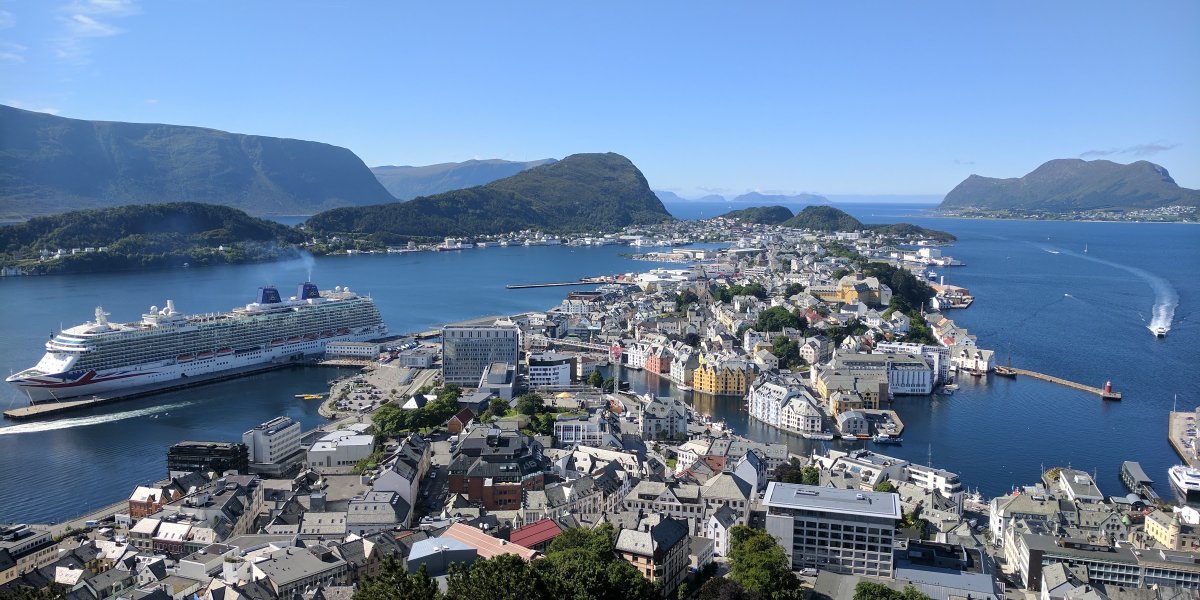
From the harbor, walk five minutes east into Byparken — the staircase begins behind the small lake at the foot of the rock. Climb the 418 numbered stone steps through pine and birch, and at the top the entire Alesund archipelago opens in a single sweep: Art Nouveau spires below, the Sunnmore Alps on the horizon, fjord water cutting between green islands. At 09:00 the eastern light hits the spires while the steps are still empty — this is the photograph of the city, and there is no other way to earn it.
Tip: Take the steps up, not the road — the rhythm of counting 418 keeps your legs moving and the views open in stages. Save the Fjellstua cafe coffee for the way down when you'll want to sit and stare; wear real shoes since the granite is uneven and slick after rain. Avoid the road-train tourist shuttle (159 NOK) — it dumps you straight at the cafe with no view of the climb.
Open in Google Maps →11:15
Neighborhood
Descend the steps back into Byparken and walk three minutes west to Kongens gate — you have just crossed from natural Norway to the human-built one. In January 1904 the town burned to ashes overnight; Kaiser Wilhelm sent ships of supplies, and within three years 320 stone houses rose again in the new Continental Art Nouveau style. Walk Kongens gate to Apotekergata 16, the former Swan Pharmacy now the Jugendstilsenteret — the densest concentration of dragons, sea-creatures and tulip-tiled facades in Northern Europe.
Tip: Walk with your eyes on the third and fourth floors — the ornament concentrates near the roofline. The three best facades, in order: Kongens gate 1B (corner turret with witch's hat), Apotekergata 16 (Swan Pharmacy entrance), Notenesgata 4 along the canal. The full self-guided loop is exactly 1.2 km and takes 45 minutes with photo stops; the museum interior costs 130 NOK and adds nothing the outside doesn't already say.
Open in Google Maps →13:00
Food
Stay on Apotekergata — Invit sits thirty seconds further down the street on the corner of Notenesgata, glass-walled, smelling of fresh coffee and butter. This is where Alesund's design crowd works at lunchtime: open-faced shrimp sandwiches, daily quiche, some of the best espresso in northern Norway. Order the rekesmorbrod (cold-water shrimp on dark bread with mayonnaise, dill and lemon, 195 NOK) and a flat white (55 NOK); you will be in and out in 35 minutes.
Tip: The rekesmorbrod is the Norwegian summer lunch — pile of tiny North Sea shrimp on rye, dressed simply; skip everything else on the menu and order this. Grab a kanelbolle (cardamom-cinnamon bun, 38 NOK) from the front counter for the coastal walk; the next food you see is six hours away. Counter service only — order at the till, find your own seat upstairs by the harbor window.
Open in Google Maps →14:00
Landmark
From Invit, walk forty seconds south down Notenesgata to the canal — you are on Brosundet, lined on both sides with the painted Jugendstil warehouses that every Norway postcard has used at least once. Follow the quay south to where it meets the open harbor, where Molja Fyr — the tiny red 1842 lighthouse, now the smallest hotel suite in Norway — marks the entrance. Cross Hellebroa, the pedestrian bridge, and look back: colored facades on your left, lighthouse on your right, the fjord ahead.
Tip: The classic angle is from the middle of Hellebroa looking north up Brosundet — afternoon light between 14:30 and 15:30 puts the western row of yellow, ochre and rust facades in full color. The lighthouse is a one-room hotel (Molja Fyr suite, 8000 NOK/night); admire from the bridge and do not try the door. There are no public benches along the canal — every seat belongs to a restaurant terrace, so do not sit unless you intend to order.
Open in Google Maps →15:45
Park
From Hellebroa, turn west and follow Skansegata along the water — fishing boats on your right, painted wooden houses on your left, salt and diesel in the air. The road becomes Borgundvegen and then a coastal footpath; in 50 minutes of steady walking you reach Tueneset on the western tip of Hessa, where the city ends and the open Atlantic begins. There are no railings, no signs — just smooth granite, gulls, the sound of waves below, and the longest western view in the city.
Tip: The path is sidewalk for the first 30 minutes, then bare rock — usable in any normal shoe, never stilettos. The Atlanterhavsparken aquarium sits at the headland; you do not need to enter (260 NOK, and the exterior alone has the same Atlantic view). Mosquitoes appear in calm summer evenings after 19:00 — buy a small can of Mygga or Off! at the Kiwi grocery on Skansegata before you walk west, and bring a layer; the wind at the point is 5 °C colder than in town.
Open in Google Maps →19:45
Food
Retrace your steps east along the harbor — 50 minutes back into the city, with the lights of Aksla coming on above the spires as you arrive. XL Diner sits in a 1907 fish warehouse on the quay and serves the single dish that built Alesund: bacalao — salt-dried cod stewed with tomato, olive oil and potato, a Mediterranean accent Norwegian fishermen brought home from a hundred years of trade with Bilbao and Lisbon. Order the XL Bacalao (319 NOK), arriving in the cast-iron skillet it was cooked in, with grilled flatbread and a glass of house Rioja (105 NOK).
Tip: Reserve a window table by 16:00 the same day — there are only eight, and on summer evenings they fill by 18:00 (call +47 70 12 42 53; the website also takes same-day requests). Order the bacalao and nothing else from the mains; everything else on the menu is competent but only this is the reason you are here. Pitfall: the harbor-front spots with laminated photo menus in English — Sjobua's terrace and the cruise-ship places along Skansegata charge 30 % more for frozen halibut from cruise traffic, and the cod is not from Sunnmore. XL Diner is the local one.
Open in Google Maps →Saltar al día
10:00
Museum
Start at Apotekergata 16 — the dragon-headed rainspouts greet you before the door does. Set in a 1907 pharmacy that survived the fire, the museum tells the six-hour story of the night Alesund burned and the Jugendstil movement that rebuilt it. The third-floor Time Machine room is the city's most underrated single experience.
Tip: Go straight to the third-floor Time Machine before 11:00 — cruise groups arrive in waves after that. Skip the KUBE contemporary gallery next door (included on your ticket but unrelated to what you came to see).
Open in Google Maps →11:45
Religious
Leave the museum, cross Kongens gate, and walk seven minutes west onto Aspøya — dragon-roof spouts repeat on a dozen facades along the way. Outside the church looks like ordinary 1909 granite; inside, every wall is golden Jugendstil fresco by Enevold Thømt, the only fully Art Nouveau-decorated church in Norway. The light around 12:15 hits the apse and the gold ignites.
Tip: Sit in the back-right pew — the only spot that shows the whole fresco cycle without craning your neck. Drop 30 NOK in the offerings box; it funds the ongoing gold-leaf restoration that started in 2022.
Open in Google Maps →13:00
Food
Walk back east across Hellebroa, past the canal's reflections, six minutes to Kipervikgata 1 — the turreted yellow corner building is unmistakable. Lyspunktet is where locals actually eat: order fiskesuppe (creamy fish soup, 165 NOK) and the open-faced reker sandwich (Norwegian shrimp on rye, 155 NOK). The hand-painted ceiling in the back hall is original to 1907.
Tip: Arrive by 12:55 — the 13:15 office wave fills every seat for an hour. No reservations; order at the counter and head for the back hall most tourists never find.
Open in Google Maps →14:30
Neighborhood
Step right out of Lyspunktet toward the water — the entire 200-meter Brosundet canal opens in front of you. This is the postcard of Alesund: turrets, gables, dragon-mouth rainspouts, reflections in still water. Walk east along Apotekergata, cross at Hellebroa, return along Kongens gate, and end where the canal meets the open sea at Molja Lighthouse.
Tip: Canal reflections are sharpest 15:00-16:00 when the harbor wind drops; aim for the bridge by Notenesgata for the iconic frame. Avoid the 'Art Nouveau Fjord Cruise' boats at Skateflukaia — they charge 350 NOK for a circuit you can walk free in 20 minutes.
Open in Google Maps →16:30
Landmark
From Molja, walk east along Lihauggata five minutes to Byparken — the brown gate marks the start of the 418 stone steps. Climb steadily (15-20 minutes); the steps were laid in 1885 so visitors would earn the view. From Fjellstua at the top the entire Art Nouveau town lies below, the Sunnmøre Alps rise to the east, and the islands fan west — at 17:00 in summer the spires turn copper-orange.
Tip: Climb the steps, then walk the paved road down (signed from the summit, much kinder on the knees). Fjellstua cafe closes at 18:00 — bring a beer from Vinmonopolet (closes 18:00 weekdays, 16:00 Saturdays) and take the western-railing bench.
Open in Google Maps →19:30
Food
From Aksla, descend via the Korsegata stone stairway — eight minutes brings you to Skaregata 1B. XL Diner is the bacalao temple of Alesund, and Alesund is the bacalao capital of Norway. Order the signature dish: salt cod stewed with tomato, onion, potato, and chili (395 NOK), served with hard flatbread and a glass of Aalborg aquavit.
Tip: Reserve three days ahead at xldiner.no — only twelve tables, and the bacalao sells out by 21:00. Pitfall: ignore the harbor-front spots on Skaregata advertising 'fjord cruise + bacalao combos' to cruise-ship arrivals; they reheat frozen cod at double the price.
Open in Google Maps →10:00
Museum
From the harbor walk west along Borgundfjordvegen — 35 minutes of open water and fishing boats with Sukkertoppen rising behind you (or Bus 18, 15 minutes). One of Northern Europe's largest saltwater aquariums sits in the bedrock at Tueneset peninsula. The 12:30 diver feeding in the 4-million-liter main tank is the highlight — wolffish, halibut, and pollock circle inches from the glass.
Tip: Enter at 10:00 sharp and claim a window seat in the main hall for the 12:30 diver show — it fills 20 minutes early. The wolffish touch pool is unique to Norwegian aquariums; skip the staged 14:30 seal feeding in favor of the quieter penguin enclosure.
Open in Google Maps →12:30
Park
Walk out of the aquarium's seaside exit — the coastal trail starts thirty meters from the door. The open-rock shoreline faces the Atlantic; on a clear day the Runde bird-island silhouette appears to the southwest. A 1-kilometer loop passes WWII bunkers cut into the bedrock and ends with the postcard panorama of Alesund's spires rising from the water in the east.
Tip: The bunker on the southwest corner is open — climb inside for a sea-level shot of the islands through the gun slit, the most overlooked frame in Alesund. Bring wind protection; even on a calm day in town, Tueneset catches the Atlantic gust.
Open in Google Maps →14:00
Food
Take Bus 18 back to Skateflukaia (15 minutes), then walk two minutes along the canal to Apotekergata 9b. Invit is the locals' lunch counter — Norwegian sourdough smørbrød with smoked salmon, brown cheese, or beetroot-cured mackerel (140-180 NOK each). Pair with their house-roasted single-origin coffee; the espresso is the best in Sunnmøre.
Tip: Order two open sandwiches, not one — they're smaller than they look. Grab the canal-window counter for the unbeatable Apotekergata view; those seats clear by 14:15 as the lunch crowd thins.
Open in Google Maps →15:30
Museum
Walk five minutes east to St. Olavs plass and catch Bus 13 — twelve minutes to Sunnmøre Museum, the entrance is across the road. One of Norway's most important open-air museums: 55 historic buildings (fishermen's huts, farmhouses, boathouses) reassembled in a fjord setting at Borgundgavlen. The Boat Hall displays original Sunnmøre fishing vessels and a 1000-year-old replica of the Kvalsund longboat.
Tip: Pick up the free English audio app at the entrance — without it, the buildings are pretty but mute. The reconstructed Borgund medieval marketplace sits at the far end of the site; budget 90 minutes minimum or you'll miss it.
Open in Google Maps →18:00
Landmark
Bus 13 returns to St. Olavs plass; walk five minutes west along Skansegata, past the original 1860s wooden warehouses that survived the fire, to the green Molja Lighthouse at the canal mouth. The 1842 lighthouse is now a one-room hotel suite, but the rocks around it are the city's classic sunset perch — at 19:00 in summer the harbor turns gold and every Art Nouveau facade glows.
Tip: Walk the small jetty to the lighthouse's south side — the classic Alesund frame with canal, spires, and Aksla in one shot is taken from exactly the third bollard. Pitfall: the gift shops on Kongens gate sell 'Norwegian troll figurines' that are Chinese imports — for real Norwegian craft, buy at Husfliden on Notenesgata before it closes at 18:00.
Open in Google Maps →19:30
Food
From Molja, ninety seconds along Apotekergata brings you to number 5 — Hotel Brosundet's restaurant Maki occupies the ground floor of one of the most photographed Jugendstil buildings in town. The four-course menu (745 NOK) shifts weekly but the langoustine course and the aged short rib are constants. The Norwegian wine pairing is genuinely worth it — sommelier Christian Lien curates.
Tip: Reserve a fjord-side window when you book online — canal-facing tables turn at 21:30, and the 19:30 seating is the only one with daylight still on the water. Ask for the cloudberry sorbet supplement (95 NOK) — it's not on the printed menu but they'll bring it on request.
Open in Google Maps →
Trip builder
Plan this trip around Alesund
Turn this guide into a bookable rail itinerary with FlipEarth.
Keep exploring
Related cities
More in the same country
FAQ
Frequently asked questions
How many days do you need in Alesund?
Most travelers enjoy Alesund in 1 days, with enough time for headline sights and a slower meal or museum stop.
What's the best time to visit Alesund?
The easiest season for most travelers is Jun-Aug, especially if you want good weather and manageable crowds.
What's the daily budget for Alesund?
A practical starting point is about €130 per person per day before hotels, then adjust based on museums, dining, and transport.
What are the must-see attractions in Alesund?
A good first shortlist for Alesund includes Mount Aksla & Fjellstua Viewpoint, Brosundet Canal & Molja Lighthouse.