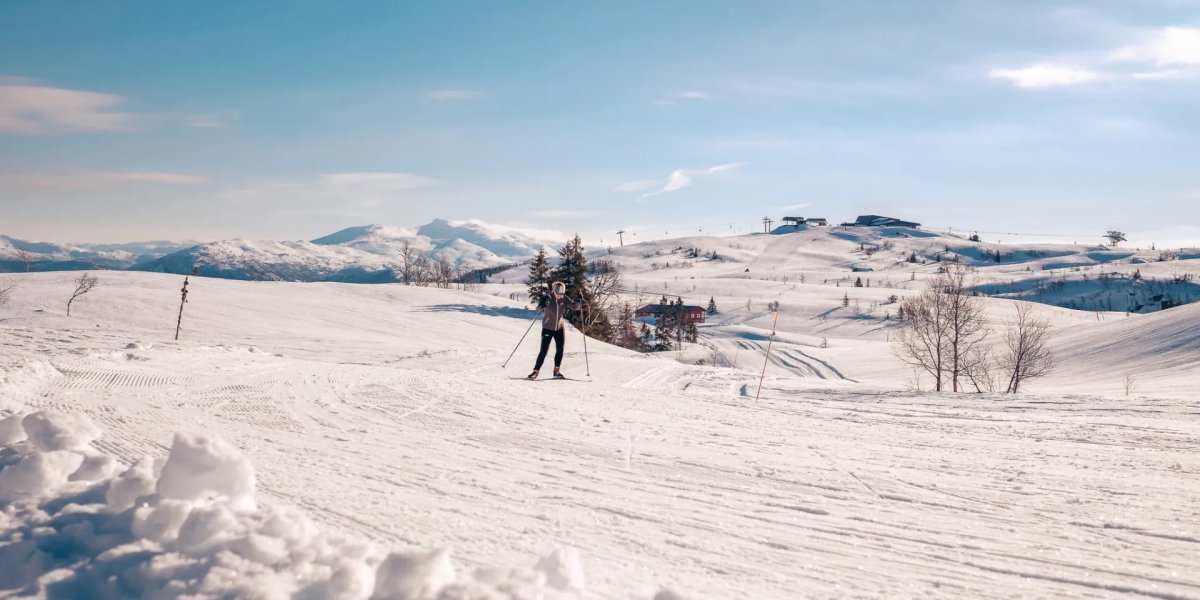
City Guide
Voss
Norway · Best time to visit: May-Sep, Dec-Mar.
Day-by-day plan
Choose your pace
Trip length
09:00
Landmark
Step out of Voss train station, cross the road toward the lake, and the dark timber gondola terminal stands directly in front of you — a 2-minute walk. The cabin climbs 800 vertical metres in seven minutes to Hangurstoppen, where the entire Voss valley unfolds below: the twin lakes Vangsvatnet and Lønavatnet, the church spire, and the wall of snow-streaked peaks running west toward the fjords. This is the single most cinematic view in town, and the reason most visitors come.
Tip: Take the very first gondola at 09:00 — the lake mirror is still, the air is clear, and you'll have the summit terrace almost to yourself. By 11:00 the tour buses from Bergen arrive and the queue at the base stretches outside. Buy a one-way ticket up only: the marked summer trail down through pine forest takes 75 minutes and the lake-facing descent is the better half of the experience.
Open in Google Maps →11:30
Religious
From the gondola base, walk east along Strandavegen for six minutes; the dark stone church appears alone on a green lawn beside the lake. Built in 1271, it is one of the very few medieval stone churches still in active use in Norway — and the reason locals call its survival a small miracle: in April 1940 German bombs flattened nearly every wooden building in Voss, but the church walls held. The wooden steeple was rebuilt; the squat granite body is original.
Tip: Walk a slow circle around the exterior — the south wall takes the late-morning sun and the bomb-pocked stones are visible at eye level near the south door. There's a small wartime photo board by the entrance showing the bombed town with only the church standing; locals point first-time visitors to it without saying a word.
Open in Google Maps →12:15
Food
Walk three minutes west along the pedestrianised Vangsgata; Tre Brør ("Three Brothers") sits on the corner with outdoor benches facing the main street. Three actual brothers run it, locals fill it at noon, and the kitchen knows what fast looks like. Their reindeer burger with brown cheese (245 NOK / ~22 EUR) is the dish to order; the creamy fish soup (195 NOK / ~18 EUR) is the colder-day fallback.
Tip: Arrive at 12:15 — at 12:30 the railway workers and gondola staff all crowd the bar at once. Order at the counter, grab the outdoor table closest to the church if it's sunny, and skip the soft drinks (almost 60 NOK for a Coke); tap water in Voss is glacier-fed and free at every table.
Open in Google Maps →13:30
Park
From Tre Brør walk east along the lakefront, then south on Bordalsvegen — twenty-five minutes through residential lanes and pasture before the road tips down into forest. Bordalsgjelet is a knife-cut in the bedrock where the Bordalselvi river drops thirty metres through walls less than five metres apart. A wooden footbridge crosses directly above the throat; the spray comes up under your feet. There is no gate, no ticket, and outside July you may have it entirely to yourself.
Tip: Time it for around 14:30 — that's the brief window when the afternoon sun reaches down into the gorge and throws rainbows across the spray. Most visitors stop on the bridge for a photo and turn back; cross to the far side and follow the small unmarked path twenty metres downstream for the side-on view of the gorge that locals consider the real shot.
Open in Google Maps →16:00
Neighborhood
Walk back to town along Bordalsvegen, then climb northeast on Mølstervegen — twenty-five steady minutes uphill until sixteen weathered log buildings appear on a grass terrace two hundred metres above the valley. Mølstertunet is a complete 17th-century Norwegian farmstead in place, not reassembled: turf roofs sprouting wildflowers, hand-hewn timbers blackened by three centuries of weather, and a clear line of sight down to the church spire and the lake. You don't need to enter — the cluster of buildings and the view from the upper meadow are the entire experience.
Tip: Aim for the upper meadow behind the main farmhouse by 17:00 — at that hour the western light turns the timber walls deep amber and the snow on the far peaks goes pink. Walk down via the orchard path on the south side rather than the road; it's the prettiest descent in Voss and almost no tourist finds it.
Open in Google Maps →19:30
Food
Descend to the lakefront and follow Evangervegen west for twenty minutes; Fleischer's is the grand wooden Swiss-chalet hotel from 1889 standing beside the train station, lit up against the dark lake. Magasinet is its restaurant — white tablecloths, dark panelling, lake-facing windows. Order the slow-cooked reindeer fillet with juniper jus (495 NOK / ~45 EUR) and, if you're two, share the local-trout starter from the Voss lakes (220 NOK / ~20 EUR). The three-course set (~75 EUR) is the smart play.
Tip: Reserve via Fleischer's website by mid-morning and explicitly ask for a window table on the lake side — they hold a few for guests who ask. Pitfall warning: the cluster of generic cafés near the station entrance push identical "Norwegian salmon" menus at 350-400 NOK; the fish is farmed, the room is bright fluorescent, and you'll spend the same money. Magasinet costs no more and is the actual Voss dinner.
Open in Google Maps →Jump to day
09:00
Landmark
From the town centre, walk five minutes north past the train station — the red gondola base sits between two hotels like a small cathedral of glass. The 8-minute ride climbs 700 vertical metres in silence; two lakes, the Bordalselvi river, and the snow gullies of Hardangervidda unfold below. At the top, the wooden viewing terrace gives you the single image of Voss you will carry home — the town threaded between two lakes, mountains stacked to the southern horizon. Walk the gentle ridge loop while the morning air is still glass-clear.
Tip: Take the 09:00 cabin sharp — the first Bergen coach group rolls into the base station at 10:30 and clogs the terrace for two hours. Inside Restaurant Hangur, order a kanelbolle (cinnamon bun, NOK 55) and black coffee and carry them onto the outdoor deck — same price as town, completely different view.
Open in Google Maps →11:45
Religious
Ride the gondola back down and walk four minutes south through the small park — Vangskyrkja's dark stone spire rises the moment you leave the cable car. Built around 1277 and one of the very few medieval stone churches surviving outside Norway's main cities, it stood through fires, the Reformation, and a direct Luftwaffe bombing in April 1940 that flattened the rest of central Voss. Step inside for the wooden ceiling, painted in 1696 with twelve biblical scenes still holding their original Baltic-blue and ochre.
Tip: Look up at the chancel ceiling and find the signature 'Mester Elias Figenschou 1696' — the painter signed his work, rare for the period. Outside in the churchyard, the rough stone marked with a cross is the Olavsteinen from around 1023 AD, Norway's earliest Christian missionary marker; 95% of visitors walk past without noticing it.
Open in Google Maps →12:45
Food
Walk one block east along Vangsgata — Tre Brør sits behind a small wooden terrace with three carved brothers above the door. This is where Voss's extreme-sports athletes refuel between morning paraglider runs; the kitchen runs a tight short menu of mountain food done properly. The reindeer burger (NOK 245 / €22) with brown-cheese cream and lingonberry is the signature, and the smoked-salmon flatbread (NOK 210 / €19) is what locals order on repeat. Budget €25-35 with a drink.
Tip: Walk in by 12:30 if you haven't reserved — the eight bar seats facing the open kitchen are first-come and far better than the back room. Skip the soft drinks (Norway sticker-shock) and ask for tap water; it comes from the same source as bottled Voss and is free.
Open in Google Maps →14:30
Park
Cross Vangsgata directly from the café and the lake begins right there — turn right (west) along the gravel promenade. For the next ninety minutes the water sits on your left and the wooden boathouses of old Voss farms on your right; Hangurstoppen, where you stood this morning, hangs above you on the far shore. Cherry trees along the path flower in May to early July; in September the birches turn lemon-yellow against fjord-black water. The path is flat and almost empty after 15:00.
Tip: Walk only as far as the small wooden jetty at Bønhusberget (about 1.8 km out) before turning back — beyond it the path turns boggy and the view stops improving. The two flat sun-warmed rocks halfway are the local swim spot; water sits 16–18 °C in July and is free public access.
Open in Google Maps →16:30
Park
From the lake path, cut south at the wooden bridge over the river Vosso — Prestegardsmoen begins as a quiet birch forest on a flat peninsula between the two lakes. This was the vicarage's grazing pasture for 400 years; today it is the only protected lowland forest in inner Vestland, and wild orchids you cannot see anywhere else in the valley grow along the boardwalk. Walk the 2 km loop counterclockwise so the late afternoon sun comes through the trees behind you and ignites the moss.
Tip: Stop at the small bird-hide near the river mouth — between 17:00 and 18:00 in spring and summer, dippers (fossekall, Norway's national bird) hunt in the rapids; bring binoculars if you have them. Mosquitoes hit hard between mid-June and late July, so spray up before entering the trees.
Open in Google Maps →19:30
Food
Walk twelve minutes east along the lake to the wooden Swiss-style tower of Fleischer's Hotel — opened 1889 for the Bergen-Voss railway tourists and almost unchanged since. The restaurant occupies the original dining hall with cut-glass chandeliers and tall windows over Lake Vangsvatnet. Their birch-cured fjord trout (NOK 285 / €25) is the starter, and the reindeer fillet from Hardangervidda (NOK 525 / €47) with juniper jus is one of the rare Norwegian mains that justifies its price. Budget €70-90 with one glass of wine.
Tip: When booking, ask for a table 'mot vatnet' (toward the water) — staff don't volunteer this, but tables 12-15 face the lake and at 21:30 in June the low sun is still gilding the gondola cabins coming down. Tip is included in the bill — do not add another 10%. AVOID the lakeside bistro on the corner of Strandavegen opposite the station: its tempting terrace serves reheated frozen food at full Norway prices and exists purely for railway-tourists who didn't research.
Open in Google Maps →09:00
Landmark
Walk twenty-five minutes south from town along Bordalsvegen — the road narrows, pine trees close in, and you cross a small wooden bridge before reaching the unmanned entrance kiosk. Bordalsgjelet is a 200-metre slot carved by the Bordalselvi river through vertical rock; an iron-and-timber walkway pinned to the cliff carries you above the rapids, with stone walls just two metres apart on each side. The roar is loudest in May-June after snowmelt, but the morning light reaches into the gorge floor only between 09:30 and 11:00 — go now, not later.
Tip: Wear shoes with proper grip — the wooden planks stay damp year-round and the spray off the lower falls coats the rails. The unmarked viewpoint about 100 m before the official end has the best composition: looking back you frame the bridge, the falls, and a strip of sky in a single shot.
Open in Google Maps →11:30
Museum
Walk thirty-five minutes back north and then east up the gentle hill to Mølstertunet — you see the cluster of sixteen dark-tarred wooden buildings on the ridge as you approach. This is a real seventeenth-century farm preserved in place, not a reconstructed village; the Mølster family lived and farmed here until 1927, and the iron stove inside the main farmhouse is the one their last generation cooked on. The view from the courtyard across both Voss lakes is exactly what they watched for 350 years.
Tip: Start with the smoke-cottage (røykstova) — the building with no chimney, where smoke escaped through a roof hole. The soot caking the rafters is 400 years old; ask the guide on duty to demonstrate the open-hearth cooking, it takes two minutes but almost no one requests it. Closed Mondays October-April.
Open in Google Maps →13:30
Food
Walk twenty minutes back down the hill to Vangsgata — Ringheim Kafe sits on the left just before the church, in a butter-yellow wooden building from 1885. This is the everyday Voss lunchroom, where farmers, shopkeepers, and railway crews eat side by side; the menu is short and almost unchanged for thirty years. Order the raspeballer (NOK 195 / €17) — Voss-style potato dumplings with lamb sausage, bacon, brown-cheese sauce, and rutabaga, served only Thursdays and Sundays — or the mussel-and-fish soup (NOK 175 / €15). Budget €20-28 with coffee.
Tip: If they're out of raspeballer (they sell out by 13:00 on serving days), go straight for the dagens fisk (catch of the day) at NOK 215. Skip dessert here — walk two doors down to Voss Bakeri for the skillingsbolle (cinnamon swirl, NOK 38), the best in the valley and the reason there's always a small queue out the door.
Open in Google Maps →15:30
Neighborhood
Step out of the café onto Vangsgata — the single street that is Voss's commercial spine. Walk west toward the church, drift south to the lakefront, then loop back through the small lanes behind. Almost every building you see was put up between 1942 and 1947: the Luftwaffe levelled central Voss in April 1940 because of the rail junction, and the town rebuilt in a single calm postwar style — the rare survivor with a steeply pitched roof is pre-war. Stop into Husfliden at number 32 for valley-knitted mittens, and pause in the small sculpture garden behind the church.
Tip: Ignore the 'Genuine Norwegian Knitwear' shop right beside the station — its sweaters are machine-knit in Latvia at half the quality for double the price. The real article carries a small white tag inside reading 'Strikket i Voss' or 'Dale of Norway'; nothing else is worth bringing home.
Open in Google Maps →17:00
Park
From the church, walk five minutes east along Strondavegen — the lake opens on your left and the path turns to packed gravel along the water. This is the local evening promenade: prams, runners, fishermen casting from the wooden piers. Walk to the rowing club at the eastern bay (about 1.5 km out) then circle back. At 17:00 in summer, the western mountains catch the low sun and the lake mirrors them perfectly — you will pass three or four photographers with tripods waiting for the colour shift around 18:00.
Tip: The single bench just past the rowing club, marked with a small bronze plate, points directly across at Hangurstoppen — sit here at 18:00 in June and the gondola cabin you rode yesterday catches gold on the cable as it descends.
Open in Google Maps →19:30
Food
Walk five minutes west back along the lake to Park Vossevangen — a slate-and-glass hotel set directly on the water. Bistro 1900 occupies the ground floor with floor-to-ceiling windows facing Lake Vangsvatnet. The kitchen is modern Nordic, sourcing almost everything from within 100 km: Hardanger lamb (NOK 445 / €40) served pink with celeriac and last year's preserved blackcurrants is the dish to order, and the cured Sognefjord salmon starter (NOK 235 / €21) is the lightest plate in town. Budget €60-85 per person.
Tip: Book the bar counter facing the open kitchen if you're a solo traveller or a couple — you watch every plate composed, and the price matches the dining room. After dinner, walk the lake at 21:30: in May-August it stays bright, and Hangurstoppen catches the very last sun. AVOID the 'Norwegian street food' food trucks parked by the station in summer — burgers at €25 reheated in a microwave, aimed squarely at confused cruise passengers; the small craft-beer pop-up two doors down from Bistro 1900 is the legitimate local nightcap.
Open in Google Maps →
Trip builder
Plan this trip around Voss
Turn this guide into a bookable rail itinerary with FlipEarth.
Keep exploring
Related cities
More in the same country
FAQ
Frequently asked questions
How many days do you need in Voss?
Most travelers enjoy Voss in 1 days, with enough time for headline sights and a slower meal or museum stop.
What's the best time to visit Voss?
The easiest season for most travelers is May-Sep, Dec-Mar, especially if you want good weather and manageable crowds.
What's the daily budget for Voss?
A practical starting point is about €140 per person per day before hotels, then adjust based on museums, dining, and transport.
What are the must-see attractions in Voss?
A good first shortlist for Voss includes Voss Gondol (Hangurstoppen Summit).