City Guide
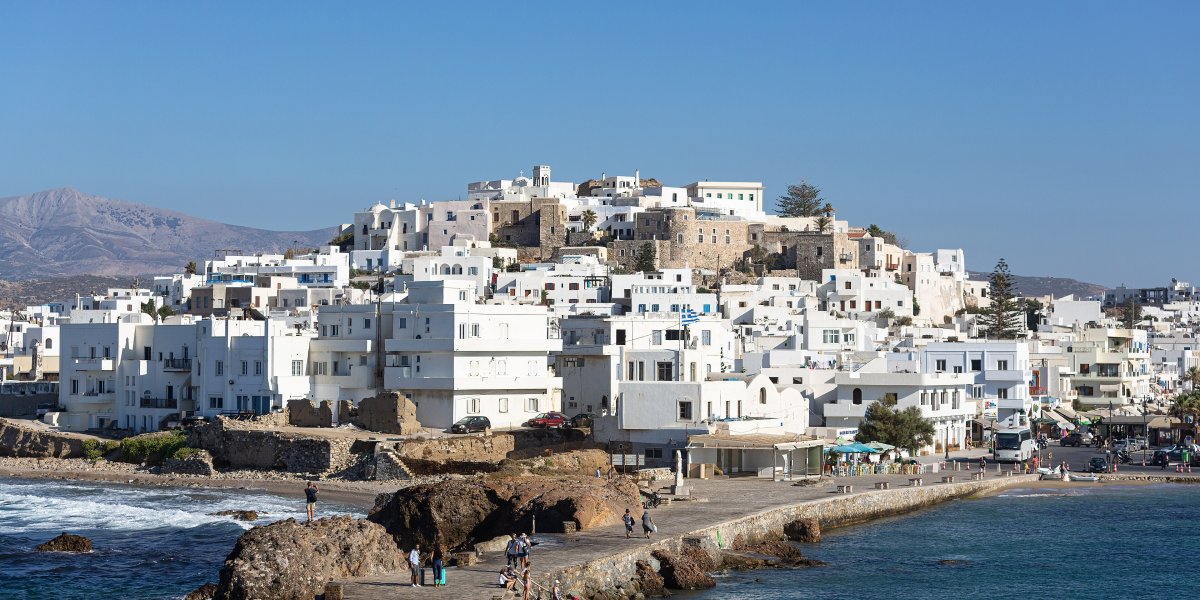
Naxos
Greece · Best time to visit: May-Oct.
Day-by-day plan
Choose your pace
Trip length
09:00
Neighborhood
From the ferry port, walk south along the harbor for two minutes until you find the small stone-arched gateway into Bourgos — slip through it before the cruise crowd wakes up. Bourgos is the lower medieval quarter where Greek islanders settled outside the Venetian walls, a tangle of whitewashed alleys, bougainvillea-draped arches and tiny chapels squeezed between houses. Wander without a map: every five minutes you stumble onto a hidden courtyard or a centuries-old marble doorway lintel. Before 10:30 it is silent except for shopkeepers sweeping their thresholds, which is the only moment of the day this quarter belongs to you.
Tip: Walk Old Market Street first, then loop back through Apollon. The open doors you see at this hour are family weaving studios — Naxian women still loom-make traditional textiles by hand here; the work is real and the prices honest, while the souvenir shops higher up the hill sell the same patterns at triple the price, machine-made in Athens.
Open in Google Maps →10:30
Landmark
From the heart of Bourgos, climb the stepped lane of Trani Strata uphill for five minutes — the alley narrows, the cobblestones smooth out, and you cross into the old aristocratic quarter through a fortified gate. Built in 1207 by the Venetian duke Marco Sanudo, the Kastro is the only inhabited medieval castle in the Aegean, and descendants of those Catholic Venetian families still live behind these doors, their family crests carved above the lintels. Walk the loop along the outer walls, find the Tower of Crispi, and at the northwest viewpoint look across the harbor to the Portara — the white limestone glows in the angled late-morning light, which is the cleanest you'll get all day.
Tip: Skip the museum interiors — the magic of Kastro is the lived-in exterior. Walk slowly and read the Latin inscriptions above each doorway, each one a family that has held this address for 800 years. The terrace beside the Catholic Cathedral on the north wall gives you the cleanest Portara-framed-by-Aegean shot of the entire day, and at 11am the harbor is empty of ferries.
Open in Google Maps →12:30
Food
Descend from the Kastro back through Bourgos and out to the waterfront in six minutes — the smell of grilled meat finds you before the sign does. Meze Meze 2 is the most beloved fast-casual mezedopoleio in Chora: small plates arrive in five minutes, you eat with your hands, and you're back on the road in under an hour. Order the grilled Naxian sausage with orange peel (€8), the kefalotyri saganaki — fried local cheese with honey (€7), and a half-litre of cold house barrel wine (€5). Budget €18–25 per person.
Tip: Three mezze maximum — do not order a main course or you'll lose the afternoon to a food coma. The Naxian sausage with citrus is the dish no guidebook flags; order it first. Skip the bottled water (€3) and ask for tap — it is excellent on Naxos and the only island in the Cyclades where locals actually drink it.
Open in Google Maps →14:00
Park
From the harbor, walk south along the waterfront promenade for 15 minutes, past the fishing boats and the windsurfing schools, until the seawall opens onto a long arc of pale sand. Agios Georgios is the closest beach to town: shallow, turquoise, completely walkable in waist-deep water for 100 metres out — and at 2pm the sea is at its warmest and the Meltemi wind kicks up just enough to feather the surface for that classic Cycladic shimmer. Drop your bag at one of the free public sand sections at the south end, swim, and walk the length of the beach barefoot before the light turns.
Tip: Free public beach is at the south end past the Hotel Iliovasilema — walk five more minutes from the main entrance and skip the €25 sunbed rental at the central section. The Meltemi wind picks up after 3pm; if you want flat water for photos, swim in the first hour. The freshwater shower at the central beach access is your only chance to rinse off salt before the long walk back.
Open in Google Maps →17:30
Landmark
From the beach, walk north along the promenade for 25 minutes — past Chora's harbor, past the ferry pier, then across the slim stone causeway that links the islet of Palatia to the mainland. The Portara is what remains of a temple to Apollo begun in 522 BC and abandoned six years later when the tyrant Lygdamis was overthrown — just the marble doorway, twenty tonnes of stone, standing alone against the Aegean for 2,500 years. Arriving at 5:30pm gives you golden-hour photos before the sunset crowd builds at 7:30pm, and then you stay for sunset itself, which falls directly through the doorway from late May through August.
Tip: The iconic photo — the sun aligned inside the doorframe — happens 20 minutes before official sunset, not at sunset. Position yourself east of the doorway (mainland side) for that shot. Once the disc drops, walk around to the west side of the islet for the second act: the sky turns pink, the Kastro lights come on across the harbor, and 90% of the crowd has already left for dinner.
Open in Google Maps →20:00
Food
Walk back across the causeway from Portara and the first taverna you reach on the harbor curve is Apolafsis — five minutes, no more. Family-run since the late 1970s, this is where Naxians eat their fish: open kitchen, blue wooden chairs, a slate board with whatever came in on the morning boats. Order the grilled octopus (€16), the Naxian potatoes with rosemary and capers (€7), and the slow-cooked goat in lemon sauce — the island specialty (€19). Budget €40–50 per person with a half-litre of local Assyrtiko.
Tip: Pitfall warning specific to the Naxos waterfront: never order whole fish 'by the kilo' without asking the exact price for YOUR fish before it goes on the grill. Two or three tavernas on this stretch quote €60–80/kg, weigh a 1.4 kg fish, and hand you a €100 bill at the end. Apolafsis is honest, but make it a habit: point at the fish, ask the total in euros, get the nod before anything moves. Walk in around 8pm for a harbor-side table; reservations only needed in peak August.
Open in Google Maps →Jump to day
09:00
Museum
From your accommodation in Chora, climb the marble steps of the Bourgos lanes up into the Kastro — the museum occupies the old Venetian Jesuit school at the highest point. It holds one of the world's finest collections of Early Cycladic figurines, those white marble idols Picasso and Modigliani copied for a living. Arrive at opening: the small upper rooms get airless and crowded after 11.
Tip: Don't rush the Cycladic figurine room on the top floor — the 3000 BC violin-shaped idols are the originals every modernist borrowed from. Look for the harpist and flute-player figures behind the central case; they are the only known depictions of music in Bronze Age Aegean art and nine out of ten visitors walk past them.
Open in Google Maps →11:00
Neighborhood
Step out of the museum and you are already inside the Kastro — keep walking under the stone archway carved with a Venetian coat of arms. For two hours wander these marble lanes, which Marco Sanudo's family laid down in 1207 and barely anyone has touched since. Note the heraldic shields above doorways: each is a Catholic family still living in that exact house, 800 years later.
Tip: Slip into the small Della Rocca-Barozzi Venetian Museum (5 euro) — it's the only private Kastro house open to visitors, and the host descends from the original 13th-century occupant who will personally walk you through. Enter the Catholic Cathedral through the main bronze gate on the south courtyard, not the closed-looking side door.
Open in Google Maps →13:00
Food
Walk down through the Bourgos lanes from the Kastro main gate — five minutes to the harbor edge where Meze Meze opens onto a sea-facing terrace. This is where Naxian fishermen's families come on Sunday: tiny ceramic plates, no menu drama, fresh catch from the morning boats. Order their octopus carpaccio (9 euro) and the smoked mackerel salad (8 euro), and split a half-liter of Naxian retsina. Budget 20-30 euro per person.
Tip: Ignore the printed English menu — ask the waiter what came in on the morning trawlers. Their grilled langoustines are off-menu and only run for those who ask in person. Get a seaside table by arriving by 13:00 sharp; by 13:30 the terrace is gone for the next two hours.
Open in Google Maps →15:30
Landmark
From the harbor bus stop opposite Meze Meze, catch the local KTEL bus (1.80 euro, departs every 30 min) for the 10-minute ride south past Stelida hill. Agios Prokopios consistently ranks among Europe's top ten beaches: a kilometer of fine white sand and water so transparent that swimmers appear to float in mid-air above the seabed. Walk to the right (north) end where the sand meets the rocks — it's quieter and the swim across to the small offshore islet is one of the great Cycladic moments.
Tip: The beach has three sections; skip the central organized stretch (crowded and sunbed-saturated by noon) and walk 8 minutes north past the salt flats to the 'Maragas' end — same water, half the sunbeds, and a single quiet canteen. Bring a 1.5L water bottle from Chora: the beach kiosks charge 4 euro for what costs 80 cents in town.
Open in Google Maps →19:00
Landmark
Take the bus back to Chora and walk north along the harbor — 8 minutes along the marble flagstones, past the moored fishing caïques, to the causeway out to the islet of Palatia. The Portara is all that remains of the temple of Apollo, begun in 530 BC and abandoned forever when its patron Lygdamis was overthrown. Time your arrival for 45 minutes before sunset (it varies by 90 minutes between May and October — check the day's exact time). The marble gate frames the sun as it drops, and the whole islet turns the color of old honey.
Tip: The crowd clusters dead center under the gate — climb 20 meters higher onto the northern lip of the islet for the iconic shot where the gate frames both the sun and the silhouette of Chora behind it. Photographers know this corner; tour groups don't. Stay 20 minutes after sunset: the afterglow phase turns the entire Aegean lavender, and the gate glows from behind.
Open in Google Maps →20:30
Food
Walk back across the causeway and four minutes along the harborfront — Apostolis sits on a tiny lane just behind the seafront, with a stone-walled garden where the Portara is visible above the rooftops, illuminated against the dark sea. They specialize in proper Naxian cooking: order the lobster pasta (28 euro, the island's signature dish, made with their own caught morning lobster) and the Naxian Graviera saganaki (9 euro) drizzled with thyme honey. The house white is a Mantilaria from a Halki vineyard, 18 euro a bottle. Budget 30-45 euro per person.
Tip: Pitfall alert for Naxos Chora: the harbor row of restaurants with photo menus and pushy English-speaking touts in front (you'll see them between the ferry pier and Plateia Mantos) is built exclusively for one-night cruise traffic, with frozen seafood and double-printed prices. Stick to places one street back from the waterfront, like Apostolis. Reserve by phone the day before for a garden-side table; the indoor room misses the Portara view entirely.
Open in Google Maps →09:30
Landmark
Pick up your rental car at 9:00 from a Chora waterfront agency and drive 20 minutes south on the inland road through silver olive groves and stone terraces — the white marble temple suddenly appears on a low hill near the village of Sangri. Built in 530 BC entirely from Naxian marble (the same quarry that supplied the Portara), this is the oldest fully marble temple in Greece, predating the Parthenon by a century. The Ionic columns were re-erected in the 2000s and you can walk freely among them, almost alone at this hour.
Tip: Be there at the 9:30 opening — by 11:00 the tour buses arrive from Chora cruises and the site has zero shade. The small museum next to the parking lot (included in your ticket) holds the original capitals and architrave fragments retrieved from the foundations; 80% of visitors skip it, but it's the only place to see Naxian master-masonry up close.
Open in Google Maps →11:00
Neighborhood
Drive 15 minutes east into the Tragea valley — the road climbs through some of Europe's oldest olive groves, trees the Venetians planted seven hundred years ago. Halki was Naxos's old capital, a single neoclassical street of pastel mansions that simply froze when the capital moved to Chora in the 19th century. Park at the village entrance and walk the main lane to the Vallindras Distillery (founded 1896), where five generations have made Kitron, the lemon-leaf liqueur that exists nowhere else on earth.
Tip: The distillery tour is free and includes a tasting of all three Kitron strengths (yellow=mildest at 30%, green=strongest at 36%) — go for the green if you only sample one; the yellow tastes diluted next to it. Across the lane, the L'Olivier shop sells the island's best single-grove olive oil; the 250ml bottle (12 euro) is the right size to slip into a carry-on liquids bag for the flight home.
Open in Google Maps →13:00
Food
Drive 10 minutes south to Filoti, the largest mountain village, terraced into the western slopes of Mount Zas. Babulas is the central village taverna at the top of the main square under a 200-year-old plane tree — the lamb is from the shepherd family next door, and the charcoal smoke you'll smell climbing the road is from their own grill. Order the goat with potatoes in lemon-egg sauce (12 euro, simmered slowly since morning) and a portion of Naxian Arseniko hard cheese with barley rusks (6 euro). Budget 15-25 euro per person.
Tip: Sit at the front terrace under the plane tree, not in the indoor room — the breeze coming off Mount Zas is the air-conditioning, and the view across the Tragea valley is the table decoration. The owner Yiannis sends out a small carafe of his homemade Kitron at the end of every meal; don't refuse it, and order a Greek coffee with it. Cash works far better than card up here.
Open in Google Maps →15:00
Neighborhood
From Babulas, drive 20 minutes northeast on the winding mountain road — you climb 600 meters and the air turns alpine, with views all the way out to the Small Cyclades islets. Apeiranthos is the most extraordinary village on Naxos: settled by Cretan refugees in the 1600s who still speak with a distinct dialect, and the entire village is paved end-to-end in white marble slabs. The narrow lanes have not changed in 400 years, and you'll pass grandmothers in black on stone doorsteps embroidering — not for tourists, but because that is how this village has always passed an afternoon.
Tip: Walk the marble lane past the main square to the tiny Archaeological Museum (founded by the local poet Michael Bardanis, 3 euro, the schoolteacher unlocks it on request — ask at the kafenion next door if it's closed). It holds Cycladic marble vessels not in any other collection. Then stop at Kafenion Lefteris on the square for a slow Greek coffee; the older village men play tavli (backgammon) there every afternoon and won't blink at you taking the next table.
Open in Google Maps →17:30
Religious
Driving back toward Chora, stop at the village of Moni — 25 minutes from Apeiranthos along the descending mountain road, with Naxos's entire western coast unfolding ahead of you. Panagia Drosiani ('Our Lady of the Refreshing') is one of the oldest churches in the Balkans, founded in the 6th century. The thick stone walls are the original Byzantine masonry, and the interior frescoes — partly 7th-century, partly 12th — survive on layers of plaster that conservators are slowly peeling back. Light enters only through three small windows; stand still and let your eyes adjust.
Tip: The church closes at 18:30 sharp and the caretaker is unbending — be there by 17:45. Cover shoulders before entering; the caretaker keeps scarves at the door. Drop a coin or two in the wooden donation box. From the small terrace just outside, the view down to Chora and the Aegean is the postcard image of Naxos, and 90% of beach-day tourists never see it.
Open in Google Maps →20:00
Food
Drive 35 minutes back to Chora — return the car at the waterfront agency by 19:45 — then walk five minutes up through the Bourgos lanes into the Old Town. Maro's is hidden inside a Venetian courtyard under a curtain of bougainvillea, candles on each table, no music louder than the cicadas. They cook the island farewell meal: pork apaki smoked in vine leaves (13 euro), and rooster pastitsada with hand-rolled noodles (16 euro, from the chef's grandmother's recipe in Halki — the village you visited this morning). Budget 25-40 euro per person.
Tip: The courtyard has only 12 tables — call to reserve the moment you sit down to lunch at Babulas, not after. Skip the printed dessert menu and ask the kitchen for the off-menu walnut spoon-sweet served with mastiha ice cream; it's a Cycladic tradition only made for those who ask by name. Pitfall alert: between Maro's lane and the harbor you'll pass two flashy 'traditional Greek' places with laminated menus and a tout reciting the dishes in five languages — these are the most overpriced restaurants in Naxos, with bills running 80+ euro per head for cruise tourists. Walk past them without slowing down.
Open in Google Maps →
Trip builder
Plan this trip around Naxos
Turn this guide into a bookable rail itinerary with FlipEarth.
Keep exploring
Related cities
More in the same country
FAQ
Frequently asked questions
How many days do you need in Naxos?
Most travelers enjoy Naxos in 1 days, with enough time for headline sights and a slower meal or museum stop.
What's the best time to visit Naxos?
The easiest season for most travelers is May-Oct, especially if you want good weather and manageable crowds.
What's the daily budget for Naxos?
A practical starting point is about €120 per person per day before hotels, then adjust based on museums, dining, and transport.
What are the must-see attractions in Naxos?
A good first shortlist for Naxos includes Kastro Venetian Castle, Portara.