City Guide
Iasi
Romania · Best time to visit: May-Sep.
Day-by-day plan
Choose your pace
Trip length
09:00
Landmark
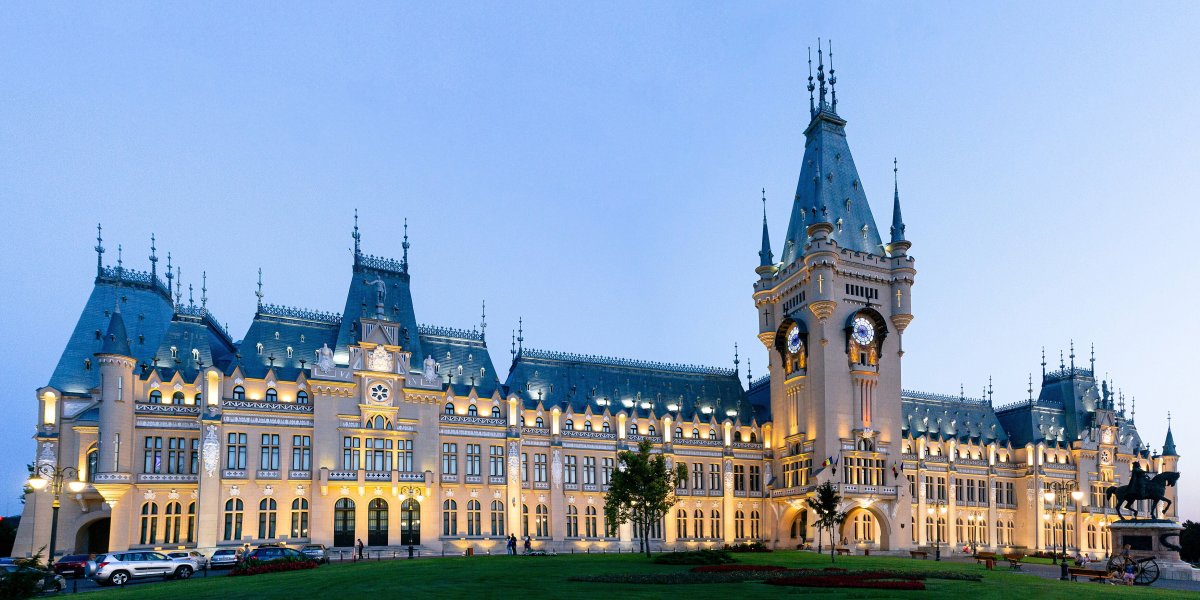
Begin at the southern end of Boulevard Stefan cel Mare, where the city's colossal Neo-Gothic palace dominates the horizon — 298 rooms, 92 spires, and a clock tower that chimes 'Hora Unirii' on the hour. Stand in the small park directly south of the facade for the symmetrical hero shot with morning light raking across the limestone tracery. We skip the four museums inside (you've got one day, not four) and instead circle the building clockwise to catch the sculpted gargoyles on the eastern wing that most visitors miss.
Tip: Arrive at 09:00 sharp — the eastern facade is backlit before then and washed-out by 11:00. The cleanest wide-angle photo is from the fountain in front (no parked cars after the morning street-cleaning crew finishes around 08:45).
Open in Google Maps →10:30
Religious
Walk 5 minutes north along Stefan cel Mare boulevard — you'll pass the bronze statue of Stephen the Great on horseback, a beloved local landmark worth a pause. Then the most extraordinary church facade in Europe appears: every centimeter of its 1639 stone exterior is carved with lace-like Byzantine, Persian, Armenian, and Ottoman patterns — 30 distinct decorative bands, originally gilded with real gold. Walk the full perimeter slowly; the south wall, hit by mid-morning sun, is where the carvings reveal their three-dimensional depth.
Tip: Bring a phone with a 2x or 3x telephoto — the carving detail at the upper bands is invisible to the naked eye but stunning when zoomed. The interior holds the tomb of Prince Dimitrie Cantemir; a quick 5-minute peek is free and worthwhile.
Open in Google Maps →11:30
Religious
Continue 5 minutes north along the boulevard. Romania's largest Orthodox cathedral rises with four matching towers in a Neo-Renaissance style that feels more Italian than Romanian — and that's deliberate, the architect studied in Vienna. Inside lie the silver-encased relics of Saint Parascheva, patroness of Moldova, drawing pilgrims from across the country. Step in for 10 minutes to see the painted dome by Gheorghe Tattarescu, then exit to the cathedral park where benches under chestnut trees give you the postcard view of the full facade.
Tip: Cover shoulders before entering (a thin scarf works); women without head covering are not turned away but a wrap is appreciated. Photography inside is technically forbidden — respect it, the local babas will tell you off and they are not gentle.
Open in Google Maps →12:30
Food
Walk 4 minutes north to Union Square — the elegant heart of the old city, ringed by 19th-century pastel facades. La Placinte is a beloved Moldovan fast-casual chain serving exactly the regional dishes you came for, at honest local prices. Order the placinta cu branza si marar (cheese-and-dill pie, 18 lei / €3.6) — flaky, hot, the size of a dinner plate — plus a bowl of ciorba de perisoare (meatball sour soup, 22 lei / €4.4). Total under €10. Counter-order, fast turnover, no reservations needed.
Tip: Skip the souvenir cafes directly on Piata Unirii — they charge triple for tourist menus. La Placinte is on the small side street Lapusneanu, 30 m off the square. Order the placinta with poppy seed (mac) for dessert — only 8 lei and most foreigners never try it.
Open in Google Maps →14:00
Neighborhood
From lunch, walk north up Bulevardul Carol I — Iasi's grandest avenue, a gentle 25-minute uphill stroll past Belle Epoque mansions, the Central University Library's columned facade, and embassies tucked behind iron gates. At the top, the 1860 Alexandru Ioan Cuza University greets you — Romania's first university, its honey-colored neo-classical facade best photographed at 15:00 when sun hits it head-on. Continue 5 minutes into Copou Park to find Eminescu's Linden Tree, the 500-year-old tree under which Romania's national poet Mihai Eminescu wrote his most famous verses; locals still leave handwritten poems in its hollow. Wander the rose garden, watch students play chess, then loop down through the Botanical Garden's edge for the long view back over the city's spires.
Tip: The university's interior courtyard with the 'Hall of the Lost Footsteps' is open to visitors during term-time weekdays — slip in past the porter's lodge on the right; nobody stops well-mannered visitors. The best city panorama is from the small terrace behind the Eminescu monument, 50 m east of the linden tree, almost no tourist finds it.
Open in Google Maps →19:00
Food
Walk 10 minutes south from Copou Park down Strada Rece to Iasi's most legendary tavern — a 200-year-old wine cellar with vaulted brick ceilings where Eminescu himself drank with his bohemian circle. The name means 'Cold Vault,' and the temperature inside really does stay cool year-round from the deep cellar walls. Order the tochitura moldoveneasca (slow-braised pork in wine sauce served over mamaliga with sheep cheese and a fried egg, 58 lei / €11.6) and a glass of dry Cotnari Feteasca Alba — the local white from vineyards 50 km north (28 lei / €5.6). Finish with papanasi (fried doughnuts with sour cream and wild blueberry jam, 32 lei / €6.4).
Tip: Reserve by phone (+40 232 212 255) at least one day ahead for a table in the cellar room — the upstairs garden is pleasant in summer but the cellar is the experience you came for. Pitfall warning: avoid the touristy restaurants clustered around Piata Unirii after dark — they hand out paper menus on the street and charge €25 for the same tochitura you'll eat here for €12, often microwaved. If a waiter chases you down the street, walk away.
Open in Google Maps →Jump to day
09:00
Religious
Begin where Moldova carved its identity into stone — every inch of this 1639 church's exterior is wrapped in lace-like Byzantine, Persian, and Armenian motifs, once entirely gilded. Inside lie the tombs of Dimitrie Cantemir and Prince Alexandru Ioan Cuza, the man who united Romania. Voivode Vasile Lupu built it as a statement that Iași could rival Constantinople.
Tip: Arrive by 9:00 sharp — the southeast morning sun rakes across the carved facade at a low angle, casting shadow into every chiseled rosette. By 11:00 the light flattens and the patterns disappear. Stand 4 metres back from the south wall for the cleanest photo without parked cars in frame.
Open in Google Maps →10:30
Museum
Walk 12 minutes east along Boulevard Ștefan cel Mare — the avenue widens, trams clack past, and at the far end the Neo-Gothic palace rises like a French château that wandered into Moldova. 298 rooms, 92 metres of facade, completed in 1925 on the foundations of the medieval princely court. Buy the combined ticket and prioritise the Art Museum (Moldovan icons, Grigorescu) and the Ethnographic Museum (Moldovan peasant interiors). Be in the central courtyard at noon — the carillon in the clock tower plays Hora Unirii, the song of Romania's 1859 union, on real bronze bells.
Tip: Skip the History Museum (dated dioramas) and the Science & Tech Museum (mostly for kids) — they will eat your time. Buy tickets at the right-hand desk inside the main vestibule, not at the museum-specific desks, to avoid backtracking. The best photo of the facade is from the fountain in Palas Park to the southwest, not from Ștefan cel Mare boulevard.
Open in Google Maps →13:00
Food
Cut northwest through Palas Park's covered arcade for 10 minutes to Lăpușneanu, the city's prettiest pedestrian street — you'll pass the Vasile Alecsandri National Theatre on the way. Mado has been baking the same Turkish-Moldovan pastries since 1959 and every generation of Iași student has eaten here. Order plăcintă poale-n brâu (sweet-cheese pastry, the Moldovan classic, ~4 €) and one covrig cu susan straight from the oven; finish with a single piece of fistikli baklava (~3 €) and a sahlep if the weather is cool. Cash counter first, then sit upstairs.
Tip: Avoid the ground-floor street tables — locals always go upstairs where the wood-panelled room with old Iași photographs is. The plăcinte sold from the front window are yesterday's; ask the woman behind the counter for one 'din cuptor' (from the oven) and she'll bring a fresh one in two minutes.
Open in Google Maps →14:30
Religious
Walk 8 minutes east along Strada Cuza Vodă and you'll see Golia's fortress walls rise abruptly out of the residential blocks. This is the only late-Renaissance walled monastery in Iași — built by the same Vasile Lupu as Three Hierarchs but in a completely different vocabulary, with Italian Corinthian columns inside an Orthodox church. The real reward is climbing the 29-metre Golia Tower: 120 steps up a narrow stone spiral to the only true panorama in the old city — Palace of Culture to the south, Metropolitan Cathedral to the west, the painted hills of Copou to the north.
Tip: The tower entrance is a separate small door to the left of the main gate, easy to miss — look for the wooden sign 'Turnul Golia'. Last admission is at 16:30 sharp and they will not let you in at 16:25. Wear shoes with grip; the stone treads are polished smooth and slope inward.
Open in Google Maps →16:30
Religious
Walk 12 minutes west along Cuza Vodă then south on Ștefan cel Mare — you'll loop back past Three Hierarchs (now in late-afternoon side light, completely different mood) before the cathedral's four cream-coloured towers come into view. This is the largest Orthodox cathedral in Romania, neo-classical, and inside rests the silver-gilt reliquary of Saint Parascheva, patron of Moldova — for whom 100,000 pilgrims queue every October. Today, in the afternoon, you can walk straight up to it. The fresco programme by Gheorghe Tattarescu is restrained, Italian-trained Orthodox at its quietest. Finish with a slow stroll south to Piața Unirii where you'll be eating later — Iași unspools in front of you.
Tip: Pitfall warning: on the cathedral square and along Ștefan cel Mare, you may be approached by women with babies asking for help in English or a man claiming he needs taxi fare to the hospital — this is a coordinated scam targeting tourists near religious sites. Polite 'nu, mulțumesc' and keep walking. Also avoid the restaurant terraces directly on Piața Unirii with multilingual menu boards and waiters who flag you down — they are 40% more expensive than two streets back, and the food is microwaved.
Open in Google Maps →19:30
Food
Three minutes' walk south brings you to Hotel Traian on Piața Unirii — yes, the building was designed in 1879 by Gustave Eiffel's bureau, the same year he was sketching what would become the tower. The ground-floor restaurant is where Iași's literary and political class has eaten for 140 years, and it still has the original mirrored salon. Order ciorbă rădăuțeană (sour chicken soup with garlic and sour cream, ~6 €), then mușchi de vită Boyar style with mămăligă (~14 €), and finish with house plăcintă poale-n brâu (~5 €). House Cotnari white from the Moldovan hills is the right pairing.
Tip: Reserve same-morning by phone for the main mirrored salon and ask specifically for a window table facing the square — the Friday and Saturday wedding parties book the back room and the noise carries. Arrive 19:15 to get the corner banquette under the original 1880 chandelier. Tipping is 10%; round up rather than calculate.
Open in Google Maps →09:00
Landmark
Tram 1 or 13 up Bulevardul Carol I (or a 4 € taxi) takes you to the foot of the university — a 1893 grey-stone palace at the top of Copou hill. Walk through the porter's gate (smile, say 'sala pașilor pierduți' and they wave you in), up the marble staircase to the second-floor ceremonial hall: nineteen monumental frescoes by Sabin Bălașa, painted between 1985 and 2002, that depict Romanian history in a surreal cobalt-blue universe — Eminescu floating among comets, Dacian warriors riding lions. Nothing else in Romania looks like it. This is the country's first modern university (1860) and the room where every doctorate has been awarded since.
Tip: Free, but only accessible on weekdays 09:00–14:00 outside the academic terms when ceremonies block it (mid-June, October). The porter at Corp A entrance is the gatekeeper — be polite and dressed neatly. Walk the length of the hall slowly, then turn around and walk back: half the frescoes only make sense when read in reverse direction (Bălașa hid the cosmic creation cycle that way).
Open in Google Maps →10:45
Park
Cross Bulevardul Carol I (use the pedestrian crossing — the trams are silent) and you're at the gate of Copou Park, 5 minutes total. This is the oldest public park in Romania (1834) and at its heart stands Teiul lui Eminescu, the silver linden under which Mihai Eminescu — the country's national poet — wrote 'Sara pe deal' and most of his early verse. The tree is over 500 years old, hollowed by lightning, propped with steel, but every June it still blooms and the entire park smells of honey. Beside it, the small Eminescu Memorial Museum holds his manuscripts, his death mask, and the hat he was wearing when committed to the asylum.
Tip: Touch the bark of the linden — Romanians do, it's not kitsch, it's pilgrimage. The museum guides only speak Romanian; ask at the desk for the printed English sheet, which is not on display. Skip the Obelisk of Lions on the far side unless you have extra time; the Junimea Alley with the busts of the literary circle is more interesting and almost no one walks it.
Open in Google Maps →12:30
Food
Walk 15 minutes south down Strada Pacurari then east through Țicău, the old wooden-house neighbourhood — winding lanes, leaning fences, an entirely different Iași. Bolta Rece (literally 'the cold vault') is the 1786 wine cellar where Eminescu, Ion Creangă, Veronica Micle and Caragiale drank together; the underground cellar still has the original brick vaults and the inscription Creangă scratched on the wall. Order tochitură moldovenească (pork stew with smoked sausage, fried egg, mămăligă and sheep's-milk brânză, ~11 €) and a glass of cellar Fetească Neagră (~5 €). This is the food the poets ate.
Tip: Ask to be seated in the underground vault (beciul), not the upstairs garden — say 'jos, la beci'. The carved oak booth on the far left of the back vault is where Creangă is documented to have sat; the waiters will confirm this if asked. Tochitura comes saltier than other Romanian versions; order a small ulcică of plain mămăligă on the side to balance it.
Open in Google Maps →14:15
Museum
Walk 6 minutes uphill on Aleea Simion Bărnuțiu — narrow, lined with elderberry — to the tiny whitewashed clay hut where Ion Creangă, Romania's great storyteller and Eminescu's drinking companion, lived from 1872 until his death in 1889. He wrote 'Amintiri din copilărie' (Memories of Childhood, the book every Romanian child knows by heart) in the single-room front parlour. Opened in 1918, this is the first literary memorial museum in Romania. Two rooms, low ceiling, original furniture, his cat's basket. Twenty minutes of reading the captions and twenty more sitting on the bench in the garden under the same walnut tree he sat under.
Tip: Closed Mondays. The guide will offer to read aloud the opening of 'Amintiri' in Romanian — accept even if you don't speak it; the cadence is the point. The wooden well in the garden still works; the bucket is original. Photography inside is forbidden but allowed in the garden where the late-afternoon light through the walnut leaves is the best shot of the day.
Open in Google Maps →15:45
Park
A 12-minute walk west on Aleea Mihail Sadoveanu — leafy, residential, you'll pass two of the grand 19th-century academic villas — ends at the gate of the largest botanical garden in Romania (100 hectares, founded 1856 by physician Anastasie Fătu as the country's first). Don't try to see all twelve sections; walk three: the Rosarium (peak bloom mid-June to mid-July, 800 varieties, climb to the small pavilion at its centre), the Japanese Garden with its red bridge over the koi pond, and the Ornamental Lake where the late-afternoon light comes in low through the willows. This is where Iași breathes.
Tip: Enter through the south gate (Aleea Mihail Sadoveanu), not the main gate — you'll save 20 minutes of walking to the Rosarium. The greenhouses close at 17:00 but the outdoor garden stays open until 20:00 in summer; the entrance fee covers both. Bring water — there are no cafés inside, only one drinking fountain near the central administration.
Open in Google Maps →19:45
Food
Take a 5 € taxi from the south gate east to the foot of Copou Hill (10 minutes) — walking the 3 km after a 14 km day is the difference between a great trip and aching feet. Hanu' Trei Sarmale is the legendary 1850s coaching inn on the old Iași–Botoșani road; folk musicians play live every night, the wooden beams are original, and the namesake dish — 'three sarmale' (small cabbage-and-pork rolls, ~12 € with mămăligă, smoked bacon and sour cream) — is the version that defines Moldovan home cooking. Add ciorbă de burtă (tripe soup, the Romanian midnight cure, ~6 €) and a pitcher of Cotnari Tămâioasă for the table. This is the meal you will remember a year from now.
Tip: Pitfall warning: the live folk band (taraf) takes requests and will play at your table — they expect 20–30 lei (5 €) cash tip per song, which is not on the menu and not optional once they've started. Decide in advance whether you want the serenade; if yes, request 'Hora Unirii' for full Iași effect. If no, smile, applaud the first song, and decline further with 'mulțumim, ascultăm doar' (thanks, we're just listening). Reserve a table indoors in the main 'sala mare' — the garden tables are quieter but you lose the music and the painted-beam ceiling that is the whole point.
Open in Google Maps →
Trip builder
Plan this trip around Iasi
Turn this guide into a bookable rail itinerary with FlipEarth.
Keep exploring
Related cities
More in the same country
FAQ
Frequently asked questions
How many days do you need in Iasi?
Most travelers enjoy Iasi in 1 days, with enough time for headline sights and a slower meal or museum stop.
What's the best time to visit Iasi?
The easiest season for most travelers is May-Sep, especially if you want good weather and manageable crowds.
What's the daily budget for Iasi?
A practical starting point is about €65 per person per day before hotels, then adjust based on museums, dining, and transport.
What are the must-see attractions in Iasi?
A good first shortlist for Iasi includes Palace of Culture (Palatul Culturii).