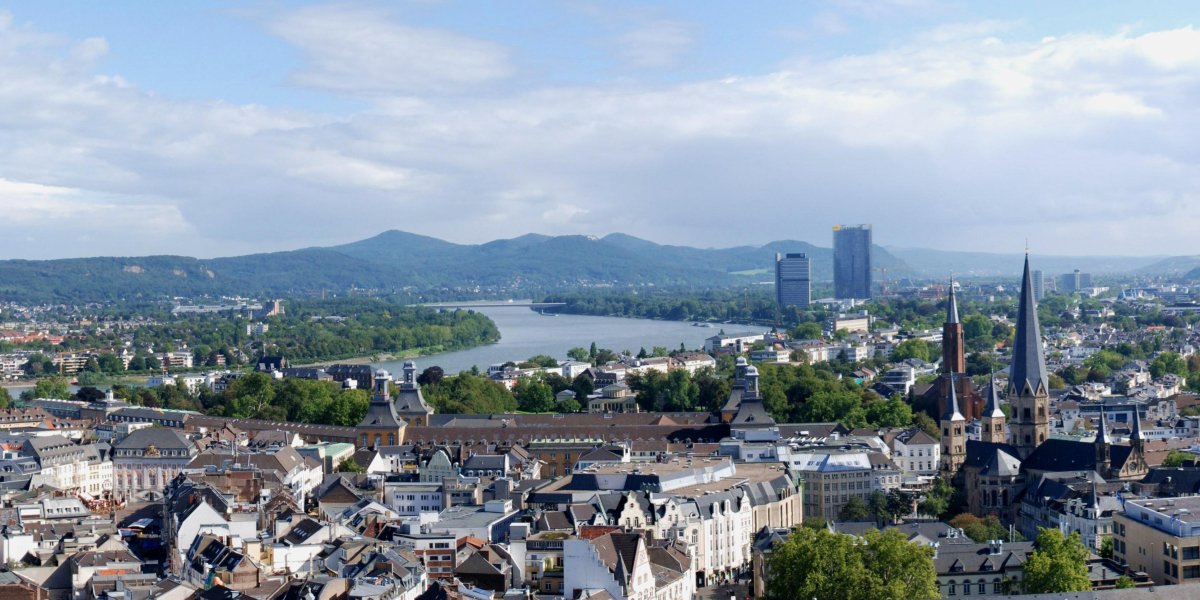
City Guide
Bonn
Germany · Best time to visit: Apr-Oct.
Day-by-day plan
Choose your pace
Trip length
09:00
Landmark
From Bonn Hauptbahnhof, exit toward Kaiserplatz and walk six minutes north along Poststraße — the first sakura branch arches over your head as you turn left onto Heerstraße. For two weeks in mid-to-late April, three hundred metres of pink double-blossom cherries close overhead in a tunnel so dense the pavement turns rose-coloured by noon — the closest thing Europe has to Kyoto. Out of season the same street rewards you with quiet bay-windowed townhouses and the bakery the neighbourhood actually queues at; either way, this is where you stand and feel you've arrived somewhere.
Tip: Peak bloom is 7-14 days in mid-to-late April — check #KirschblüteBonn on Instagram the morning of arrival for live status. Be on the street by 8:30 to shoot the empty pink arch before the tripods arrive; the densest 'tunnel' is the 80-metre stretch between Maxstraße and Breite Straße, NOT the wider section near Kaiserplatz where most TikToks are filmed.
Open in Google Maps →10:30
Landmark
Walk ten minutes east through quiet Maxstraße and turn south onto Bonngasse — Beethoven's father's old pawnshops once lined this very street. Number 20 is unmistakable: a tall pink-and-grey townhouse with a green flag, the attic room behind those upper windows being where Ludwig was born in December 1770. We won't go in — the small museum interior is for true musicology pilgrims — but the façade itself is the photograph, the bronze ear-trumpet sculpture by the door is the detail nobody notices, and the inner courtyard accessed via the gift-shop side gate is the moment every coach tour misses.
Tip: Slip through the side gate beside the gift shop into the inner courtyard — it's free, open until 18:00, and almost always empty. Look up at the doorway above the courtyard for the inscription 'Es muss sein' — the line Beethoven wrote into his final string quartet, his answer to the question of fate. The pink café Bonnaparte across the street does the best Flat White on Bonngasse if you need caffeine before lunch.
Open in Google Maps →12:30
Food
Walk four minutes south down Bonngasse, past the bronze of a teenage Beethoven, into Münsterplatz — where the cathedral steps spill into the city's working open-air market (Mon-Sat, since 1810). Office workers in suits eat shoulder-to-shoulder with university students at chest-high tables ringed around the stone fountain. The Fischbrötchen stand at the south-east corner is the order: a Bismarckhering roll — pickled herring, raw onion, a slice of gherkin — €5.50, eaten standing up, the cathedral spire as your view. Wash it down with a glass of Federweißer if you're here in September.
Tip: Skip the bratwurst stalls (generic every-German-market food) and the doner kebab vendors — the Fischbrötchen and the local Reibekuchen (potato pancake with apple sauce, €4) are the actual Rhineland lunch. Stand at the tables on the south side of the fountain — they face the Münster's east tower; the north tables face the parked delivery vans. Cash only at most stalls.
Open in Google Maps →14:00
Neighborhood
Cross Münsterplatz to the seated Beethoven Monument (1845, the city's first) at its centre — he faces the cathedral, his back to the palace he refused to flatter. Behind him, the Bonner Münster's eleventh-century Romanesque east tower is one of the oldest church spires in Germany still standing. Two blocks north, the Marktplatz opens up — and the Altes Rathaus appears in the colour every postcard captures: rococo rose-pink and gold, its double staircase the exact spot where JFK waved to Bonners in June 1963, where de Gaulle had stood three months before, where every visiting head of state spoke when this was West Germany's capital. The whole loop is a thousand-year compression of German history in three city blocks.
Tip: Photograph the pink Altes Rathaus at 14:30-15:00 — the sun lands directly on the façade and the gold gilding actually glows; before 14:00 it's in shadow. The double staircase is open to walk up (free, no ticket, no guards), and the small balcony at the top is where Kennedy stood — almost no tourist tries the door. The 'Drei Männer am Brunnen' fountain at the corner has potable water; refill before the long Poppelsdorf walk.
Open in Google Maps →16:30
Landmark
From the Altes Rathaus walk twelve minutes south down cobbled Remigiusstraße and onto Poppelsdorfer Allee — a 600-metre arrow of horse-chestnut trees, four rows deep, that frames the baroque Poppelsdorfer Schloss at its far end like a perspective drawing in a Renaissance textbook. The palace itself, built 1715-1753 as the Cologne archbishop-elector's summer hunting lodge, now belongs to the university — its yellow stucco and white pilasters wrap a perfectly circular inner courtyard that almost no day-tripper finds. The Botanical Garden behind it is the original baroque parterre, redesigned in the English landscape style after Beethoven's lifetime; the magnolias here outshine even Heerstraße's cherries in March.
Tip: Time your arrival for 17:30 — the low western sun hits the south façade and turns the yellow stucco gold against the blue sky behind the dome. Walk into the inner circular courtyard (free, open until 18:00 via the south arch) — most visitors stop at the front gate and miss the perfect symmetry, which is the actual photograph everyone should take. Sit on the steps of the south fountain for ten minutes before walking back — it's the moment the day earns.
Open in Google Maps →19:00
Food
Walk fifteen minutes back toward the Altstadt along Argelanderstraße — the cathedral spire lit copper against the dusk on your right — to Sterntorbrücke, where Brauhaus Bönnsch's red shutters and brass lettering appear on your left. The copper brewing kettles are visible from the front tables; Bönnsch is the unfiltered, slightly cloudy wheat-pale lager brewed only here, served in the curved 0.2L Stange glass that no other brewery in Germany uses. The kitchen does the Rhineland classics with no concessions to tourist palates: Bönnsch Sauerbraten (marinated beef, raisin gravy, potato dumpling) at €19.50 is the signature, the Schweinshaxe at €18 is large enough for two, and the Halve Hahn — a rye roll with aged Gouda and mustard, €7.50 — is the dish Konrad Adenauer ordered when he was Bonn's mayor in the 1920s.
Tip: Reserve by 18:00 on Friday/Saturday (+49 228 6509-610) or arrive at 18:45 sharp to get the wooden booth tables in the cellar room — the upstairs tables sit you under the kitchen vent. Order the Bönnsch beer flight (4 × 0.2L for €9) if you can't decide. AVOID the restaurants directly on Marktplatz with English-only menus, laminated photo boards, and waiters who beckon you in — they're 30-50% more expensive than Bönnsch for half the food, the classic Bonn tourist trap. Trains back to Cologne run every 10 minutes from Hauptbahnhof; the last one is 23:46.
Open in Google Maps →Jump to day
10:00
Museum
Begin in the heart of Altstadt — a 10-minute walk north from Hauptbahnhof up Poststraße brings you straight onto Bonngasse and the pink-yellow facade of No. 20. This is the house where Ludwig was born in 1770, holding his last grand piano, the ear trumpets that map his slow descent into deafness, and the original handwritten Heiligenstadt Testament. The rooms are tiny by design, the floorboards creak — at opening you have them almost alone.
Tip: Book the timed ticket online the night before — by 11:30 the walk-in counter often shows 'next slot 14:00'. Don't skip the Digital Studio in the basement: it dramatises the Heiligenstadt letter with surround audio, and 80% of visitors walk straight past it.
Open in Google Maps →12:30
Food
Exit Beethoven-Haus and walk 4 minutes south on Friedrichstraße — you'll pass the stubby Sterntor gate and the brauhaus appears on your left, copper kettles glinting through the window. The house Bönnsch lager is brewed in those very kettles, served only here and at three sister taverns. Order the Bönnsche Rievkooche (Rhineland potato pancakes with apple sauce, €11) or the rich Sauerbraten with rye dumpling (€19).
Tip: What the regulars order: the Halve Hahn (rye roll with aged Gouda and mustard, €6.50) alongside the beer — it's not on the tourist plate but the bartender will bring it on request. Cash speeds the check; the kitchen closes the rievkooche pan at 14:30.
Open in Google Maps →14:30
Landmark
From the brauhaus, walk 6 minutes northeast through Sterntorbrücke into Remigiusstraße and you emerge behind the rose-pink rococo town hall. The 1737 Altes Rathaus is Bonn's signature postcard — Kennedy, de Gaulle and Gorbachev all waved to crowds from its gilded outdoor staircase during the West German capital years. The square itself has been the city's beating heart for 700 years and the Saturday market has just packed up, leaving the cobblestones clean for photos.
Tip: Stand at the southeast corner of the square in front of the Stadtkasse for the cleanest staircase shot — the angle most guidebooks miss because they're shooting head-on into the sun. The macaron boutique on the square charges €3 each; the identical Pierre Hermé brand is €1.30 at the REWE supermarket one block north on Friedrichstraße.
Open in Google Maps →15:30
Religious
Leave the Marktplatz and walk 4 minutes southwest down Vivatsgasse — the 11th-century minster's twin Romanesque towers rise the instant you turn the corner. Inside, late-afternoon light streams through the south windows and the apse glows amber by 16:00, the moment to be there. Beneath the choir, in a small crypt most tourists overlook, lie the Roman soldier-martyrs Cassius and Florentius — Bonn's patron saints, who gave the city its first name.
Tip: Enter through the side door on Münsterplatz, not the grand west portal — saves the queue when a service is on. The cloister to the right of the nave (free, signed 'Kreuzgang') is a quiet 12th-century square with carved tympana that almost no day-tripper finds; ask the verger to unlock the crypt gate if it's shut.
Open in Google Maps →17:00
Neighborhood
From the Minster, walk 7 minutes north back through Markt and onto Heerstraße — the rows of Japanese cherries begin the moment you cross Stockenstraße. From roughly 8 to 22 April the trees form a continuous pink tunnel for 300 metres, the most photographed street in Western Germany. Outside bloom week it's still one of Bonn's quietest, prettiest residential lanes, lined with painted 19th-century facades — an honest glimpse of how locals actually live.
Tip: Stand at the Heerstraße/Breite Straße junction facing south for the famous 'infinity tunnel' frame. During bloom days arrive before 17:30 — by 18:30 there are wedding photographers and influencer queues; locals come at sunrise (7:00) for empty shots. Outside April, walk one street east to Maxstraße for the same painted facades without the crowds.
Open in Google Maps →19:30
Food
Walk 5 minutes south from Heerstraße back to Marktplatz — Em Höttche is the leaning half-timbered building on the square's north side. Beethoven's father reportedly drank away his court salary at these tables; the inn has poured beer continuously since 1389, making it the second-oldest in the Rhineland. Order the Himmel un Ääd (black pudding with apple-mashed potato, €17) or the slow-braised Schweinshaxe (pork knuckle, €23) with a half-litre of Bönnsch from the wood keg.
Tip: Reserve online — the 12-table dining room fills by 20:30. Ask for 'Stube 1' (the small room immediately left of the entrance) with its 17th-century green-tiled stove and original wood panelling. Area pitfall: ignore the restaurants lining Münsterplatz's east side — they intercept Cologne–Bonn river-cruise day-trippers with €28 reheated schnitzels; every place locals eat is on the inner Altstadt streets behind, at half the price.
Open in Google Maps →09:00
Museum
Take U-Bahn 16/63/66/67 four minutes from Hauptbahnhof to Heussallee/Museumsmeile, then walk 100m east — the entrance is unmistakable, framed by giant outdoor relief sculptures of postwar German history. Free, brilliantly curated and the most underrated museum in Germany: Adenauer's actual Mercedes 300, the JFK podium from his 1963 Berlin speech, the steel-grate carriage East German guards used to inspect Western travelers, the original dance-floor planks from Berlin's Tresor techno club. Allow a full two hours.
Tip: Skip the audio guide — English captioning is excellent everywhere — and spend that time on the 1950s consumer-culture floor (the original VW Beetle, Persil ads, Petticoat dresses). Most visitors charge through to the Berlin Wall and miss the most charming gallery in the building. Lockers take a €1 coin and return it.
Open in Google Maps →11:00
Museum
From Haus der Geschichte, walk 4 minutes south along the Museumsmeile promenade — you'll pass Bundeskunsthalle's blue rooftop palm trees before arriving at Kunstmuseum's stark white minimalist facade. The collection holds Germany's finest 20th-century painting outside Munich, but the unmissable room is dedicated to August Macke — Bonn's own boy, Expressionist, killed at 27 in the first weeks of WWI. His Tunisian watercolors from 1914, painted six weeks before he died, hang in the top-floor skylight room where the midday sun is calibrated for them.
Tip: Walk straight to the August Macke room first (top floor, far right) — afternoon school groups arrive at 13:00 and stand in front of the Tunisian series for half an hour. Buy the combined Museumsmeile ticket (€16) only if you also plan to hit Bundeskunsthalle; otherwise the standalone (€10) is better value.
Open in Google Maps →13:00
Food
Take U-Bahn 16/63/66/67 one stop back from Heussallee to Universität/Markt (3 min), then walk 200m west on Maximilianstraße — the broad green awning is impossible to miss. Bonn's most beloved vegetarian buffet since 1984: thirty hot and cold dishes (sweet-potato curry, six salads, fresh-pressed juices), pay by the gram at roughly €2.40 per 100g for an average plate of €11. The buffet is restocked at 12:30 and 14:00, so 13:00 catches it freshest before the post-university wave hits.
Tip: What to load your plate with: the warm spinach-and-feta lasagne and the carrot-ginger fresh-pressed juice — both have a cult following with Bonn students. Sit upstairs by the back courtyard window; the ground floor gets noisy after 13:30 and the lift queue costs you 5 minutes.
Open in Google Maps →14:30
Park
Walk 7 minutes southeast from Cassius Garten through Friedrichstraße — the Hofgarten opens suddenly and the salmon-pink Electoral Palace stretches across its entire eastern edge like a stage backdrop. The 7-hectare lawn is Bonn University's front garden; generations of students have picnicked, protested and sunbathed here, and the long view back toward the palace from the southern lawn is one of Germany's classic university photographs. At this hour the southern sun rakes the lawn at a low angle, casting long tree shadows perfect for portraits.
Tip: The tiny Akademisches Kunstmuseum tucked into the lawn's east edge is free and houses 600 plaster casts of every major Greek and Roman statue — almost no tourist knows it exists. Walk through the palace's central arch (Koblenzer Tor) to find Poppelsdorfer Allee, the dead-straight chestnut avenue that frames your next stop perfectly.
Open in Google Maps →16:00
Park
From the Hofgarten, walk 12 minutes southwest down Poppelsdorfer Allee — a 700-metre baroque axis of chestnut trees laid out in 1715 so the Cologne archbishop-elector could see his summer palace from his winter one. The horseshoe courtyard fills with white magnolia blossoms in late March; the botanical garden beyond holds 11,000 species, including a 200-year-old taxodium and the Victoria amazonica water-lily house. 16:00 gives you golden light on the yellow palace facade and almost two hours before the garden closes at 18:00.
Tip: Enter through the side gate on Meckenheimer Allee (€3, cash only, exact change appreciated) rather than the main entrance — weekend queues there can hit 15 minutes. The Viktoriahaus (giant Amazonian water-lily greenhouse) only opens 14:00–17:00; head there first, then circle back through the rose terrace and magnolia courtyard. Under 18 is free.
Open in Google Maps →19:30
Food
Walk 8 minutes south from Poppelsdorfer Schloss down Argelanderstraße — Strandhaus is on the corner of Georgstraße, marked by lantern-lit terrace tables spilling onto the sidewalk. A Südstadt neighborhood institution since 2003, set in a converted apothecary's flat with bare-wood floors, brass lamps and a six-table bow window. Order the Rheinischer Sauerbraten (raisin-and-clove braised beef, slow-cooked four days, €26) or in season the white-asparagus risotto with cured ham (€24).
Tip: Reserve a week ahead for Friday/Saturday and ask for 'Tisch 7' in the bow window facing Georgstraße — the warmest corner in the room. Area pitfall: do not eat anywhere within 200m of Hauptbahnhof on your way back to the hotel — every 'Restaurant Café Bonn' there serves the same frozen-schnitzel menu at a 30% markup to confused arrivals. The U-Bahn from Poppelsdorf to anywhere in town runs every 5 minutes and takes 6; always eat where locals live, never where they only catch trains.
Open in Google Maps →
Trip builder
Plan this trip around Bonn
Turn this guide into a bookable rail itinerary with FlipEarth.
Keep exploring
Related cities
More in the same country
FAQ
Frequently asked questions
How many days do you need in Bonn?
Most travelers enjoy Bonn in 1 days, with enough time for headline sights and a slower meal or museum stop.
What's the best time to visit Bonn?
The easiest season for most travelers is Apr-Oct, especially if you want good weather and manageable crowds.
What's the daily budget for Bonn?
A practical starting point is about €70 per person per day before hotels, then adjust based on museums, dining, and transport.
What are the must-see attractions in Bonn?
A good first shortlist for Bonn includes Heerstraße Cherry Blossom Avenue, Beethoven-Haus (Birthplace) Exterior, Poppelsdorfer Allee & Schloss.