City Guide
Quedlinburg
Deutschland · Best time to visit: May-Oct.
Day-by-day plan
Choose your pace
Reisedauer
09:00
Landmark
Start at the foot of the old town and walk the cobbled Burgberg ramp uphill — six minutes of steady sandstone climb. Step onto the Schlossberg terrace just as the eastern sun rakes across the Romanesque facade of the Stiftskirche St. Servatius, where Heinrich I — the first king of the Germans — was buried in 936. Circle the perimeter wall for the photograph that earned Quedlinburg its 1994 UNESCO listing: a thousand red-tiled roofs unbroken by a single modern building.
Tip: Be on the terrace by 09:00 sharp. The first day-trip coach from Wernigerode arrives at 10:30, after which the narrow stair to the western wall becomes a slow-moving queue. The north wall (left of the church door) frames the old town without a single telegraph wire in the shot.
Open in Google Maps →11:30
Landmark
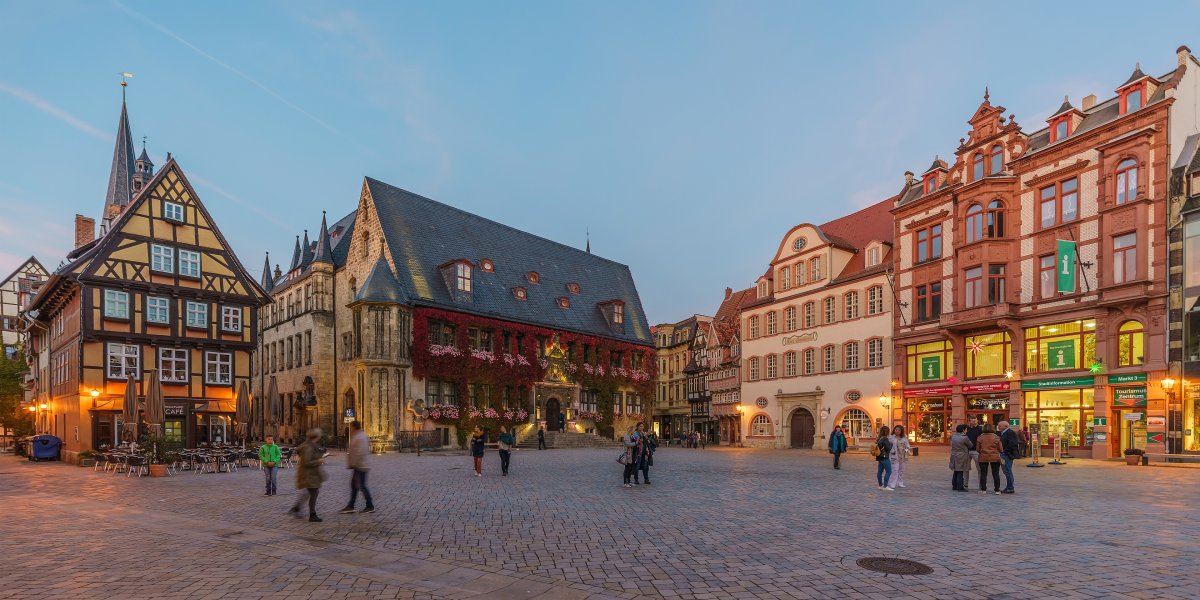
Descend the Schlossberg via the Finkenherd path — five minutes of cobbles past the legendary spot where, in 919, a delegation supposedly found Heinrich I catching finches and offered him the German crown. The Marktplatz then unfolds beneath the Renaissance Rathaus, guarded by a 2.75-meter Roland statue raised in 1426 to declare imperial trading rights. The Marktkirche St. Benedikti's twin towers anchor the eastern edge, and on the south side the Gildehaus zur Rose displays the most ornate timber facade of any guild house in the Harz.
Tip: Stand at the southeast corner of the square — Rathaus, Roland and Marktkirche line up in a single 35mm frame. If you land on a Wednesday or Saturday before 12:30, the farmers' market spreads across the cobbles with Harz smoked trout, mountain cheese and slices of Quedlinburger Baumkuchen at half the café price.
Open in Google Maps →13:00
Food
Forty seconds west from the Roland statue — Vincent's modest dining room sits two doors down Marktstraße at no.8, with no English photo-menu propped outside. This is the address Quedlinburgers send visiting relatives to. Order the Soljanka (€7.80), a tangy smoked-sausage soup native to the former East, followed by Bratkartoffeln mit Sülze — pan-fried potatoes with house-made head cheese and pickle (€12.80). Budget €18-25 per person.
Tip: Skip the printed card and ask for the chalk-board Mittagskarte (€9-11) — it changes daily based on whatever the Harz farmer delivered that morning and is consistently better than the standard menu. Walk in before 13:15 and you won't need a reservation; arrive at 13:30 and you'll wait twenty minutes.
Open in Google Maps →14:30
Neighborhood
Two minutes south from Vincent down Carl-Ritter-Straße — the timber facades begin to bow over the cobbles as you enter the Word. Wordgasse 3 holds the Ständerbau, built around 1310 and one of the oldest preserved half-timbered houses in Germany, the architectural Adam from which everything else here descends. Walk a slow loop through Hohe Straße, Breite Straße and Steinweg and you cross every century of German carpentry standing in chronological order — Gothic post-and-beam, Renaissance fan rosettes, Baroque diagonal bracing, sometimes three styles on a single block.
Tip: Look up — each century left a signature. The carved Fächerrosetten (fan rosettes) are 16th century, the X-shaped Andreaskreuz braces are pre-1500 Gothic, the curved S-shapes are 17th-century Baroque. Slip into the unmarked alley Schuhhof off Steinweg — Quedlinburg's quietest courtyard, never on a tour route, lined with three centuries of carpentry and not a single souvenir shop.
Open in Google Maps →17:00
Landmark
Eight minutes west from Steinweg, across the Mühlgraben footbridge and up the steep Münzenberg lane — short but vertical, do it now while the light is at its peak. The Münzenberg was a Romanesque convent demolished in the Reformation, its stones recycled into the tightest cluster of musicians' and craftsmen's cottages in town — Quedlinburg's smallest half-timbered houses, glued to the hillside. The terrace beside the Münzenbergkirche St. Marien gives the city's defining photograph: the entire Schlossberg silhouette lit by the low western sun, the red-tiled old town spread below like a relief map.
Tip: Be on the summit terrace by 17:00 from May to August (16:00 in October) — the western sun rakes the Stiftskirche's sandstone for roughly forty-five minutes of pure gold light. Position yourself left of the church entrance where a low stone wall gives you a clean foreground of red tiles, no parked cars in the frame, and the silhouette dead-centered.
Open in Google Maps →19:00
Food
Twelve minutes back down Münzenberg, across the Mühlgraben and east into Blasiistraße — the brewery's wrought-iron sign juts over the street on your left at no.14. Brauhaus Lüdde has brewed inside this 1807 half-timbered shell for over two centuries and is where Quedlinburgers themselves go for a proper meal. Order a half-liter of Pubarschknall (€4.50), the brewery's unfiltered dark beer named after a 19th-century miller's joke, paired with Harzer Köhlerpfanne — a sizzling iron pan of pork medallions, mushrooms, onions and pan-roasted potatoes (€18.90). Budget €30-40 per person with two beers.
Tip: Reserve the inner courtyard table by phone for 19:00 sharp (+49 3946 705206) — the front rooms fill by 19:30 on Friday and Saturday. PITFALL: avoid any restaurant on Marktplatz with a multilingual photo-menu propped at the door — they're calibrated for the day-trip coach crowd and charge €25+ for a schnitzel that costs €14 two streets over. The same warning applies to the souvenir-shop cafés along Steinweg: their Baumkuchen is industrial; the real one is sold at Quedlinburger Baumkuchen GmbH on Heiligegeiststraße.
Open in Google Maps →
Trip builder
Plan this trip around Quedlinburg
Turn this guide into a bookable rail itinerary with FlipEarth.
Keep exploring
Related cities
More in the same country
FAQ
Frequently asked questions
How many days do you need in Quedlinburg?
Most travelers enjoy Quedlinburg in 1 days, with enough time for headline sights and a slower meal or museum stop.
What's the best time to visit Quedlinburg?
The easiest season for most travelers is May-Oct, especially if you want good weather and manageable crowds.
What's the daily budget for Quedlinburg?
A practical starting point is about €70 per person per day before hotels, then adjust based on museums, dining, and transport.
What are the must-see attractions in Quedlinburg?
A good first shortlist for Quedlinburg includes Schlossberg & Stiftskirche St. Servatius, Marktplatz, Rathaus & Roland Statue, Münzenberg & St. Marien Terrace.