City Guide
Mtskheta
Georgien · Best time to visit: Apr-Oct.
Day-by-day plan
Choose your pace
Reisedauer
09:00
Religious
Arriving from Tbilisi, have your marshrutka or taxi take you straight up the eastern ridge — 15 minutes of switchbacks on a road with no shoulder, so do not attempt the climb on foot. At 09:00 the courtyard is nearly empty and the 6th-century stone has just caught its first light; from the cliff edge you see exactly what the poet Lermontov saw — the milky Aragvi pouring into the slate-blue Mtkvari at the foot of the rock. This is the emotional peak of the day, deliberately placed first while the air is still sharp and the buses from Tbilisi have not yet arrived.
Tip: The postcard view of the river confluence is not from the parking lot — walk 50 m past the south side of the church to the unmarked cliff edge. The wind up here is fierce in every season; bring a windbreaker even in July, and time your exit before 10:30 when the first tour coaches grind up the hill.
Open in Google Maps →11:30
Landmark
Ask your Jvari driver to drop you at the north end of Mtskheta on Davit Aghmashenebeli Street — from there a 12-minute walk uphill past wooden balconies and grape arbors brings you to the ruined fortress that guarded the old kingdom's northern flank. Bebris Tsikhe is roofless, half-collapsed, and almost always empty; climb the stone steps onto the surviving wall and the whole town opens beneath you like a scale model, Svetitskhoveli's dome anchoring the centre. No ticket, no guard, no crowd — just you, the lizards, and a thousand years of mortar.
Tip: The final path up is loose gravel on uneven stone — grippy soles only, no slick sneakers. Locals' chained dogs in the lower lane will bark; walk on the right side of the road to give them space and they will settle as soon as you pass.
Open in Google Maps →13:00
Food
Walk south down Davit Aghmashenebeli for 12 minutes — the street opens onto Mtskheta's main square, and Pasanauri sits on its east side. This is the khinkali chain Tbilisi taxi drivers actually recommend to each other, and at this hour the Mtskheta branch is louder in Georgian than English. Order four kalakuri khinkali (meat with broth, ~8 GEL each) and one mtsvadi pork skewer (~18 GEL); skip the rice — bread comes with everything.
Tip: Eat khinkali by the topknot, bite the side, sip the broth, then eat the rest — never a fork, or you lose the soup and earn a smile from the next table. Four dumplings is a real meal; six is showing off. The discarded topknots stay on your plate so the waiter can count them at the end.
Open in Google Maps →14:30
Religious
Cross the square diagonally — Samtavro's stone wall is two minutes from Pasanauri's door. This is the working convent where King Mirian and Queen Nana, the rulers who made Georgia Christian in the 4th century, lie buried; black-robed nuns still cross the courtyard between offices, and after the open sky of Bebris the cool dim interior feels like stepping underwater. The 11th-century frescoes on the north wall are nearly untouched — the soot of nine centuries of candles is the only patina.
Tip: Women must cover their heads and wear a long skirt — both are stacked free in a basket at the gate, take and return. Step into the small stone chapel to the left of the main church: it holds the relics of Saint Gabriel the Confessor and is where local women still come to whisper prayers, far more intimate than the main nave.
Open in Google Maps →16:00
Religious
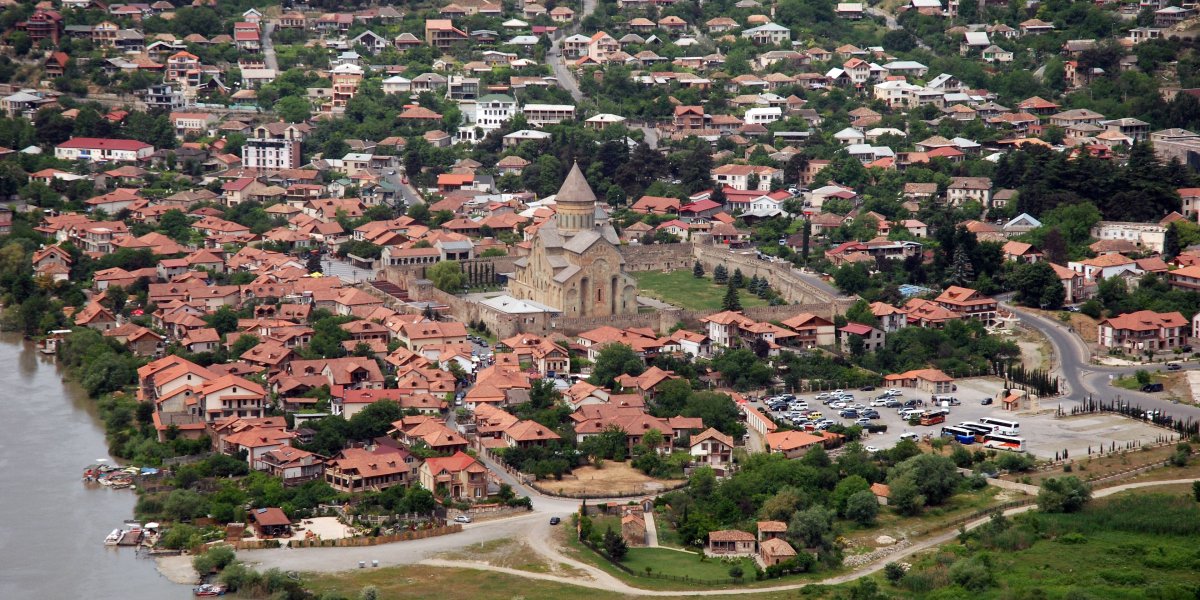
Walk south down the cobbled main street for five minutes; the cathedral's bell tower rises into view before you reach the square. By 16:00 the western sun has turned the sandstone facade honey-gold — the only hour the 11th-century carvings really reveal their depth — and the day-trip coaches from Tbilisi have already pulled out. Svetitskhoveli is the spiritual centre of the country: every Georgian king from the 12th century onward was crowned and buried here, and beneath the central stone of the nave, tradition says, lies the robe of Christ.
Tip: Look up at the exterior of the north transept — the famous 11th-century relief shows a severed sculptor's hand, the legend of architect Arsukidze whose master cut it off so he could never build a greater church elsewhere. Inside, the dark stone slab in the centre of the nave with a small bronze marker is the burial spot of Christ's tunic; do not photograph it, and step around the slab, never over it.
Open in Google Maps →19:00
Food
Take a five-minute taxi (or a 25-minute walk along the Mtkvari riverbank) south to Salobie Bia on the old Tbilisi highway — this is where Mtskhetans actually celebrate weddings and Sunday lunches, not the tourist-priced terraces facing the cathedral square. The lobio that built the restaurant's reputation in the Soviet era still comes in a clay pot with hot mchadi cornbread and pickled jonjoli flower buds (14 GEL); pair it with one shkmeruli — chicken in garlic cream, 28 GEL — and a 500 ml jug of house saperavi.
Tip: Reserve by phone for any Friday or weekend evening — locals always do, foreign visitors rarely do, and you will watch tables disappear from the doorway. Pitfall warning: never accept the 'free welcome wine' or 'photo with traditional costume' from touts near Svetitskhoveli's parking lot — it ends in an aggressive overcharge — and avoid the restaurants directly on the cathedral square, which double the price for frozen mtsvadi and pre-made lobio.
Open in Google Maps →
Trip builder
Plan this trip around Mtskheta
Turn this guide into a bookable rail itinerary with FlipEarth.
Keep exploring
Related cities
More in the same country

FAQ
Frequently asked questions
How many days do you need in Mtskheta?
Most travelers enjoy Mtskheta in 1 days, with enough time for headline sights and a slower meal or museum stop.
What's the best time to visit Mtskheta?
The easiest season for most travelers is Apr-Oct, especially if you want good weather and manageable crowds.
What's the daily budget for Mtskheta?
A practical starting point is about €55 per person per day before hotels, then adjust based on museums, dining, and transport.
What are the must-see attractions in Mtskheta?
A good first shortlist for Mtskheta includes Bebris Tsikhe Fortress.