City Guide
Larnaca
Zypern · Best time to visit: Apr-Jun, Sep-Oct.
Day-by-day plan
Choose your pace
Reisedauer
09:00
Religious
The most important Byzantine church in Cyprus and Larnaca's spiritual heart — Lazarus, raised from the dead by Christ, lived out his second life as Bishop of Kition here and is buried beneath the altar in a marble sarcophagus you can descend to see. Arrive right at the 8:30 opening to have the gold-leaf iconostasis and the sarcophagus crypt almost to yourself before tour groups roll up at 10.
Tip: Climb the bell tower (€1, entrance just right of the altar). At 9 AM you'll usually have it to yourself; the morning sun angles down through the openings and washes the old town's terracotta roofs in warm gold — the city's signature photograph and the only spot you'll get this view.
Open in Google Maps →10:30
Neighborhood
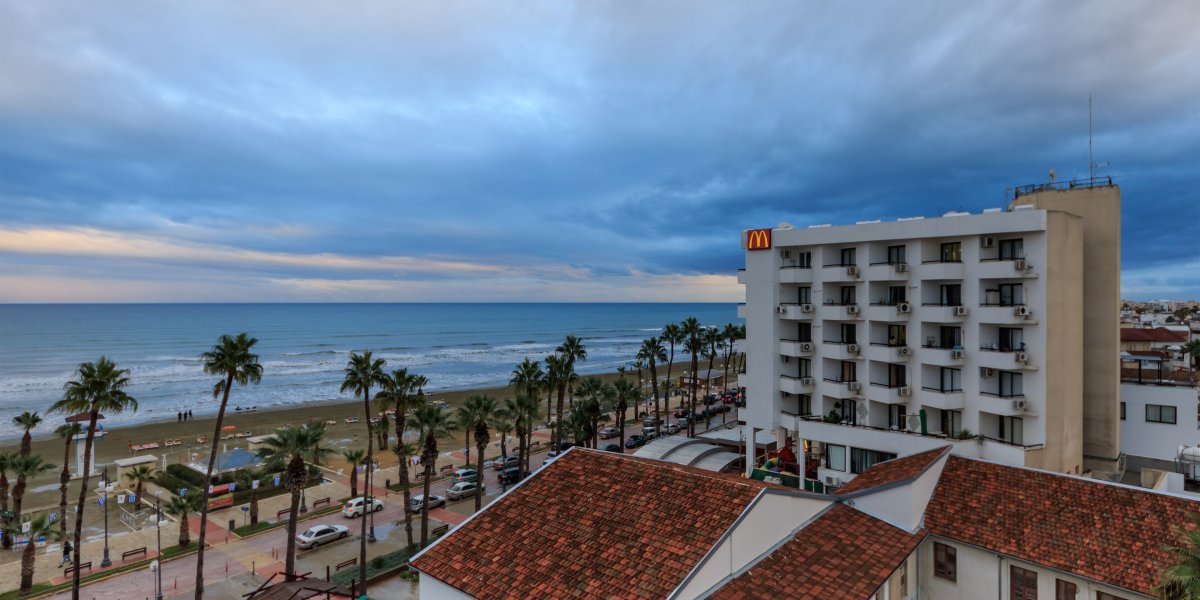
Exit Saint Lazarus east on Pavlou Valdaseridi — eight minutes through the lazy old quarter, past pastel shopfronts and barbershops where old men play backgammon in the doorway, until the palm canopy of Finikoudes opens ahead and the Mediterranean fills the horizon. This 600-metre palm-lined seafront paired with a wide pedestrian boulevard, sand to one side and café tables to the other, is Larnaca's social spine — every Cypriot ends up here at some point in the day. Walk it slowly southward as the boats rock in the morning light and palm shadows stripe the pavement; at the far end the medieval castle squats on the shore like punctuation.
Tip: Walk the SAND side, not the road side. At low tide hop down onto the beach itself for the unobstructed shot looking back along the entire palm curve toward the marina — the road-side angle gives you parked cars in every frame, and 90% of tourists never notice the difference.
Open in Google Maps →11:30
Landmark
Continue south along the promenade for 10 minutes — the palms thin out, fishermen mend nets at the small dock, and the squat ochre walls of the fort rise where the boulevard ends. A small Ottoman-rebuilt fortress marking the boundary between modern Larnaca and the old Turkish quarter, said to have garrisoned Richard the Lionheart's troops during the Third Crusade. The interior is a forgettable museum but the squat ochre walls against the sea are the photograph; circle to the southern wall for the iconic angle with palm trees and the fishing pier in frame.
Tip: Don't pay the €2.50 to go inside — the museum is small and the real photo is from the fishing pier 50 metres south, where you frame the castle, an open sea, and a single palm together in one shot. The eastern wall lights up directly in late morning, never in the afternoon.
Open in Google Maps →12:00
Food
Cross the small square behind the castle on Piyale Pasa — Militzis is the building 90 seconds away with blue wooden chairs spilling onto the seafront pavement. Larnaca's most beloved old-school taverna, in business since 1922 and still run by the same family — three generations of Cypriots have eaten lamb here. The kleftiko (slow-baked lamb in a sealed clay oven, €18) is the legend, but for a quick lunch order sheftalia (€1.80 each, grilled minced-pork sausages wrapped in caul fat) with a Cypriot village salad (€8) — both arrive in under ten minutes. Budget €15-20 with a KEO beer.
Tip: Skip the kleftiko at lunch — it's the signature dish but takes 25 minutes to plate and you have a long walk ahead. Three sheftalia, a village salad, and a cold KEO is the locals' weekday lunch and lands in 8 minutes. Sit on the seafront side of the road and you'll watch fishing boats unload while you eat.
Open in Google Maps →13:30
Religious
Leave Militzis south on Piyale Pasa, follow the seafront past Mackenzie Beach for 30 minutes, then turn inland onto the marked lake path — about 90 minutes of steady walking, mostly flat, with the salt crust glaring white as the trail bends west. One of Islam's most venerated shrines outside Saudi Arabia: a humble pale-blue mosque on the lake's western shore, holding the tomb of Umm Haram — foster aunt of the Prophet Muhammad — who died on this spot in 649 AD. The mosque itself is modest; the magic is the setting, with palm-fringed minaret silhouetted against a salt pan that turns pink as the sun drops, and in April-June stragglers from the previous winter's flamingo flock still wading at the lake edge. Time your arrival for 90 minutes before sunset — this western light is the single most iconic image in southern Cyprus.
Tip: Stand 30 metres west of the mosque entrance 45 minutes before sunset — that exact angle aligns the minaret, the palms, and the salt-pan reflection in one frame. Bring two bottles of water and a snack; there is nothing to buy out here. Women must cover hair AND knees to enter (loaner scarves at the door); shoes off inside, no exceptions.
Open in Google Maps →20:00
Food
After sunset, the guards at the mosque gate will call you a taxi back to Finikoudes (€10-12, 12 minutes); Monte Carlo's blue-and-white terrace sits midway along the promenade with tables a few steps from the lapping water. Family-run on this same Finikoudes terrace since 1933 — three Cypriot generations have served fish from the morning's catch within sight of where it was landed. Order the catch of the day grilled whole (priced by weight, ~€8/100g; sea bream or sea bass run €25-30 a portion) with grilled halloumi (€8) to start and a chilled bottle of Cypriot Xinisteri white (€18). The plates are simple, the fish is impeccable, and the setting — palms, sea, lit promenade — is the perfect close to the day.
Tip: PITFALL WARNING for the entire Finikoudes strip: many restaurants advertise low menu prices then pad bills with €3-4 'bread and olives,' €5 cover charges, and inflated drink prices. At Monte Carlo the bread is included, but anywhere on this seafront — refuse anything brought to your table you didn't order, and confirm the fish's WEIGHT before they cook it (a 'small' fish on the chalkboard can be 600g = €48). Reputable spots will quote you to the cent; if they hedge, walk.
Open in Google Maps →Zu Tag springen
08:30
Religious
Begin where Larnaca's soul lives — at the 9th-century stone church holding the tomb of Lazarus, who, the Cypriots tell you, was raised by Christ and then sailed here to live a second life as Kition's first bishop. At 08:30 the heavy doors open to a near-empty nave; morning sun slants through the iconostasis and the silver-bound icons glow as priests light the first candles of the day. Descend the small staircase by the altar to see the sealed sarcophagus inscribed 'Lazarus, friend of Christ' — the most quietly powerful 90 seconds in all of Cyprus.
Tip: Entry is free, but skip the postcard sellers in the square and ask the deacon (€1 donation) to unlock the small ecclesiastical museum behind the altar — almost no tourist knows it exists, and it holds 17th-century gospel covers worth crossing the island for. Shoulders must be covered; a free wrap is offered at the door.
Open in Google Maps →10:00
Museum
From the church, walk north up Ayiou Lazarou and Zinonos Kitieos for 8 minutes through whitewashed lanes still hung with old-town laundry — you'll pass Plateia Vasileos Pavlou with its Sunday flower market on the way. The Pierides is Cyprus's oldest private collection: four rooms in an 1815 colonial house holding 3,000 years of the island in one bite — Neolithic axe heads, Phoenician glass, the famous 'Howling Man' terracotta from 5500 BC. Don't try to read every label; spend ninety minutes letting the chronological order tell you the entire story of Cyprus from Stone Age to British rule — the Roman glass in Room 2 is what you'll remember on the flight home.
Tip: Closed Sundays — if your weekend lands Sun–Mon, swap this morning slot with the castle. Buy your ticket from the little bookshop in the entrance hall, also the only place in Larnaca that sells a signed Cypriot cookbook in English (€18) and will hold your bag free of charge.
Open in Google Maps →12:30
Food
Retrace your steps south past Saint Lazarus toward the seafront — 10 minutes along Piale Pasa Avenue brings you to a green-shuttered taverna directly across from the castle wall, where clay ovens have been smoking since before sunrise. Militzis is where Larnaca eats kleftiko — lamb shoulder slow-baked seven hours in a wood-fired oven sealed with clay at 4 AM until it falls apart at the touch of a fork. Order the kleftiko (€14), a half portion of yiouvarlakia meatballs (€8), and a glass of village red — under €22 a head, and the lamb tastes of nothing but bay leaf, fat, and time.
Tip: Arrive at exactly 12:30 — every later minute costs you a longer wait, and by 14:00 the kleftiko is sold out for the day. Skip the dessert menu; instead say 'glykó' to the owner and you'll receive a complimentary spoon of preserved bergamot, the real ending of every traditional Larnaca meal.
Open in Google Maps →14:00
Landmark
Cross the street — the castle's stone bulk is fifty metres from Militzis' door, and you can already see Mackenzie Beach unfurling south from the front terrace. Built by the Lusignans, finished by the Ottomans, and used by the British as a prison and gallows, this small fort holds a tight medieval museum and the best free panorama of Larnaca Bay. Climb directly to the upper rampart first (skip the ground-floor displays for now) — at 14:30 the sun is behind you, the palm-line of Finikoudes is to your left, and the entire promenade reads as a single curving sweep of green and white.
Tip: The ramparts close 15 minutes before the museum, so do the rampart loop first and the indoor exhibits after. Tuesday afternoons it's almost deserted — most cruise-ship coaches stop visits by 11:00.
Open in Google Maps →15:30
Neighborhood
Exit the castle and turn left along the seafront — you are now at the southern end of Finikoudes, with the full kilometre of palm trees stretching north before you. Finikoudes is Larnaca's living room — a single kilometre of palm-shaded promenade where teenagers rollerblade, grandfathers play tavli, and fishing boats unload red mullet ten metres from your feet. Walk it slowly north toward the marina; pause at the Zenon of Citium statue (Larnaca's home-born Stoic philosopher), then at the freshwater fountains where children play in the late sun, and sit on the wooden deck at the marina end for sunset, which lights the masts gold from behind you.
Tip: Avoid every restaurant directly on the promenade — they are pure tourist traps charging €18 for mediocre moussaka. The local move is a fresh-squeezed orange juice (€2.50) from the kiosk by the Sun Hall hotel, drunk while walking; in summer the same kiosk sells frozen mango on a stick for €3, a Larnaca childhood memory.
Open in Google Maps →19:30
Food
Walk inland three blocks to Stasinou Avenue then north one block — ten minutes from the marina end of Finikoudes to a yellow neoclassical house with an open courtyard and a single fig tree at its centre. Art Cafe 1900 occupies a true 1900 Larnaca townhouse — two floors of wooden shutters, framed lace, and the best slow-cooked rabbit stifado (kouneli, €19) on the island. Order the stifado, a half plate of grilled halloumi with caper leaves (€9), and a small carafe of the family's Maratheftiko (€12) — under €40 a head with everything; the chef-owner Costa often comes by, so ask him about the framed 1920s harbour map and you've made a friend for the rest of the trip.
Tip: Reserve for any seating after 20:00 (Tel: +357 24 653 027); arriving at 19:30 walk-in lands you the upstairs window table over the fig tree. Closed Mondays. Pitfall warning for this neighbourhood: the souvenir shops around Lazarus Square advertising 'handmade Cypriot lace' are 95% Chinese imports — genuine Lefkara lace is sold only in Lefkara village or at the small counter inside Pierides' bookshop, and a real handmade doily starts at €60, never the €8 you see on the postcard racks.
Open in Google Maps →08:00
Religious
A 10-minute taxi (€8) takes you five kilometres west — past the airport runway and onto the lake's western shore, where a single white minaret rises from a grove of date palms above the water. The Tekke holds the tomb of Umm Haram, the Prophet Muhammad's foster aunt, who died falling from her mule on this exact spot in 649 AD, making this the third-holiest Islamic site in the Mediterranean. At 08:00 you arrive before the heat and before the air-conditioned tour coaches roll in from Ayia Napa — the courtyard is empty save for a caretaker raking gravel, the cicadas are starting, and the dome's reflection in the small ablution pool is uncut by tourists.
Tip: Entry is free; a €1 coin in the wooden donation box is expected. Women cover hair with the free scarves at the door, all visitors remove shoes. Friday late mornings are prayer time and the inner shrine closes to non-Muslims — schedule any other day. From November through March the flamingo flocks settle on the lake's southern shore; the eastern terrace gives the closest view, so bring small binoculars.
Open in Google Maps →09:30
Park
From the mosque's east gate, follow the gravel path 200 metres down to the lakeshore — you're now on the official Salt Lake nature trail that loops four kilometres around the southern half. The Salt Lake is a single white-rimmed bowl — bone-dry and crystalline in summer, a shallow turquoise mirror from November to March when flocks of greater flamingos pull in to feed on the brine shrimp. Walk the southern arc for forty minutes — there is no shade, no people, just the salt crunch underfoot and the chance to gather a single white crystal as a free souvenir (one in the hand is legal, a bagful is not); you are walking in the same pan that supplied salt to Roman Cyprus.
Tip: Wear closed shoes — the salt crystals cut bare skin and ruin sandal soles. The photograph everyone misses is at 10:00, when the low sun still skims the surface and turns the dry pan to mirror glass; by midday it goes a flat dazzling white that washes out every photo.
Open in Google Maps →11:00
Landmark
A €10 taxi takes you three kilometres north — the aqueduct stands isolated in an open field beside the Limassol–Nicosia highway, and the driver drops you right at the base of the first arch. Built in 1750 by Ottoman governor Bekir Pasha to bring spring water ten kilometres into Larnaca, seventy-five honey-coloured arches still stand, completely free to walk among, and almost entirely tourist-free. The aqueduct supplied the city's fountains until 1939 — every old well in the town still bears Bekir Pasha's mark, and the receding-perspective shot down the line of arches is the photo your Larnaca trip will be remembered by.
Tip: Approach from the eastern (city-facing) side — the western side has highway noise and a chain-link fence in every frame. At 11:00 the sun falls across the arches from the south, throwing every shadow into the field for the best perspective shot. After dark the arches are floodlit and quietly spectacular, but you'll need a taxi to bring you back specifically.
Open in Google Maps →12:30
Food
Another €8 taxi takes you four kilometres east onto the Mackenzie seafront — Zorbas occupies a glass-fronted corner where the airport access road meets the beach. Zorbas is a Cyprus-wide bakery institution, but the Mackenzie branch is the one Larnacans pile into between flights and beach swims. Order a fresh halloumi-and-mint pie (€2.80), a sesame-crusted koulouri ring (€1.20), and a bougatsa with custard and cinnamon (€2.50) — total under €8 a head with a Cyprus coffee, all eaten standing at the beachside counter or carried out to the sea wall.
Tip: Point at items on the rack rather than ordering from the cabinet — the pies coming out every thirty minutes from the back oven are crisp; the pre-wrapped ones in the chilled display are not. Save the bougatsa for last and eat it sitting on the low sea wall opposite — the cinnamon and the salt air together is the whole point.
Open in Google Maps →14:00
Park
Cross the road from Zorbas — your toes are on the sand in sixty seconds, and the runway of Larnaca International lies 800 metres to your right. Mackenzie is where Larnacans actually swim — 700 metres of fine grey sand, Blue Flag water, and the surreal show of widebody jets lifting off runway 22 at the southern end. Rent a lounger-and-umbrella set from any beach bar for €5; the water is shallow for thirty metres out and stays a flat 26 °C from June through October — between dips, watch the 15:30 Emirates A380 climb directly over the shoreline, a free spectacle no other airport in Europe offers.
Tip: Walk to the southernmost beach bar (Caprice or Mavri Helona) — fewer loungers, quieter sand, and the closest legal position to the runway fence. The FlightRadar24 app shows exact takeoff times, so you can swim while the sky is quiet and be standing on the sand exactly when a heavyweight rotates.
Open in Google Maps →19:30
Food
Two minutes' walk north along the Mackenzie seafront — the blue-and-white tavern is set back one row from the water, opposite the small fishing pier where its own boats unload at dawn. Zephyros is Larnaca's seafood institution — three generations of the Hadjipanayis family, fish landed by their own caïque that morning, and a single sea-facing patio where every Cypriot wedding meze-night ends up. Order the fish meze for two (€32 per person) — eighteen small plates beginning with marinated octopus, climbing through grilled calamari and red mullet, finishing with whole-roasted sea bream and a half-bottle of Anama dessert wine; by 20:30 the patio is full, the waiters are singing, and this is the meal you will talk about at home.
Tip: Reserve at least one day ahead for any Friday or Saturday (Tel: +357 24 657 198) and ask specifically for 'the patio table near the pomegranate tree.' Pitfall warning for Mackenzie: every other taverna on this strip displays the same 'fresh catch of the day' sign, but half of them buy from the Limassol wholesale market and re-ice it overnight. The mark of a real Mackenzie fish tavern is a wooden caïque parked nose-up on the sand outside the kitchen — Zephyros keeps theirs in the side garden; if you don't see a boat, walk on.
Open in Google Maps →
Trip builder
Plan this trip around Larnaca
Turn this guide into a bookable rail itinerary with FlipEarth.
Keep exploring
Related cities
More in the same country
FAQ
Frequently asked questions
How many days do you need in Larnaca?
Most travelers enjoy Larnaca in 1 days, with enough time for headline sights and a slower meal or museum stop.
What's the best time to visit Larnaca?
The easiest season for most travelers is Apr-Jun, Sep-Oct, especially if you want good weather and manageable crowds.
What's the daily budget for Larnaca?
A practical starting point is about €90 per person per day before hotels, then adjust based on museums, dining, and transport.
What are the must-see attractions in Larnaca?
A good first shortlist for Larnaca includes Larnaca Medieval Castle (exterior).