City Guide
Heraklion
Griechenland · Best time to visit: Apr-Oct.
Day-by-day plan
Choose your pace
Reisedauer
09:00
Landmark
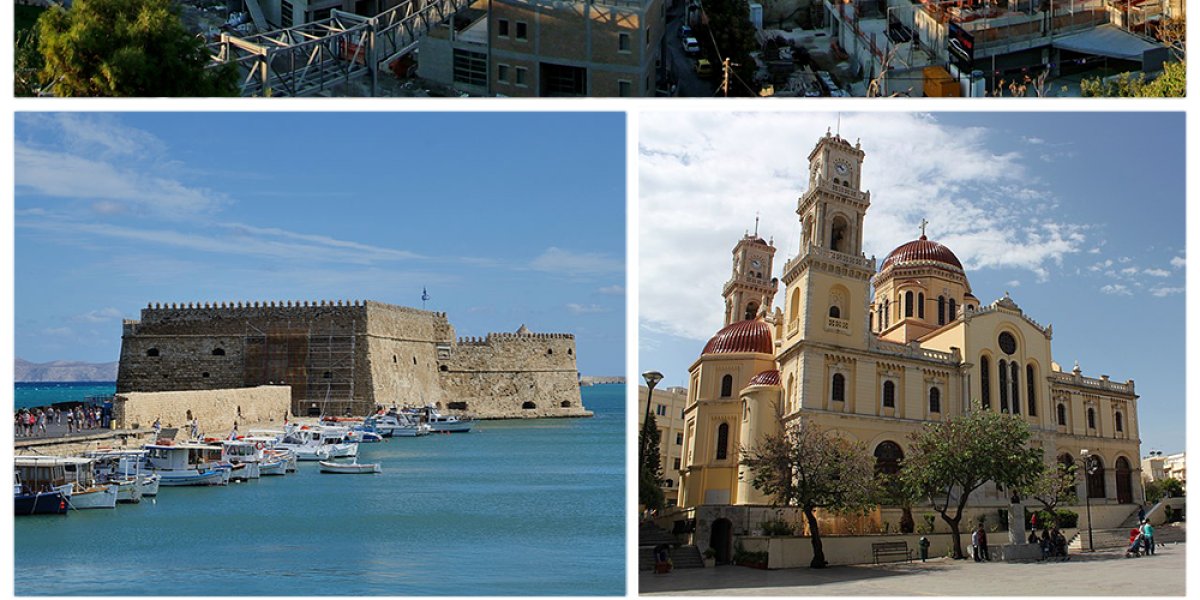
Begin where Heraklion meets the sea — out on the stone causeway that the Venetians flung into the harbor in 1540 to guard the city from the Ottomans. At nine the cruise passengers haven't disembarked yet and the morning sun strikes the ochre walls from the east, the only hour of the day the seaward ramparts glow rather than flatten into shadow. Climb through the lower powder magazines to the upper battlements for a 360° sweep: Mount Juktas brooding to the south, the breakwater curving toward the lighthouse, and the rust-streaked fishing trawlers below where Crete still earns its living from the Aegean. Walk the breakwater out toward the lighthouse on your way back — fifteen minutes round trip, no shade, but the photograph of the fortress framed against the city skyline is the postcard you came for.
Tip: Buy your ticket at 09:00 sharp and head straight up to the rooftop — you'll have the upper battlements to yourself for about 20 minutes before the first guided groups arrive at 09:30. Skip the audio guide; the panels are sparse and the views, not the captions, are why you came. The carved Lion of St. Mark above the western gate is the most photographed detail, but the better shot is the eastern gate, where the lion faces the lighthouse.
Open in Google Maps →11:00
Neighborhood
From Koules, follow the harbor causeway back toward town and turn left into 25th of August Street — the marble-paved spine of the old city, closed to cars, lined with the dignified neoclassical and Venetian facades that survived the WWII bombings. Drift through three landmarks at your own pace: the small domed church of Agios Titos (free, step inside for two minutes — the skull of Saint Titus, brought back from Venice in 1966, is in a gilded reliquary on the right wall); the Venetian Loggia, the 17th-century merchants' clubhouse whose triple-arched gallery now serves as Heraklion's City Hall; and Lions Square, where the four marble lions of the Morosini Fountain have been pouring spring water from Mount Juktas into the basin since 1628. Sit on the rim for ten minutes — this is where Heraklion takes its coffee and reads the paper.
Tip: Climb the worn stone staircase inside the Loggia to the upper gallery — the guards rarely shoo anyone away, the Venetian cornices are at eye level, and you'll be one of the few visitors who actually sees the upstairs. For the fountain, shoot from the southwest corner: the lions face the camera, the Basilica of Agios Markos fills the background, and the mid-morning light is still soft enough that the marble doesn't burn out.
Open in Google Maps →13:00
Food
Five steps off the southwest corner of Lions Square, the modest green awning of Kir Kor has been serving the same single dish since the Armenian Karipidis family opened in 1922: bougatsa, a paper-thin filo pastry stuffed with sweet myzithra cheese, baked to order, sliced with scissors, and dusted with cinnamon and powdered sugar. Order one bougatsa (€3.50), one Greek coffee glykos (€2), and stand at the marble counter the way the old men do — no menu, no English, no decisions, no chairs. Three minutes to eat, ten minutes to linger, and you've had the most beloved breakfast on the island.
Tip: Cash only — they do not take cards and have not for 100 years. Arrive at 13:00 sharp; by 13:30 there is a 15-minute queue out the door. If you want savory instead of sweet, ask for tyropita (cheese pie, same shop, same price) — most tourists don't know it exists. Do not order the iced coffee here; the bougatsa demands hot Greek coffee.
Open in Google Maps →14:00
Landmark
Walk three minutes east through quiet Daskalogianni Square to the Heraklion Archaeological Museum on Xanthoudidou Street. The interior holds the finest Minoan collection on earth — the Phaistos Disc, the bull-leaping fresco, the snake goddess figurines — but for a single-day power walk, the take is the austere 1937 Bauhaus facade by Patroklos Karantinos and the shaded courtyard out front where the marble fragments are propped along the walls like a free open-air prologue. Continue two minutes east to Eleftherias Square (Liberty Square), the leafy plaza ringed by café terraces where Heraklion actually lives: pensioners hunched over tavli boards, university students smoking on benches under the ficus trees, and the bronze statue of Eleftherios Venizelos looking sternly out to sea. Take a freddo espresso (€3) at one of the kiosks — this is the city's living room.
Tip: If a single one-hour museum dash changes your mind, walk directly to Room III on the ground floor: the Phaistos Disc, the bull-leaper fresco, and the snake goddesses are all in that one room, and they are the only pieces you will remember a year from now. Skip the upper floors. The courtyard fragments outside are best photographed against the cream-colored wall on the south side — the morning shadow has lifted by 14:00.
Open in Google Maps →16:00
Landmark
From Eleftherias Square, walk south along Dimokratias Avenue for ten minutes, then climb the grassy ramp onto the top of the Venetian walls — the longest intact urban fortifications in the Mediterranean, raised between 1462 and 1669 to hold the city against the Ottomans (a siege that eventually lasted 21 years, the longest in recorded history). Walk westward along the wall top: past the Jesus Bastion, then the great triangular Martinengo Bastion at the southwest corner, where a single unadorned stone slab marks the grave of Nikos Kazantzakis — author of Zorba the Greek, denied a Christian burial by the Orthodox Church, who chose this windswept spot himself. The inscription, in his own hand: 'I hope for nothing. I fear nothing. I am free.' Continue the full wall circuit north through Bethlehem Bastion and Pantokrator Bastion — about 3 km of rampart, no rails, the city spread below on one side and the open country on the other. The 17:30 light from the west turns the entire old town gold; by 19:00 the sun is dropping behind the walls themselves and Koules glows pink across the harbor.
Tip: The wall top is free, unfenced, and largely deserted after 17:00 — families with small children should be careful at the bastion corners where the drop is unprotected. For the Kazantzakis inscription in your photograph, shoot before 17:30 or the low western sun bleaches the lettering off the stone. Bring water; there are no kiosks on the walls themselves and the climb back down is at the western Chania Gate, a 12-minute walk from the grave.
Open in Google Maps →20:00
Food
Descend from the walls at Chania Gate and walk fifteen minutes north through the quiet lanes of the upper old town to Kapetan Charalampi 6, a restored 16th-century Venetian townhouse where Peskesi serves the most ambitious Cretan kitchen on the island. Everything — the heirloom-variety olive oil, the slow-grown vegetables, the goat, even the snails — comes from the restaurant's own organic farm in the foothills of Mount Psiloritis. Order the apaki (vinegar-cured smoked pork with thyme honey, €9), the gamopilafo (wedding rice cooked in goat broth and finished with stakavoutyro butter, €13), and a half-litre of the house Vidiano white from Rethymno (€9). Budget €30-40 per person with wine. The stone courtyard at the back is the room to ask for.
Tip: Reserve by phone or website by morning at the latest — Peskesi has been on every serious food list since 2017 and walk-ins after 20:30 are routinely turned away. Ask specifically for a table in the inner stone courtyard rather than the street-front room; the acoustics and the light are completely different. Avoid the touts who try to wave you into the seafront tavernas back near Koules: their fish is frozen, their prices are 30-40% inflated, and the moment a waiter physically blocks the sidewalk with a menu is the moment to walk past — that is the tourist-trap signature in this city.
Open in Google Maps →Zu Tag springen
08:30
Landmark
Catch Bus 2 from Lions Square at 08:00 (every 20 minutes, €1.70 one-way) — a 15-minute ride through olive groves drops you at Crete's oldest royal seat. Be among the first through the gate to walk the Throne Room and the Queen's Megaron before the cruise coaches unload around 10:30. Evans's controversial red-and-black reconstruction is what most visitors photograph, but the real magic is the original limestone slabs underfoot, where the Bull Dancers once moved four thousand years ago.
Tip: Enter via the West Court rather than the standard south path — Evans's reconstructed columns frame the dramatic descent into the palace, which is the exact angle the bull-leaping fresco was painted from. Skip the audio guide rental; buy the small green Knossos guidebook at the gate kiosk for €4 instead — it has the floor plan you'll actually use, and the audio guides repeatedly cut out around the South Propylaeum.
Open in Google Maps →12:30
Food
Back on Bus 2 to Lions Square (15 min); Phyllo Sophies hides one block east of the Morosini lions, tucked behind the Agios Markos basilica on Mitsotaki Street. This is where Heraklion office workers go for a fast Cretan lunch — counter service, no English menu needed, finished plates in 40 minutes. The phyllo is hand-rolled at 6am daily by the owner's mother in a back kitchen you can see from the till.
Tip: Order the savoury kalitsounia with mizithra and wild greens (€2.50 each, get two), the bougatsa with feta if it's on the counter (€3.50), and a small glass of raki from the bottle on the bar — gratis with the meal if you make eye contact with the cook. Skip the souvlaki here; it's correct but unremarkable, and you'll regret not having room for a second kalitsouni.
Open in Google Maps →14:00
Museum
Walk east along pedestrian Daidalou Street for 5 minutes — past the wedding-dress shops and the gelateria with the queue — and Eleftherias Square opens up to your right. The museum occupies the south side, an unassuming Bauhaus block hiding the greatest collection of Minoan art on earth. Two upper-floor rooms hold everything you've come for: the Phaistos Disc, the Bull Leaper fresco, the Snake Goddess figurines, the gold double-axes, the rhytons shaped like bulls' heads.
Tip: Bypass the chronological route and go straight up to Room IV (upper floor) the moment you enter — the Phaistos Disc and the Bull Leaper are swarmed by group tours from 11:00 onward, but at 14:30 you'll have ten quiet minutes with each. The Roman wing on Floor 1 is skippable; you came for the Minoans, and giving them 90 of your 120 minutes is the right call.
Open in Google Maps →16:30
Landmark
Walk west back along Daidalou for 5 minutes and the four marble lions appear at the heart of the old city. Built in 1628 by Francesco Morosini to bring fresh water from Mount Juktas seven kilometres away, the fountain is a surviving fragment of the Venetian republic still living in a Greek square. This is where Heraklion gathers — old men over backgammon, schoolchildren on the bench, the gelato queue spilling onto the cobbles, the cathedral bells from Agios Markos sounding the half-hour.
Tip: Stand at the corner of Daidalou and 25 Avgoustou Street at the south-east edge of the square — late afternoon sun rakes across the lions' backs and turns the Venetian marble copper. The bougatsa shop on the north side is a tourist trap (€6 for a thimble-sized portion); the real one is Kirkor on the south side, where locals queue for breakfast and a bougatsa costs €3.20.
Open in Google Maps →18:00
Religious
Two blocks north of Lions Square on 25 Avgoustou Street — the wide pedestrian avenue lined with palms and the late golden light. Originally a 10th-century Byzantine cathedral, rebuilt by the Venetians in the 1500s, converted to a mosque under the Ottomans, then returned to Orthodoxy in 1925. Each conqueror left a layer, and you can read all three in the masonry if you look at the corner stones outside the apse.
Tip: Step inside and find the silver reliquary on the left wall — it holds the skull of Saint Titus, the disciple Paul left in Crete to lead the early church. The skull was carried to Venice in 1669 when the Ottomans took the city, and only returned in 1966 after three centuries of pilgrimage. Light a slim brown candle in the box by the door (€0.50) and place it in the iron tray — it is the single act locals come here for.
Open in Google Maps →20:00
Food
Five minutes east of Agios Titos through a quiet residential lane to Kapetan Charialaou Street. Peskesi grows or sources every ingredient from its own farm in central Crete — the apaki (vine-smoked pork cured in the Anogeia mountains), the gamopilafo (wedding rice slow-cooked in goat broth), the wild greens that change weekly. The dining room is a restored Venetian mansion with a courtyard tree older than the menu and waiters who genuinely know the provenance of each plate.
Tip: Reserve two days ahead via their website — walk-ins after 20:00 are turned away on weekends. Must-orders: apaki (€9), gamopilafo (€16), and dakos with xinomyzithra (€8). Skip the wine list and ask for their farm raki — it comes free in a small carafe. Pitfall: the lookalike tavernas along Daidalou Street with English menus and laminated photos of food — those are tourist traps charging €18 for a microwaved moussaka that costs €9 here, made properly.
Open in Google Maps →09:00
Landmark
From any old-town hotel, walk down 25 Avgoustou Street toward the sea — 10 minutes past palm trees and the morning ferry queues to Mykonos. The fortress sits at the end of the long Venetian breakwater, sea on three sides, a square block of honey-coloured limestone with the lion of Saint Mark carved into its eastern wall. Walk through the cool stone corridors of the lower vaults, where Venetian galleys once hauled cargo straight off the boats, then climb to the upper terrace where the cannons still face Africa.
Tip: Continue past the fortress to the very tip of the breakwater — about 800m round trip from the gate — because most visitors stop at Koules and miss the best view in the city: the entire old town rising behind the harbor with Mount Juktas in the morning haze. The fishermen at the end will sometimes sell you the morning's bream straight from the bucket for €5 — locals do, and the restaurants nearby will cook it for you for €3 corkage.
Open in Google Maps →11:00
Museum
Walk 5 minutes west along the waterfront to a quiet corner of Sofokli Venizelou. This museum picks up where the Archaeological Museum leaves off: Byzantine icons, the Venetian-Ottoman wars, the German invasion of 1941, and a Kazantzakis room with the writer's personal desk and original manuscripts of Zorba and The Last Temptation of Christ. The two El Greco paintings — the only ones in his birth-island — are on the ground floor.
Tip: Find the giant scale model of Heraklion in 1645 on the first floor before anything else — it's the only place you'll ever see the city in its full Venetian glory, with the harbor walls intact and the Sultan's fleet visible offshore at the start of the 21-year siege. Skip the gift shop; the same El Greco icon prints are €4 cheaper at the small kiosk on 25 Avgoustou Street, three doors down from the bookstore.
Open in Google Maps →13:00
Food
Three minutes back east along Sofokli Venizelou — a blue-and-white awning, plastic chairs spilling onto the sidewalk, the sea on the other side of the road and the masts of the fishing boats rocking in time. Ippokampos is where Heraklion eats fish: families with grandparents, port workers, off-duty taxi drivers, the occasional priest. The menu is whatever came in this morning, written by hand on a chalkboard propped by the door.
Tip: Arrive by 13:00 sharp or you'll wait 45 minutes — they don't take reservations, ever. Order one plate of grilled sardines (€8), one plate of fried gavros (anchovies, €7), the tomato-cucumber salad, and a half-litre carafe of white wine (€5) — total under €25 a head. Do not order anything not on the daily chalkboard; the printed menu items are mediocre, the catch-of-the-day is the whole point of being here.
Open in Google Maps →15:00
Religious
Walk 10 minutes south through the old town — up Kalokerinou Street, past the leather-shoe shops and the 1866 Market spilling honey, olives, and dried oregano onto the pavement. The cathedral rises suddenly in a quiet square: the largest church in Crete, built between 1862 and 1895, twin domes carrying the icon of Saint Minas who allegedly rode his white horse through these streets on Christmas Eve 1826 to scatter Ottoman troops planning to massacre Christians at midnight Mass.
Tip: Skip the cathedral interior — it's vast but visually ordinary — and instead enter the small 18th-century church of Saint Minas tucked into the south-east corner of the same square (free, often empty). On the iconostasis you'll find the original icon of the saint that is said to weep on the city's anniversary days; if the warden is in, he will show you the cotton swab in a glass vial where last year's tears were caught.
Open in Google Maps →16:30
Landmark
Walk south uphill for 10 minutes through the residential lanes — the streets get narrower, the bougainvillea heavier on the walls, the traffic noise drops away. The Martinengo Bastion is the southernmost and highest point of the 4-kilometre Venetian walls, and on its grass plateau sits a plain wooden cross over a slab of unworked Cretan limestone. The grave is Kazantzakis's — refused a Christian burial in 1957 because Rome had placed his novels on the Index, so the city of Heraklion buried him on its highest wall instead. The view of Mount Juktas to the south is the same view he wrote about in Zorba.
Tip: Read the epitaph carved into the cross aloud — 'I hope for nothing. I fear nothing. I am free.' — and then walk five minutes east along the wall ramparts to the Jesus Bastion. The sun hits the Martinengo from the west around 19:00 in summer (17:30 in winter), and from there you can see the whole old town, the harbor, Koules glowing copper, and the sea fading toward Africa. Bring a one-litre bottle of water from the kiosk on Plastira Square before you go up — there is no shop within 10 minutes of the tomb.
Open in Google Maps →20:00
Food
Walk back down the wall path north toward the old town — 15 minutes downhill, all the way to Lysimachou Kalokerinou Street, the lights coming on in the doorways as you go. Avli tou Defkaliona, 'Deukalion's Courtyard,' sits in a converted 19th-century stone house with a vine-covered patio and a fig tree growing through the roof. It is a singer-songwriter's taverna: live Cretan lyra music on Friday and Saturday nights, mezedes brought out four small plates at a time, the host pouring raki from a copper jug onto the table without asking.
Tip: Order the boureki (zucchini-potato-mizithra pie, €9), the slow-cooked lamb with stamnagathi greens (€16), and the htipiti (whipped feta with roasted red pepper, €6). Don't ask for the bill before 22:00 — the lyra player arrives around 21:30 and the regulars come for the second half. Pitfall: avoid the souvenir tavernas right on the breakwater side of the harbor — they double their prices for the cruise ships, the moussaka is microwaved from a frozen tray, and the 'fresh fish display' out front is for show; the real catch never leaves the kitchen.
Open in Google Maps →
Trip builder
Plan this trip around Heraklion
Turn this guide into a bookable rail itinerary with FlipEarth.
Keep exploring
Related cities
More in the same country
FAQ
Frequently asked questions
How many days do you need in Heraklion?
Most travelers enjoy Heraklion in 1 days, with enough time for headline sights and a slower meal or museum stop.
What's the best time to visit Heraklion?
The easiest season for most travelers is Apr-Oct, especially if you want good weather and manageable crowds.
What's the daily budget for Heraklion?
A practical starting point is about €70 per person per day before hotels, then adjust based on museums, dining, and transport.
What are the must-see attractions in Heraklion?
A good first shortlist for Heraklion includes Koules Fortress (Rocca al Mare), Archaeological Museum Exterior & Eleftherias Square, Venetian Walls & Tomb of Nikos Kazantzakis (Martinengo Bastion).