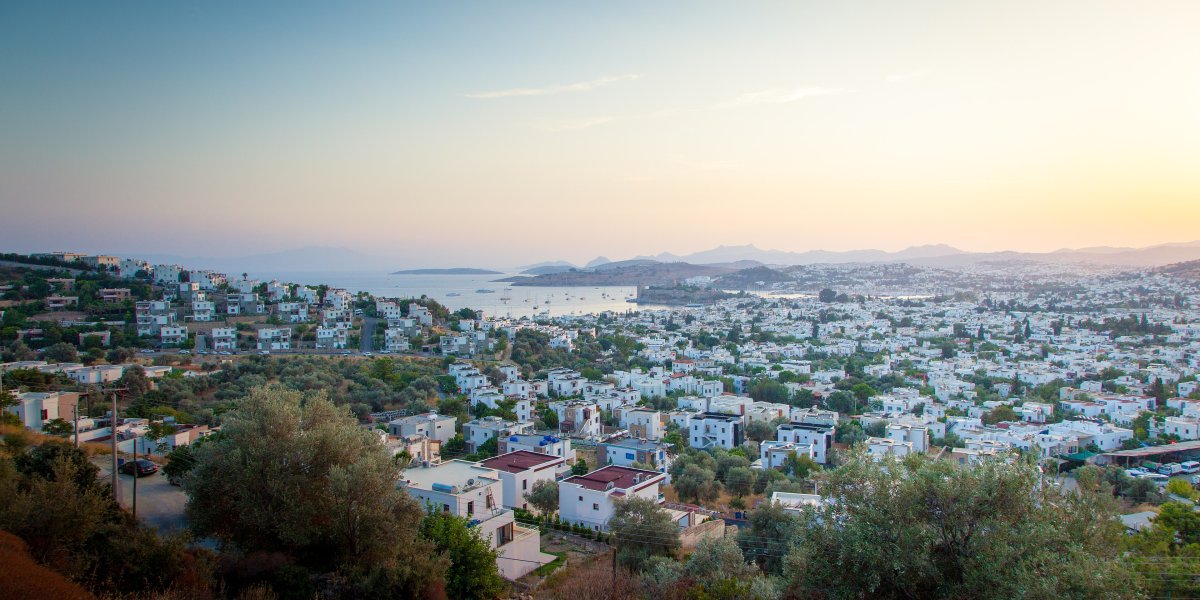
City Guide
Bodrum
Türkei · Best time to visit: Apr-Jun, Sep-Oct.
Day-by-day plan
Choose your pace
Reisedauer
09:00
Landmark
From the harbor, climb 15 minutes up Türgütreis Caddesi — the road threads past whitewashed Ottoman houses draped in bougainvillea before breaking out into pine scrub above the town. The 4th-century-BC Hellenistic theatre is carved straight into the hillside, still seating 13,000, with both of Bodrum's twin bays unfolding beneath you. The morning light catches the limestone at exactly the right angle to frame the castle below.
Tip: Climb to the top row by 09:15 — that is the only angle where Bodrum Castle, the marina, and Kara Ada island line up in one frame. Tour buses start arriving at 10:30 and crowd the upper tier; leave by 10:15 to keep your lead on the day.
Open in Google Maps →10:30
Landmark
Walk back down Türgütreis Caddesi for 8 minutes, turning left onto Hamam Sokak — you will pass Ottoman cisterns and the old hammam dome before the site opens up on your right. What remains of one of the Seven Wonders of the Ancient World are foundations, green-veined marble fragments, and the burial chamber of King Mausolus, the man who gave the world the word 'mausoleum.' Small, quiet, and far more moving than the photos suggest.
Tip: The Knights Hospitaller dismantled the Mausoleum in 1494 to build the castle stones you will see this afternoon — carry that fact downhill and the two sites click into one story. The green-marble chamber on the east side is the must-photograph remnant; skip the plaster reproductions in the small shed by the gate.
Open in Google Maps →12:30
Food
From the Mausoleum, walk 5 minutes south down Türgütreis Caddesi into the bazaar — you will smell the charcoal and grilled fish before you see the market hall. Pick your own fish — sea bass, sea bream, calamari, octopus — from the ice-stacked stalls, then carry it to one of the surrounding restaurants where they grill it for a small fee and bring it to your table with meze. The cheapest, freshest seafood lunch you will ever eat in Bodrum.
Tip: Lock in the price BEFORE you sit down: the cooking fee should be 150-200 TL per person and meze 60-90 TL each — write the numbers on a napkin if needed. Order the levrek (sea bass, ~250 TL/kg) or grilled calamari (~180 TL/kg). Skip the prawns; they are imported and frozen here.
Open in Google Maps →14:30
Landmark
From the fish market, walk 6 minutes south along Cevat Şakir Caddesi — the castle ramparts rise above the marina, white limestone studded with darker ancient stones recycled from the Mausoleum. Circle the exterior promenade around the headland; Crusader-era Knights' coats of arms are set into the bastion walls, and the twin bays glow turquoise on either side.
Tip: Walk the east seawall path at 15:00 when the sun is behind you — that is the exact angle every Bodrum postcard uses, with the castle bright and a forest of gulet masts in the foreground. Look closely at the lower courses of the south bastion: the green-marble fragments are pieces of the Mausoleum you saw this morning. On a layover, the museum interior is not worth the entry — the story is in the stones outside.
Open in Google Maps →17:00
Landmark
From the castle, walk 25 minutes west along Neyzen Tevfik Caddesi past the marina, then turn uphill at the Gümbet road sign — the path winds past whitewashed cubic houses and prickly-pear fences before climbing the ridge. Seven 18th-century Ottoman stone windmills crown the saddle between Bodrum and Gümbet bays. This is Bodrum's sunset spot, and the only place where you see both harbors at once.
Tip: Aim for the southernmost mill — it is the only one that frames the castle exactly between the two bays as the sun drops behind Kara Ada. Arrive 45 minutes before sunset (about 19:45 in May, 18:30 in October) to claim the flat rocks at the base; the ridge fills with tour vans in the final 30 minutes.
Open in Google Maps →20:00
Food
Walk back down Neyzen Tevfik Caddesi for 25 minutes as Bodrum's lights come on — you cut through the bazaar, now strung with bulbs and humming with the smell of grilled fish. Kocadon sits two streets back from the marina in a restored 19th-century stone house with a vine-shaded courtyard. Aegean meze, char-grilled levrek, and the strongest local wine list in town.
Tip: Reserve same-day by 5 pm via Instagram and ask explicitly for a courtyard table — the indoor room loses all the atmosphere. Order the octopus carpaccio (~280 TL) and the grilled levrek (~480 TL) with a glass of local Şarafşa white. Pitfall warning: avoid the harbor-front restaurants on Cumhuriyet Caddesi between the castle and Bar Street — touts will pull you in with 'fresh fish' menus, but the fish is frozen, bills are doubled with surprise meze, and locals never eat there. If you cannot get a Kocadon table, walk one street inland in any direction; never sit where someone is calling out at you.
Open in Google Maps →Zu Tag springen
09:00
Museum
Start your morning walking down Neyzen Tevfik Caddesi along the harbour — the honey-coloured fortress on its own peninsula appears in front of you, wooden gulets bobbing at its feet. Built by the Knights Hospitaller in 1402 using marble pulled directly from the collapsed Mausoleum, the castle now houses one of the world's finest underwater archaeology collections, including the Uluburun shipwreck — the oldest seagoing vessel ever excavated. Climb the English Tower last for the highest panorama back across the twin bays.
Tip: Arrive 08:45, fifteen minutes before opening — by 11:00 cruise-ship groups pour in. The Carian Princess hall and the Glass Wreck hall open on a rotating schedule; ask at the ticket booth which halls are open today and head to those first before everyone else does.
Open in Google Maps →11:45
Landmark
Exit the castle, cross the harbour road and walk north up Turgutreis Caddesi — 10 minutes uphill through quiet residential lanes draped in bougainvillea. What greets you is not a wonder but a foundation pit, scattered column drums, a single sarcophagus chamber — yet this is the exact ground where Queen Artemisia raised a 45-metre marble tomb for King Mausolus in 350 BC, the building so magnificent it gave every grand tomb since its name. The frieze fragments now sit in the British Museum; what remains here is the silence.
Tip: Study the small on-site 3D reconstruction panel first — once you can picture the original silhouette towering above you, walk back out to the foundation and look up. That is the only way this visit makes emotional sense; without that mental overlay it just looks like rubble.
Open in Google Maps →13:00
Food
Walk 8 minutes back down to the seafront and turn left along the marina road — Sünger sits in a yellow-shuttered building directly opposite the yachts. Open since 1979 and still run by the same family, this is Bodrum's most beloved pide house, serving Turkish flatbread baked in a wood oven, blistered and dripping with butter at the corners. Order the kıymalı (minced lamb) pide with a glass of fresh ayran — locals have been coming here for exactly this pairing for forty years.
Tip: Skip the pastas and salads — the kitchen has one real specialty and that is pide. The kıymalı (€7) and kuşbaşılı (cubed lamb, €8) are the two to order; ask the waiter for it 'çıtır' (extra crispy) and the baker will leave it in 90 seconds longer.
Open in Google Maps →14:30
Neighborhood
From Sünger's door, simply turn left and follow the waterfront west — the entire promenade is car-free, lined with date palms and traditional wooden gulets. Walk all the way to the marina's far western end, past the row of sail-training schooners, until the Knights Hospitaller's chain wall reappears across the water on your right. The afternoon sun is now behind you, lighting the castle in warm honey tones — this is the iconic Bodrum postcard view, and almost nobody photographs it from this angle.
Tip: Stop at the small bench platform almost exactly opposite the castle (about 400 m past Sünger) — sit on the seawall, wait for a gulet under sail to glide across the frame, then shoot. That single composition is worth ten close-ups from the castle gate.
Open in Google Maps →16:30
Shopping
Walk back east along the harbour and duck one block inland at Kale Caddesi — instantly the world flips from yachts to a labyrinth of whitewashed alleys barely wide enough for two people abreast. This is the old Greek-Ottoman quarter: blue doors, lemon trees in stone courtyards, leather-sandal makers still cutting on the doorstep. Wander north through Eskicesme and Tepecik until you stop hearing other tourists — that is when you have found the right alleys.
Tip: Hand-stitched leather sandals on Kale Caddesi are Bodrum's true local craft (€25-40, custom-fitted in 20 minutes) — but skip the carbon-copy shops near the castle gate and walk one block deeper inland, where the workshops are still physically attached to the storefronts.
Open in Google Maps →19:30
Food
From the bazaar, walk 4 minutes north onto Saray Sokak — Kocadon is hidden behind an unmarked stone wall, revealed only when you push open the heavy wooden gate. Inside is a four-hundred-year-old stone courtyard beneath a single ancient fig tree, oil lamps in the wall niches, no music louder than the cicadas. Modern Aegean cooking — order the octopus carpaccio with sumac (€16) and the slow-braised lamb shank on smoked aubergine purée (€28); the wine list is the most carefully curated Turkish-only selection in town.
Tip: Reserve at least 24 hours ahead and ask specifically for a 'fig tree table' — there are only six and they go to whoever asks by name. Tourist-trap warning for tonight: avoid the photo-menu fish restaurants along Cumhuriyet Caddesi — they station touts outside, mark prices up 3× for foreigners, and the iced fish on display is rarely the day's catch. If a host is hustling you on the street, walk past.
Open in Google Maps →08:30
Landmark
Walk north out of the old town up Kıbrıs Şehitleri Caddesi for 15 minutes — the road climbs steeply, and as it does the city unfolds behind you like a fan. Carved into the south slope of Göktepe Hill in the 4th century BC and later expanded by the Romans, the theatre still seats 13,000 facing straight out across the Aegean. Climb to the topmost tier, settle on a sun-warmed marble bench, and look down: the modern town, the castle, the harbour, and the open sea — all framed by a stage that has watched 2,400 years of this same view.
Tip: Go before 09:30 — by mid-morning the marble is too hot to sit on and there is zero shade on the upper tiers. From row 30 (the steep upper section), a whisper from the stage carries perfectly; bring a friend and test the acoustics, the engineering still works.
Open in Google Maps →10:30
Landmark
Descend the theatre hill and walk west along Cevat Şakir Caddesi for about 1 km — you are tracing the inside line of what was once a 7 km city wall. Myndos Gate is the only piece left: two stout towers flanking a moat-cut entrance, the very gate Alexander the Great hammered against during his 334 BC siege of Halicarnassus and could not break for weeks. The site is unfenced, almost always empty, and the rock-cut moat is still visibly there in the foreground.
Tip: There is a small footpath down into the rock-cut moat itself on the eastern side — climb in and photograph the gate from below. The wall suddenly looks the way it must have felt to Alexander's soldiers staring up at it. Almost no visitor realises you can get inside the trench.
Open in Google Maps →12:30
Food
Walk back east toward the centre for 15 minutes along the residential Türkkuyusu lanes — Mantı Evi sits on a quiet side street one block back from the harbour, blue shutters, six small tables. Mantı are tiny Turkish dumplings, beef-filled, the size of a fingernail, boiled and drowned in garlic yoghurt with paprika-butter sizzled on top. The family hand-pinches every dumpling that morning — this is genuinely how Aegean grandmothers cook, not a tourist-grade approximation.
Tip: Order the Kayseri mantı (€9) and one side of haydari (strained yoghurt with fresh mint, €3) — spoon a little haydari into every bite. Skip the lentil soup starter, it is the one underwhelming item on the menu; save the appetite entirely for dumplings.
Open in Google Maps →14:30
Park
From the restaurant, walk west along the coastal footpath past the small fishing wharf — a 25-minute seaside walk hugging the cliffs as the marina disappears behind you. Bardakçı is a pebble-and-sand crescent tucked under pine slopes, reachable only on foot or by water taxi, which means the beach clubs stay small and the noisy crowds drain into Gümbet next door. Swim, lie under the tamarisk trees, order a fresh-squeezed pomegranate juice from the single wooden shack — this is what an Aegean afternoon was always supposed to feel like.
Tip: Take a sunbed (€5-8) at the unnamed shack on the eastern end of the bay — half the price of the branded 'beach club' at the western end, same water, better tamarisk shade. Bring water shoes if you have them; the pebbles get sharp where the sand thins out at the shoreline.
Open in Google Maps →17:30
Landmark
Walk up the dirt path behind Bardakçı for 15 minutes — it climbs the bare ridge that divides Bodrum's twin bays. At the top stand seven 18th-century stone windmills, their sails long gone but the skeletons intact, on a wind-scoured hilltop poised exactly between the harbour you came from and Gümbet Bay to the south. The sun sets straight into the western sea between Bodrum and Kara Ada island; from here you watch it drop while the castle behind you turns pink. The single best free sunset spot in town.
Tip: Arrive 45 minutes before sunset to claim the flat rock platform on the north side of the third windmill (counting from the east) — it perfectly frames the castle, the harbour and the sun in one composition. Bring water; there is no shop or kiosk on the hill.
Open in Google Maps →19:45
Food
Walk back down the windmill path and east along the south-harbour road for 20 minutes — the marina lights come on as the sky shifts to navy. Berk Balık is set back one block off the tourist strip, tables spilling into a vine-shaded courtyard where actual Bodrum families eat on a Saturday. The meze tray comes to you — point at six small plates — and the daily fish is whatever came off the boats that morning, grilled simply with olive oil and lemon. The way Aegean dinner has always been done.
Tip: Choose çupra (sea bream) or barbun (red mullet) over the showy big sea bass — they are local, in season, and priced per piece rather than per kilo. Share a small carafe of rakı (€10) across the whole meal, sipped slowly, not as a shot. Last-day pitfall warning: the 'Bar Street' along Cumhuriyet Caddesi pulls tourists in for €15 cocktails with photo bills at the end — walk past it, head straight back to your hotel.
Open in Google Maps →
Trip builder
Plan this trip around Bodrum
Turn this guide into a bookable rail itinerary with FlipEarth.
Keep exploring
Related cities
More in the same country
FAQ
Frequently asked questions
How many days do you need in Bodrum?
Most travelers enjoy Bodrum in 1 days, with enough time for headline sights and a slower meal or museum stop.
What's the best time to visit Bodrum?
The easiest season for most travelers is Apr-Jun, Sep-Oct, especially if you want good weather and manageable crowds.
What's the daily budget for Bodrum?
A practical starting point is about €80 per person per day before hotels, then adjust based on museums, dining, and transport.
What are the must-see attractions in Bodrum?
A good first shortlist for Bodrum includes Bodrum Antique Theatre, Mausoleum of Halicarnassus, Bodrum Castle (Castle of St. Peter).